


An artifact from the history of Mormon migration to Arizona, the Lees Ferry bell, has now been donated and dedicated to be displayed at Wesley Bolin Memorial Plaza at the Arizona Capitol Mall in downtown Phoenix.
The monument marks the migration of thousands of Mormon settlers who came from Utah to Arizona in the 19th Century, crossing the dangerous Colorado River at Lees Ferry — where the bell was rung to summon the ferry — with their wagons and livestock.

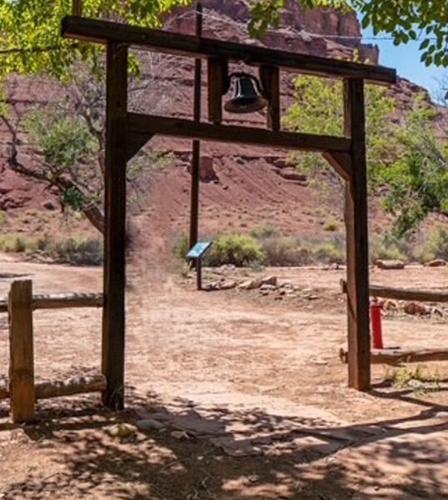
The historic bell as it appeared at Lees Ferry.
“This bell represents origin stories, so I’m one of those origin stories,” said C. Denny Barney, a descendant who was present at the dedication ceremony on Tuesday, Dec. 9. Barney stood next to a painting of the Colorado River, where a ferry service was built in 1872 by John D. Lee — a loyal lieutenant to Brigham Young, president of the Church of Jesus Christ of Latter-Day Saints — to help Mormons migrate to Arizona.
“My first name is Charles. I’m named after my great-grandfather, Charles Innes Robson III, (and) his grandfather, Charles Innes Robson I, used that bell to cross that river — this insurmountable hurdle on their journey to a new life, and I think there’s so much power in what that bell represents,” Barney said, pointing to the painting by renowned artist Glen Hopkinson.
When Mormons arrived at the confluence of the Paria and Colorado rivers northeast of the Grand Canyon, they found the ideal place to establish a ferry service across the Colorado to facilitate the Mormon migration south into Arizona. Lee, a controversial figure in Mormon history, was sent to create the ferry service, followed over the years by many ferry operators.

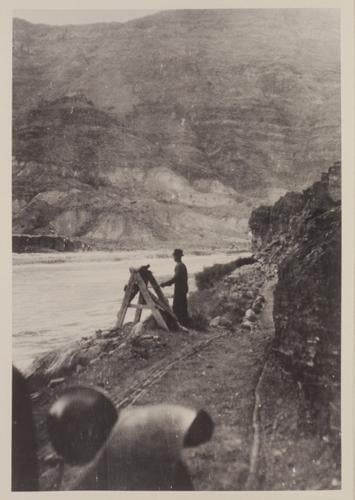
Ringing the bell at Lees Ferry to call the ferryman so travelers could cross the Colorado River.
It was the only viable means of crossing the river without taking a 500-mile detour around the Grand Canyon.
In the early days of the ferry operation, the bell was hung on an arch at a school as the little community built up. It was rung to start the school day, call families to church and for dinner, and to let the ferry operators know when travelers needed transport.
“The number of really prominent Mormon legatees of the experience recounted stories from their great-great-grandparents and great-grandparents who had crossed and (if not) for the crossing, would have never made it to Arizona. Because it would take, by wagon, an additional four days to go around the canyon,” said Fred DuVal, a member of the Arizona Board of Regents, at the dedication ceremony.
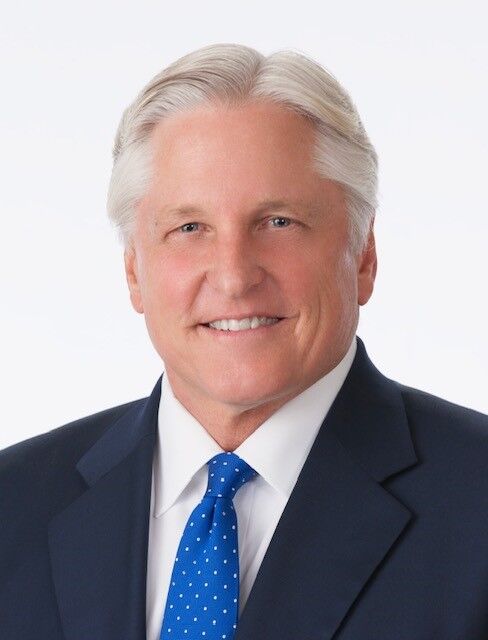
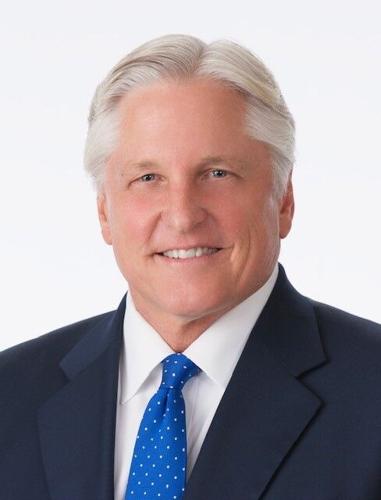
Fred DuVal donated the bell to be a monument at the Arizona State Capitol.
“And that’s really brutal, having already come from Salt Lake, or wherever they’re coming from,” DuVal said. “So, this thing was sort of indispensable, and it was there for a long time.”
More than half a million LDS members call Arizona home today, with a large percentage of them tracing their roots to ancestors who crossed the river at Lees Ferry between 1972 and 1928, DuVal wrote in a 2018 column in The Arizona Republic.
DuVal's stepfather, Jack Whiteman, acquired the Lees Ferry bell after he and a group of Phoenix businessman bought the Lees Ferry property in 1964. Whiteman left the bell with DuVal, who stored it in his backyard for seven or eight years but ultimately wanted to donate it as a state monument.
“I’m always inspired by human grit and stories of people who inspire new beginnings and have the grit,” DuVal told the Star in an interview Friday. “So, I just find it inspirational. … I mean, it was an arduous journey and this raft is really rickety and it didn’t always make it in one piece. And it’s just the power of human hope is just so powerful that when a piece of it touched me, as this fell into my possession, I thought this has so much more power in a public domain than it does in my yard.”
Legislation to establish the bell monument at Wesley Bolin Memorial Plaza was introduced with bipartisan support in 2018 and eventually passed in 2023. The bell was then donated to the Arizona Migration Monument Foundation, created by DuVal and Kevin DeMenna, a lobbyist who helped lead the effort to pass the bill. The foundation is now responsible for the bell’s maintenance.
Konden Smith Hansen, a University of Arizona expert in frontier Mormonism, said in an interview that Brigham Young's priority was to establish colonies of the church as God's mission. Thus, Hansen argued that while it is a story of strength and survival, it was also about colonization.
“I think colonization in general in the Southwest is very problematic, because you’re dealing with lands (where) there are already (Indigenous) inhabitants," he said. "I think Latter-Day Saints fit into the same category as other colonization efforts from the United States," including "very problematic situations. So, celebrating it seems like there’s more nuance needed with that; a little more reflection is needed than just a pure celebration of it.”
That was, in fact, an issue for a state senator who voted against the monument legislation in 2018, Tempe Democrat Juan Mendez, who said it didn't reflect oppression brought by pioneers, The Arizona Republic reported at the time. "What we are passing doesn’t do enough to cover the entire history of it,” Mendez said then.
The monument originally was to be named after Lee, DuVal told the Star Friday, but Lee is "so controversial that it just became a non-starter, and we didn’t want to get sidetracked, because the story isn’t about Lee. The story is about the power of migration."
Lee lived in exile for a period because of his role in the 1857 Mountain Meadows Massacre, when he and other Mormons killed 120 people in a wagon train on their way to California.
“So, we landed on ‘Migration Bell,’" DuVal explained, "both because that’s the story of the hardship that these traveling LDS members went through to settle in Arizona, and migration is such a universal story in the United States generally and in Arizona specifically."

