

After the Treaty of Guadalupe Hidalgo effectively ended the U.S.-Mexican War in 1848, the U.S. government acquired jurisdiction of what later became Arizona territory north of the Gila River.
A clear route to the California gold fields resulted and was exploited by the 10,000 or more gold seekers who crossed the Colorado River unaware of the abundant mineral deposits in the land soon to become the territory and ultimately the state of Arizona.
Following the Gadsden Purchase, also referred to as the Treaty of Mesilla in 1854, land south of the Gila River became part of the United States. American mining operations near the Gila River subsequently increased in the proceeding decades including those at Reymert, Ripsey, Cochran, and Copper Butte in Pinal County.
The Reymert silver mine, 11 miles southwest of Superior in the Pioneer district, was named after James DeNoon Reymert, a Norwegian immigrant, who was also responsible for founding the nearby mining camp of DeNoon.
Production occurred between 1887 and 1930 with $575,000 in silver. Afterward, multiple lessees assumed responsibility of the mine sending 100,000 tons of ore to the Magma smelter at a gross value of $150,000. Some of the miners who lived in Superior were involved with the mines at Reymert into the 1950s.
By 1894, the Ripsey mine in the Tortilla Mountains west of Kearny went into production and leased by Otho Moses the following year and several years later operated by the Norman Mining and Milling Co.
Ore was originally shipped to the smelter in Tucson prior to the erection of the Asarco smelter in Hayden. Metals produced included gold, silver and copper. Prior to closure in 1941, the Ripsey Canyon group of mines produced 200 carloads of ore and concentrates that had been shipped for processing with a total production of 2,000 ounces of gold, 40,000 ounces of silver, and 50,000 pounds of copper. Operations at the Ripsey mine included a 40-ton boiler, nearby mill and main shaft in excess of 500 feet.
The small mining community of Cochran, serviced by the Phoenix and Eastern Railroad, served the Silver Bell-Martinez and Columbia lead-silver mines in the Mineral Hill district. Named after the town’s second postmaster John S. Cochran, its ephemeral existence lasted from 1904 until 1915. A steep narrow canyon made transportation to and from the Silver Bell-Martinez Mine 12 miles northeast of Florence on the northside of the Gila River challenging. Oxidized lead and silver were discovered at this locality in 1879.
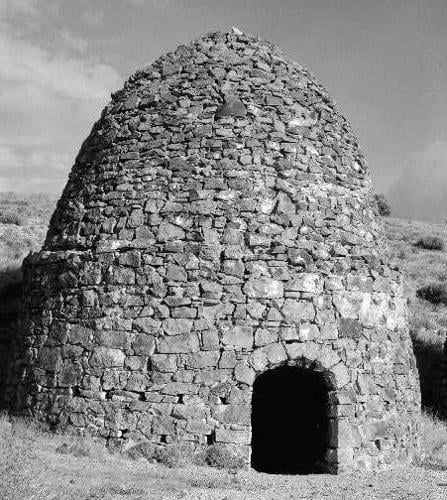
A nearby smelter (30-ton furnace) was erected at Butte City along the Gila River. Charcoal, necessary to fuel the smelter and used in place of coke (coal) necessitated the erection of five stone charcoal kilns built by the Pinal Consolidated Mining Co. and completed in January 1883, on the north side of the Gila River opposite Cochran station.
The operation was overseen by Aaron. Each beehive oven measured 30 feet high, 72 feet in circumference and 20 feet in diameter with 2-foot thick walls at the base. The kilns purpose was to reduce mesquite to charcoal since the latter burned hotter and longer than wood. The smelter produced two million pounds of lead and silver during its first six months of operation in 1883 acquiring shipments of ore from the Silver Bell-Martinez and as distant as the silver/copper mine at Vekol 25 miles southwest of Casa Grande.
Located 8 miles west of the Ray Mine is the Copper Butte mine. Owned by Fred Mitchell who converted the underground operation to open pit in 1942, it produced 100,000 tons of copper ore averaging 2.5% copper by 1956.
Additional value was gleaned by the high silica content of the ore, 65% used as a flux at the Hayden smelter.

