



From 1908 through World War I the Vekol Mine was heavily prospected with a 400 foot shaft dug yielding little production.
Some ore shipments were made after a group of Phoenix investors took over the mine in 1918 installing concentrating tables and reconditioning the mill to work the mine dumps.
Paul A. Daggs acquired the mine, then composed of six patented claims of which the Vekol being the greatest producer along with the Argosy, Lookout, Flat Iron, Mount Vernon and Grandfather. It included a 40-ton mill, three steam power hoists, air compressor and assorted buildings including a machine shop, carpenter shop, office and laboratory.
The Reward Mine five miles east of the Vekol Mine was discovered and developed during the early 1880s and worked with success by the Reward Mining Co. It included a 110-foot incline and 800-foot well to sustain a small water-jacket blast furnace.
Production involved 37,660 pounds of black copper comprising 26 percent grade in 1884 valued at 13 cents per pound. Worked again in the early 1900s through World War I, it shipped high-grade ore to the El Paso smelter in 1907-08, producing 450,000 pounds of copper valued at $75,000.
E.J. Bonsall developed the nearby Copperosity Mine in 1890 and some ore was shipped from incline shafts. In 1907 the Copperosity Mining Co. briefly operated the mine.
World War I saw the development of a two compartment vertical shaft developed the ore body at several hundred feet. High grade ore was stoped and transported to Casa Grande for shipping to the refiner. Total production was 360,000 pounds of copper valued at $80,000. Credited with $45,000 in gold production; the nearby Christmas Gift Mine included a thick pocket of high-grade gold ore associated with galena along with cerussite outcrops that appear on the surface.
During the 1950s, the bank and assay office building still stood at Vekol. Two brothers by the name of Elliot operated the mine using the old safe in the assay office as a cupboard.
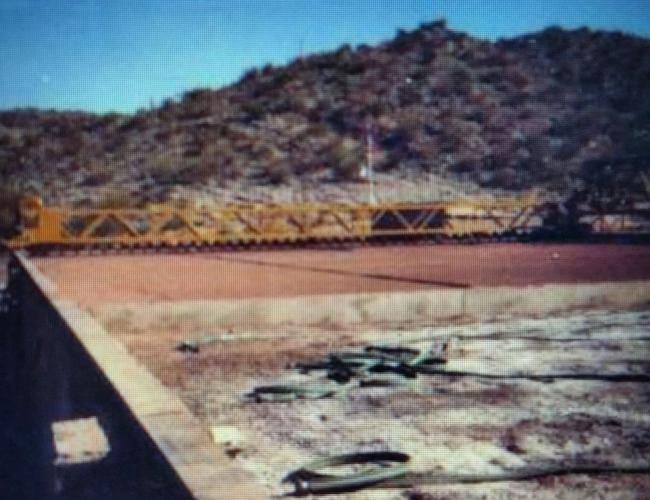
The Vekol Mine was leased and optioned from Federal Mines to Mineral Harvesters Inc. during the mid-1960s. Emphasis was on working the tailings and mine dumps. The operation included a straight line motion jig that successfully ran dry providing an 8:1 concentration ratio of dump material averaging $8 in lead and $4 to $5 in gold and silver per ton.
Between 1882 and 1965 the mine was credited with having produced 100,000 tons including 753,000 pounds of copper and 95,000 pounds of lead, along with 500 ounces of gold and 1 million troy ounces of silver from pods and lenses of oxide ore.
Newmont Mining Co. became interested in the Vekol property negotiating with the Papago Tribe involving a $1 million deal to build a custom copper smelter. However, it failed to meet the necessary $45 million investment to put the mine back into production.
The Argosy Mining Co. acquired six patented claims comprising the Vekol Mine in January 1983 investigating the economic potential for processing dump material while initiating a leaching operation, and a geological mapping program to seek out additional ore reserves.
It was determined that in order to mine by open pit operation it would require the removal of 62 million tons of overburden before the sulfide ore zone could be effectively mined.
A sulfide flotation plant using water from local wells would need to be established along with a pit reaching a depth of 1,200 feet. Projected annual production of copper was 66.5 million pounds along with 1.2 million pounds of molybdenum. Secondary mineral production also included gold and silver treated off site.
After leaching operations were suspended in 1984, Bill Ewing leased the mine from Wilson, Clemons and Westling. He undertook some air-track drilling for silver and lead bearing faults however; assays of the fault material proved low metal values.
Today the Vekol Mining district holds interest among treasure hunters who actively seek out a cache of 300 silver ingots weighing 25 pounds a piece rumored to have been buried several miles north of the mine site in 1891. It also holds an interest among mineral collectors seeking out chlorargyrite (a silver ore mineral) and ferroan dolomite crystals in the mine dumps. The area is also a corridor for illegal immigration and drug smuggling.

