


Arizona, California and Nevada would take a disproportionate share of water-use cuts proposed in a new federal environmental report aimed at preventing "dead pool" levels in Colorado River reservoirs, several experts say.
The U.S. Bureau of Reclamation's draft environmental impact statement for the river proposes four new alternative plans for bringing water use in balance with the ever-declining supply. All call for curbs for both the Lower and Upper Colorado River basins.
But the cuts shown are much sharper for Arizona and fellow Lower Basin states California and Nevada, in proportion to their total water supplies, than for the Upper Basin states of Colorado, New Mexico, Utah and Wyoming.
The four proposals would shave a range of 1.48 million to 4 million acre-feet a year of river water supply from the Lower Basin states, compared to 200,000 to 500,000 acre-feet annually from the Upper Basin states.

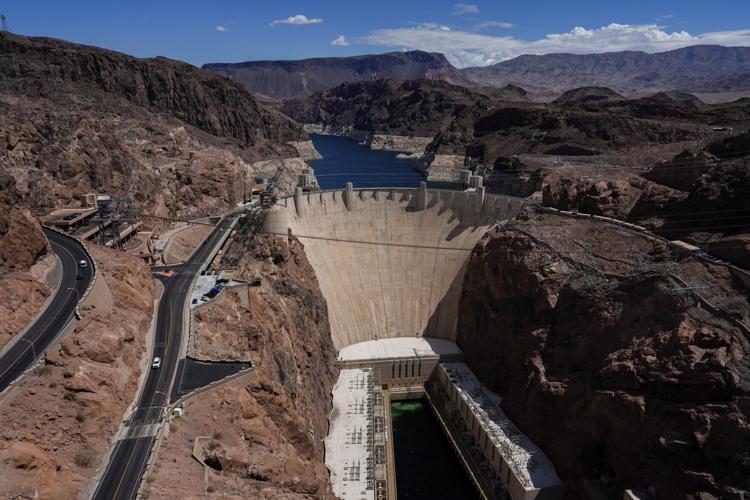
Hoover Dam on the Colorado River near Boulder City, Nevada. Arizona, California and Nevada would take a disproportionate share of water-use cuts proposed in a new federal environmental report aimed at preventing "dead pool" levels in Colorado River reservoirs, several experts say.
Together, the Lower Basin states have used 6 million to 7 million acre-feet of river water annually in recent years, not counting evaporation that draws down another 12 million acre-feet a year. The Upper basin states use about 4.5 million acre-feet a year, a figure that typically includes evaporation.
An acre-foot is enough to serve four Tucson homes or three Phoenix-area homes for a year. If the Lower Basin loses 1.48 million acre-feet, that would be the equivalent of enough water to serve all Tucson Water customers for nearly 15 years.
Might not be able to stabilize the river
At the same time, the new report raises the very real possibility that if precipitation and other climate-related conditions on the Colorado don't improve, none of the proposed alternatives will be able to stabilize the river so its flows don't decline even more.
Battered by a long-term drought and continually warming temperatures, the river's flows have declined roughly 20% since 2000 to an annual average of 12 million or so acre-feet a year. In the past five years, that decline has worsened, dropping average annual flows to about 11 million acre-feet annually.
The new report comes as the seven basin states are deadlocked in conflict over how to apportion the cuts, needed in part to prevent Lakes Mead and Powell from dropping so low as to reach "dead pool", when no water could be pulled out of them. More than two years of negotiations have brought the states no closer to consensus on a solution.
The Reclamation report is just one more step down the road to a possible federally-imposed solution, although bureau officials and water officials from all seven states say that's the last thing they want. Bureau officials hope to develop new guidelines to manage the river's reservoirs once the current rules expire at the end of 2026.
But the new report says, "Developing new guidelines is difficult in this complex Basin, where critically low storage in Lake Powell and Lake Mead, significant hydrologic variability, and the anticipation of drier future conditions amplify the central tradeoff: balancing the potentially profound impacts of water-delivery reductions with the need to maintain reservoir storage."
The alternatives in the draft report capture a broad range of management strategies to address this tradeoff, "and they demonstrate that there are multiple ways to find a balance if conditions improve," the report says.

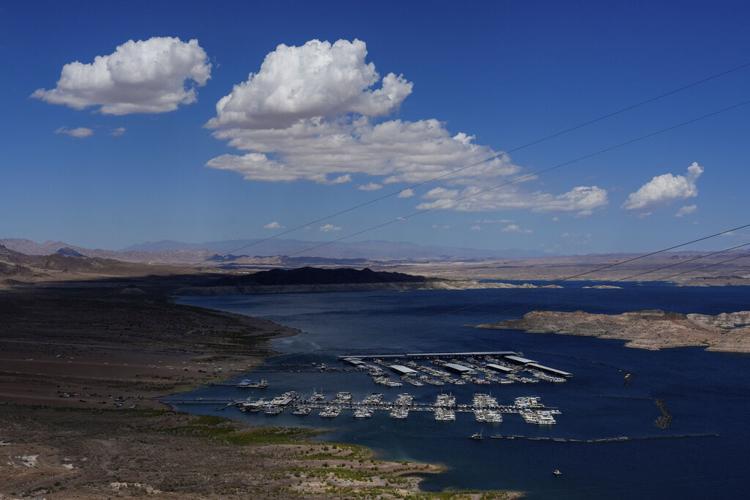
Lake Mead at Hoover Dam, near Boulder City, Nevada. A new federal report comes as the seven Colorado River basin states are deadlocked over how to divvy up cuts in water use, needed to prevent Lakes Mead and Powell from dropping so low as to reach "dead pool", when no water could be pulled out of them.
"If conditions do not improve, achieving a balance is more difficult, and, under critically dry futures, even large and unprecedented reductions may not be enough to stabilize storage," it warns.
Longtime Colorado-based water official and consultant Jim Lochhead said the federal alternative, the one that would be used only if the states can't agree on a plan, recognizes that it may not be adequate to stabilize the river even in the short term.
"It may be necessary for the feds to exercise their existing emergency authorities and seek additional authority," said Lochhead, a former Denver water director who today represents several conservation groups involved in the negotiations from the outside.
'Very sobering'
Eric Kuhn, a water researcher and former general manager of a Colorado water district, called the report's conclusions about the workability of some of its solutions "very sobering."
He said, for instance, that all but one of the alternatives would require granting states a waiver of some of their rights to water under the Colorado River Compact. That's because under some circumstances, the water released from Lake Powell to Lower Basin states would be less than the compact's legal minimum releases.
"You're going to have to fix the problem in some way. The question is can you do it without litigation," which would drag out a solution to the river's chronic supply-demand gap while its conditions keep deteriorating, Kuhn said. "This is a very sobering analysis of the reality of what's going on with the river."
Cynthia Campbell, head of an Arizona State University water research program, said she was encouraged by the report's candor about the possibilities that one or more alternatives wouldn't preserve the river system and its reservoirs and that at least some could lead to crashes in the system.
At the same time, she expressed major doubts that the Lower Basin states could alone shoulder the entire burden of the cuts the new report says are needed. That's been the central conflict between officials of the two basins throughout the negotiations.
"I was struck at how candid the authors of the EIS were in terms of stating when they thought an alternative would likely crash the system, or they wouldn’t have the requisite legal authority to carry out an alternative," said Campbell, director of policy innovation for ASU's Water Innovation Institute.

Four proposals in a new U.S. environmental report on the Colorado River would shave 1.48 million to 4 million acre-feet a year of river water supply from the Lower Basin states, compared to 200,000 to 500,000 acre-feet annually from the Upper Basin states.
But officials of Southern California's Metropolitan Water District reacted more critically to the new report. It's "yet another wake-up call that we need a consensus agreement supported by all water users that rely on the Colorado River," the district said in a written statement.
"The various alternatives highlight the significant risks we could face if we don’t reach an agreement. And implementation of any alternatives would likely lead to lengthy litigation," the district said.
Several of the alternatives are "alarming" for the Metropolitan Water District, which serves six southern California counties — "indicating potentially dramatic cuts to our supply," it said.
"While the people and communities we serve are committed to reducing their use through conservation and investments in new supplies, our Colorado River supply cannot be randomly slashed," the district said. "Our people, our economy, our state depend on this river — half of the 40 million people who rely on this critical water source live in Southern California."
Four alternatives under consideraton
The report contains five alternatives for future river management. But one, called the No Action Alternative, is there only because it's legally required in all environmental impact statements. It's almost never adopted.
Three of the other four alternatives were drawn up by the bureau in response to various proposals and input from representatives of the two basins, tribes, conservationists, other federal agencies and members of the public, the bureau said. Those three would all require agreement among the seven states to be put into effect, said Lochhead of Colorado.
The bureau proposed the fourth alternative as one that could be implemented if the seven states can't reach consensus.
Because no consensus exists among the states today for what should be done, the bureau didn't select a preferred alternative. Federal agencies usually do pick a preferred option in preparing an environmental review for a major project.
"Since 1970, the basin states have supported operations and reached agreements among themselves and with the (U.S. Interior) Secretary on various aspects of Colorado River reservoir operations. It is beyond question that achieving a consensus-based approach to basin reservoir operations has proved critical to the long-term operating success of the basin," the report said.
Left unsaid is that if a consensus isn't reached, the almost inevitable result will be that the bureau imposes a solution on the seven states, most likely triggering litigation.
The details
The four alternatives are:
- Coordinated Reservoir Operations Alternative. It could be approved if the seven states can't reach agreement. It would shave the Lower Basin states' river water use up to 1.48 million acre-feet annually, depending on the river's flows.
The cuts would be split among the three states based on which has higher priority to river water rights. Arizona has the lowest priority to access river water during shortages under the 1968 law that authorized the Central Arizona Project canal system from the river to Tucson. As such, Arizona would take the overwhelming majority of the cuts — 77%. California would take no cuts, Nevada would take nearly 6% of the cuts, and Mexico would take the remainder.
The bureau acknowledged in the new report that this alternative may not provide "adequate protection of critical infrastructure of the system and may be viable only in the short term given current reservoir conditions." If this alternative were selected, the agency would "identify conditions under which further action may be required."
This alternative "really hammers Arizona," said Kuhn, citing legal priorities that put this state at the bottom of the totem pole. "I don't see how Arizona can accept that."
No Upper Basin state conservation would be required by this agreement "since it would require agreements outside Reclamation's control," the report says.
- Enhanced Coordination Alternative. This is based on proposals and concepts from some tribes, federal agencies such as the U.S. Fish and Wildlife Service and National Park Service, the Western Area Power Administration and other interest groups.
It proposes cuts of up to 3 million acre-feet annually, to be allocated in proportion to each Lower Basin state and Mexico's share of the river's water rights. That would give California a 48% share of the cuts, Arizona a 31% share, Nevada a 3.3% share and Mexico a 16.7% share.
Upper Basin states' conservation would gradually scale up, from a maximum of 200,000 acre-feet to a maximum of 350,000 acre-feet annually.
- Maximum Operational Flexibility Alternative. It's based in part on a proposal submitted by a group of conservation organizations. It relies on what the bureau calls "innovative and flexible tools" to address "an increasingly variable set of future hydrologic conditions" on the river. Shortages could range from 1 million to 4 million acre-feet a year.
Shortages of Upper Basin water could be up to 500,000 acre-feet.
The alternative would employ a "conservation reserve" of up to 8 million acre-feet of water that would be stored in either basin for the benefit of Lakes Powell and Mead, when needed there. That reserve could also be used for major environmental resources such as the Colorado River Delta in Sonora, a multi-species conservation reserve along the Lower Colorado River at the Arizona-California border, and the Grand Canyon.
- Supply Driven Alternative. This plan would base releases of water from Lake Powell to Lake Mead on a set percentage of three-year natural flows down the river at Lee's Ferry just below Glen Canyon Dam. It's based on ideas taken from proposals submitted separately by the Upper and Lower Basin states, along with ideas discussed among all the states during negotiations.
Under this plan, the Lower Basin would take shortages of up to 1.5 million to 2 million acre-feet, with the shortages based partly on which states have legal priorities to the water and partly on their proportionate share of the water. For the first 1.5 million acre-feet of cuts, Arizona would lose 760,000 acre-feet, California 440,000, Nevada 50,000 and Mexico 250,000. For shortages of 1.5 million to 2 million acre-feet, the cuts could be split by priority, favoring California over Arizona, or proportionally, favoring Arizona over California.
The Upper Basin states would conserve up to 200,000 acre-feet a year.
No authority to mandate Upper Basin cuts?
Several officials, researchers and environmentalists from the Lower Basin observed that the Upper Basin's share of water conservation is generally described in the various alternatives as "uncertain."
By contrast, the Lower Basin shortages would be set specifically under each alternative, based on the amount of water available in the big reservoirs, among other factors, they noted.
"It definitely does not put any pressure on the Upper Basin states," said ASU's Campbell, a former water resources adviser and attorney for the city of Phoenix. 'There’s very little in the EIS which indicates the need or necessity for Upper Basin states to take those cuts."
The bureau's position toward the Upper Basin cuts in the environmental report comes close to matching the Upper Basin states' position in the ongoing seven-state negotiations. They've refused to commit to mandatory cuts, although they've at times offered voluntary cuts. Arizona Department of Water Resources Director Tom Buschatzke has said he won't accept any agreement unless the Upper Basin states commit in writing to some form of mandatory cuts.
Both Campbell and Nevada activist Kyle Roerink, of the Great Basin Water Network said, in different ways, that the bureau's stance on Lower Basin cuts rests on its uncertainty of its legal authority to impose mandatory cuts on Upper Basin water use.
By contrast, the bureau's authority to cut Lower Basin use is clear, they say, not least because the bureau has signed contracts with the Lower Basin users to deliver them water from Lake Mead. Such contracts are much rarer between the bureau and Upper Basin states.
One alternative in the environmental statement proposes Upper Basin conservation but adds additional legal authority is needed for the bureau to carry such cuts out, Campbell said. The same goes for two other alternatives in which the bureau said "they would have to seek additional authority," she said. "They weren't clear what kind of authority but I assume they need congressional authority."
The bureau wrote that the full extent of Reclamation’s operational authority has not been tested to date — either through legislation or judicial review.
The primary reason is that management of the river has been based on agreements among basin water users. In such cases, Reclamation’s authority to fully implement past agreements has not been in question.
"The reason why we're not seeing greater cuts imposed on the Upper Basin could come from the mere fact they can say, 'We haven’t developed our full entitlements of water yet,'" said Roerink, meaning that Upper Basin states, unlike those in the Lower Basin, still don't use their full river water allocations. "It’s a lot easier to cut identifiable and quantifiable water uses in the Lower Basin compared to in the Upper Basin, where you do indeed have those types of uses — just not as many of them," he said.
"I do believe wholeheartedly that cuts proposed for Upper Basin all around will not be sufficient to help stabilize the system in an an environmentally sound way or in an equitable way," Roerink said.
Plus, according to Kuhn, it likely would take several years for the feds to raise the money to pay Upper Basin users to voluntarily save water.
"And how are they going to administer it?" Kuhn said of an Upper Basin conservation program. "In the Lower Basin, there's a dozen major water users. In the Upper Basin, there are hundreds if not over 1,000 individual ditches and water companies. To conserve a couple hundred thousand acre-feet would require a couple hundred contracts with individual entities."
Longtime Arizona Daily Star reporter Tony Davis explains what "dead pool" means as water levels shrink along the Colorado River.

