





The University of Arizona will not restrict academic freedom or individual speech for faculty and students acting in their personal capacities, President Suresh Garimella told the Trump administration in his “Statement of Principles” submitted in response to its proposed higher education compact.
“The university maintains its commitment to academic freedom which undergirds the right of faculty to teach free from unreasonable or arbitrary restrictions, to conduct research, and to address matters of institutional policy and governance,” Garimella wrote to U.S. Education Secretary Linda McMahon in response to the proposed compact. “The university shall not restrict academic freedom in scholarship and teaching or individual speech by students and employees acting in their personal capacities.”
Garimella said the UA abides by the Chicago Principles on Freedom of Expression compiled by the University of Chicago — which affirm a commitment to free debate on college campuses — and holds a green light rating in the Spotlight on Speech Codes report published by the Foundation for Individual Rights and Expression. Green, as in a green light rating, is the foundation’s highest rating for speech codes, meaning the university has no written policies that seriously imperil student speech.

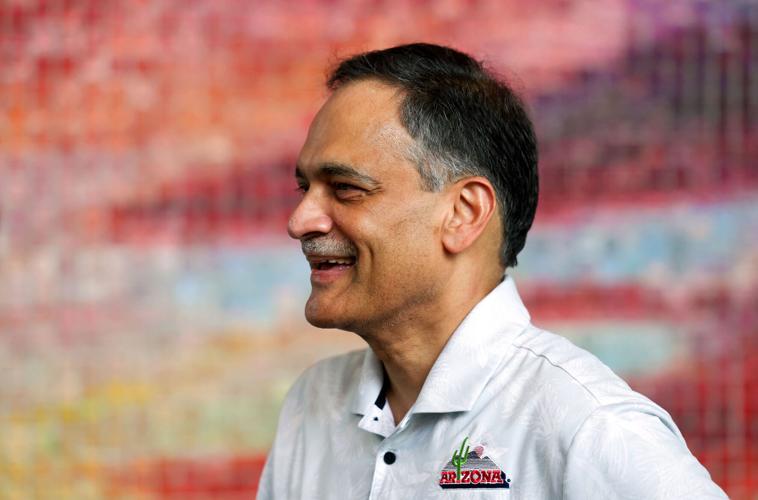
University of Arizona President Suresh Garimella.
“University programs such as the Center for the Philosophy of Freedom and the Discourse Series (College of Social and Behavioral Sciences) exemplify this commitment by fostering rigorous inquiry, respectful debate, and exposure to diverse viewpoints, which are values that strengthen the marketplace of ideas central to the university’s mission,” Garimella wrote.
Garimella also told McMahon that the university “refrains from taking positions on political and social issues that do not directly affect campus operations, safety, compliance, or the teaching and research mission.”
Garimella attached his Statement of Principles to his Oct. 20 letter to McMahon in which he declined to sign the White House’s “draft” compact, which offered priority access to federal funding to a first round of nine universities, including the UA, in return for committing to 10 pages of the Trump administration’s financial, political and ideological goals for higher education.
Six other universities have also rejected the compact, but UA under Garimella appears to be the only one to attach a list of principles providing feedback on the specific points of the compact. He told McMahon the Statement of Principles demonstrates the UA’s commitment to collaborating with the federal government.

The University of Arizona “will periodically conduct anonymous campus surveys on free expression and viewpoint diversity and publish the results,” its president told the Trump administration.
The White House compact calls for banning the use of race or gender in hiring and admissions; freezing tuition for five years; capping international undergrad enrollment at 15%; committing to biological definitions of gender and applying it to campus bathrooms, locker rooms and sports teams; changing or abolishing units that criticize “conservative” ideologies; banning university employees from speaking about any societal or political event unless it directly impacts the university; and other requirements.
Thomas Volgy, a UA emeritus professor of political science, told the Arizona Daily Star the university already abides by policies that protect academic freedom and freedom of speech in classrooms, teaching, research and scholarships. He also said the UA has always maintained that employees should not speak about societal and political events as representatives of the university, but may do so in their personal capacities.
The UA’s commitment to academic freedom was one of numerous aspects Garimella addressed in his list of principles. The others are student learning and fair admissions, equal treatment and non-discrimination, freedom of expression and civil discourse, financial responsibility and affordability, and finally, foreign engagements, international enrollment and research security.
“These principles are not just an expression of philosophy; they are a commitment to strengthen or continue reforms that benefit our students, advance our shared national interests, and protect the taxpayers,” Garimella wrote to McMahon.
Volgy said the most important thing in Garimella’s response was his explicit “no” to the offer of preferential treatment for federal funding. “We said no. We were more than happy to compete in the marketplace of ideas,” Volgy said.
In the letter to McMahon, Garimella said: “A federal research funding system based on anything other than merit would weaken the world’s preeminent engine for innovation, advancement of technology, and solutions to many of our nation’s most profound challenges. We seek no special treatment and believe in our ability to compete for federally funded research strictly on merit.”
Garimella also said the university explicitly prohibits discrimination in admissions based on “race, color, religion, sex, national origin, age, disability, veteran status, sexual orientation, gender identity, and genetic information.” He said hiring at the UA complies with requirements of Title VII of the Civil Rights Act, and other federal and state employment discrimination laws, which say factors including sex, ethnicity, race, national origin, disability, color or religion aren’t to be considered in hiring.
“The University provides access to safe campus facilities for all students, employees and visitors that protects their privacy,” Garimella wrote, saying “no” to the Trump administration’s ask of defining genders only as male or female, based on biological attributes at birth, and applying them to campus bathrooms and locker rooms. “For intercollegiate athletics, the university follows sport-specific eligibility standards established by respective governing bodies,” Garimella added.

The University of Arizona will not restrict academic freedom or individual speech for faculty and students acting in their personal capacities, its President Suresh Garimella told the Trump administration.
Mark Stegeman, a UA associate professor of economics, said Garimella’s letter essentially expresses thanks for the compact offer, makes minimal reference to its specific terms, and looks forward to engagement, discussion, and a continued partnership with the federal government.
The letter “mostly seeks to establish viewpoint alignment with the administration on various issues through philosophical statements and recitations of ongoing UA practices that either align with specific compact requirements or seem aligned with its underlying philosophy,” Stegeman said.
Regarding freezing tuition for five years, Garimella said that while the UA will continue to reduce unnecessary administrative costs, increase efficiency and “streamline or sunset” programs that fail to serve students or the state, all tuition decisions must be approved by the Arizona Board of Regents that governs the state’s public universities. He said the UA kept tuition flat this academic year for in-state students and will continue to limit increases for Arizonans as much as it can.
Garimella did not address specific asks of the Trump administration on capping international undergraduate student enrollment at 15% and enrollment from specific countries at 5%. Instead, he said that the UA “values the rich contributions of international faculty, staff and students who provide numerous intellectual and cultural contributions,” recognizes “potential risks with certain foreign engagements and research security concerns,” and will continue to comply with applicable federal laws.
Volgy pointed to Garimella not mentioning the 15% enrollment cap and said it is irrelevant to the UA since its current percentage is nowhere near 15%. Roughly 3.3% of UA’s total student enrollment is in international students.
Under the current Trump administration, thousands of international students around the country have had their visas and Student and Exchange Visitor Information System records revoked by the Department of Homeland Security, which made them vulnerable to detention, arrest or deportation by Immigration and Customs Enforcement. Additionally, the administration has placed travel bans and visa restrictions on numerous countries and subjected potential international students to social media vetting.

UA President Suresh Garimella, whose office is in Old Main, shown here, wrote to the Trump administration: “The university maintains its commitment to academic freedom which undergirds the right of faculty to teach free from unreasonable or arbitrary restrictions.”
“The university complies with the Student Visa Exchange Program reporting obligations and lawful government requests consistent with the Family Educational Rights and Privacy Act and other privacy laws,” Garimella wrote. That act, known as FERPA, restricts the disclosure of personally identifiable information from a student’s education record.
Stegeman said Garimella’s letter, on several relatively minor points, “promises unilateral actions that go beyond UA’s current practice and respond to the compact’s requirements.”
“The most prominent is a promise to conduct and publish the results of anonymous surveys on free expression and viewpoint diversity,” Stegeman said, adding, “None of these promises seem controversial.”
Garimella wrote to McMahon: “The university will periodically conduct anonymous campus surveys on free expression and viewpoint diversity and publish the results.”

In his list of principles, UA President Suresh Garimella addressed student learning and fair admissions, equal treatment and non-discrimination, freedom of expression and civil discourse, financial responsibility and affordability, and finally, foreign engagements, international enrollment and research security.
Stegeman also said Garimella never explicitly rejected any of the compact’s points but came close to rejection twice — in saying the UA will not restrict academic freedom in teaching, which appears incompatible with the compact’s requirement to “transform or abolish units that purposefully belittle conservative ideas;” and in expressing strong support for a federal research funding system being based on merit and nothing else.
“Of course, there are probably other lines that the university is unwilling to cross, but it is not stating them in this first letter,” said Stegeman. ”I think this can be viewed as an opening offer to negotiate, and you do not typically disclose everything before the negotiation begins. I think this approach makes sense. Judgment will depend on what if anything comes out of it.”
Ben Armentrout, a member of UA’s Graduate and Professional Student Council from the College of Optical Sciences, said he thought Garimella’s responses to the compact’s specific demands were strategic and well-written. “President Garimella and the U of A administration are calling Trump’s bluff,” he wrote to the Star.
“The principles and standards stated in the response are mostly reasonable, per se,” Armentrout said. “However, we know that the Trump admin, via the compact, wanted to use a facsimile of those principles to exert political control over our university, and the university response forces the Trump admin to answer the question — ’U of A is adhering to those principles already, what are you really asking us to do?’” he said.
“I do believe that some aspects of the response indicate already existing principles by university leadership that are out of step with campus values, like the university not making comments on certain current events, prioritizing academic preparedness over a more holistic admissions approach,” Armentrout added.
Since Garimella’s response to McMahon, there has been discussion on whether the UA actually rejected the compact or instead opened the door to continued negotiations on its terms. Arizona Superintendent of Public Instruction Tom Horne, an elected Republican, said it clearly isn’t a “no” and that the UA is showing willingness to collaborate with the federal administration. On the other hand, UA Faculty Chair Leila Hudson said it was clearly a “no,” and she appreciates Garimella’s approach of opening conversations.
Volgy said that while some people wanted Garimella’s rejection to be more aggressive, he can’t fault him for being diplomatic. “I read it as a pretty clear ‘no’,” Volgy said. “(Garimella’s) job is to maintain the integrity of the university and not to cause it more headache than necessary, so you do this in a diplomatic manner.”

“The University provides access to safe campus facilities for all students, employees and visitors that protects their privacy,” President Suresh Garimella wrote, saying “no” to the Trump administration’s ask of defining genders only as male or female, based on biological attributes at birth, and applying them to campus bathrooms and locker rooms.
“The key to it all is the president’s rejection of preferential treatment for federal funding — that is the ‘carrot and the stick’ that the administration was holding up to these nine institutions,” Volgy said. Along with the suggestion that universities would receive federal grants for agreeing to the compact, the White House had warned that universities choosing to instead go their own way would “forego” federal benefits.
Volgy emphasized the significance of Garimella saying: “‘We believe that preferential treatment for certain universities, because they abide by certain ideas that the White House has, is inappropriate.’”

