


Bobcats have long been thought of as loners, but don’t tell Margaret that.
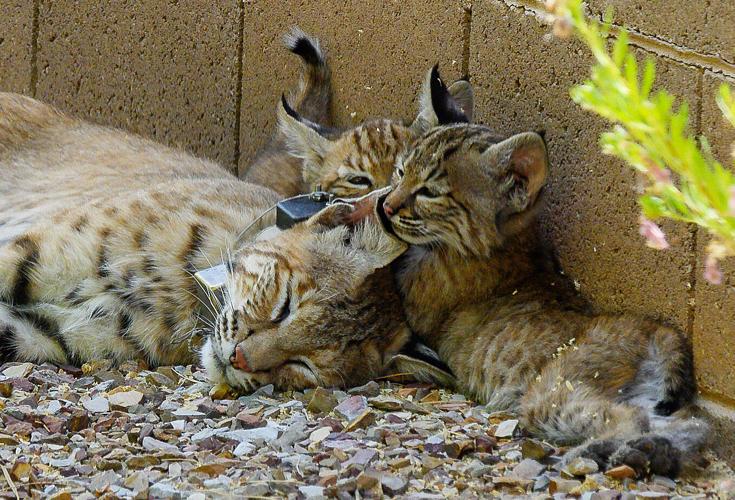
For years, the adult female nicknamed by researchers has shared her territory on the west side of Tucson with her grown daughter, Elsie, who eventually had kittens of her own using one of the same shelters her mother also favors.
During one stretch lasting several weeks, the two cats were hunkered down with their young in dens on the same hillside overlooking the city.
“They were both on Tumamoc, within 100 yards of each other, raising kittens,” said wildlife biologist Cheryl Mollohan, lead investigator for the recently completed Bobcats in Tucson study.
This sort of family cohabitation by bobcats has been reported elsewhere before, but it was never cataloged to this extent until now. Researchers documented four other mother-daughter pairs just like Margaret and Elsie, all confirmed with DNA and sharing their respective home ranges in Tucson.
“There’s a whole social life out there that we’ve just never credited bobcats with,” Mollohan said. “We’ve always just said they were solitary. That was always the conventional wisdom.”
And that was just one of the surprises researchers discovered during their 4-year study of urban bobcats in the Old Pueblo.
The investigation used radio tracking collars, genetic testing and chemical analysis of the animals’ fur to learn about how our local wildcats move through residential areas, what they eat and how they navigate roads and other hazards.
Mollohan said Tucson is home to one of the highest densities of urban bobcats in the nation, yet little was known about their behavior and habitat preferences.
From November 2020 through December 2023, the research team captured and released 56 bobcats between Interstate 10 and the Tucson Mountains, under a permit from the Arizona Game and Fish Department. Thirty-eight of the cats were fitted with tracking collars designed to record the animals’ movements for a year or so, then automatically fall off once the batteries ran out.

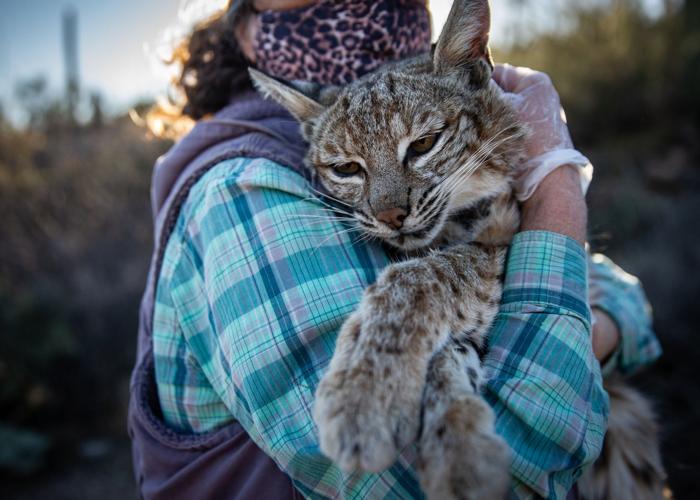
Wildlife biologist Cheryl Mollohan carries a tranquilized male bobcat that has just been fitted with a tracking collar at Sweetwater Preserve in 2021. Mollohan and her Bobcats in Tucson research team just released the findings from their 4-year study of the animals living on the west side of the city.
By the time the last collar dropped off in June of last year, researchers had logged more than 53,000 GPS locations, allowing them to chart where their test subjects went to hunt, rest and raise their young.
Mollohan and company just released the final report they submitted to the Game and Fish Department, which also helped pay for the research project with a $34,000 grant from the agency’s Heritage Fund of Arizona Lottery proceeds.
The 116-page document is now available on the Bobcats in Tucson website, along with a 22-page summary and several new informational pamphlets the team produced about observing the animals and avoiding conflicts with them.
They plan to discuss their results and “celebrate Tucson’s remarkable urban bobcats” during a pair of public presentations on Feb. 18 and 19.
City cats
What researchers found was a bobcat population that appears well-adapted to life in the city.
Over the four-year study period, most of the collared females successfully raised young, with at least 28 kittens surviving long enough to leave their dens and travel with their mothers, even in the most urbanized parts of the study area.
Mollohan said survival rates of 84% or better among their test subjects during the final two years of the study point to an overall population that is both stable and sustainable, though that certainly didn’t seem to be the case early on.
Of the 12 deaths documented over the course of the project, half came in the first 12 months alone, including three cats in six weeks that were “clearly killed by people,” Mollohan said.
“That first year was tough. I thought, ‘This is not going to be any fun, picking up dead bobcats. There’s nothing fun about that.’”
The two primary causes of death — vehicle strikes and intentional killings by people — declined as the study went on, but more research is needed to understand exactly why. Maybe what happened in the first year was just a statistical fluke, Mollohan said. Or maybe all the publicity surrounding the study and its early losses prompted changes in human behavior, resulting in fewer bobcats killed.
Unsurprisingly, perhaps, tracking data shows that our urban cats frequent washes and other green spaces, which they tend to use where available for hunting, hiding and traversing their territory.
But researchers were surprised to learn that the cats also spent a lot of time in residential areas, even when other, more natural options are available. In fact, the animals seemed to prefer human structures for a number of important functions, from finding sustenance to rearing their young.

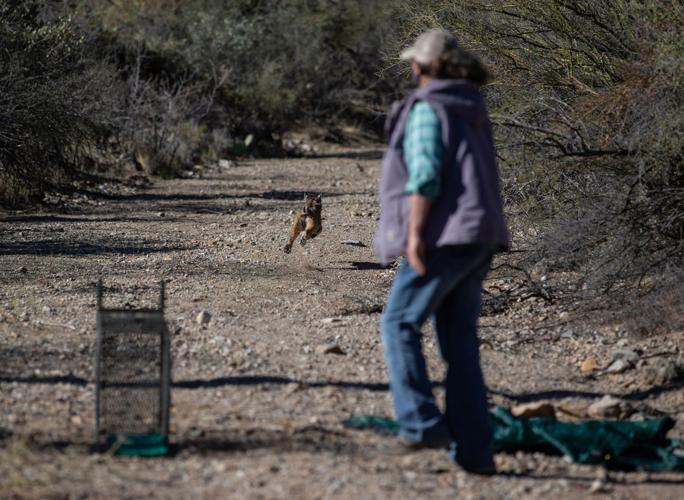
Wildlife biologist Cheryl Mollohan watches a bobcat scurry away upon being released in a wash in Sweetwater Preserve, after the animal was captured, examined and fitted with a satellite tracking collar as part of a study in February of 2021.
“I think they look at a house as a pile of rocks that a person lives in,” Mollohan said. “They use our structures and buildings just like they would use rocks and mountains. It’s just there. It’s part of their environment.”
But unlike actual mountains, human settlements come with built-in amenities such as water features, irrigated landscaping and bird feeders that attract rabbits, quail, doves and other favored prey. “It’s just an easier place to make a living,” Mollohan said.
For proof, look no further than Ben and Sweetwater, two of the study’s male test subjects. Both cats were caught and collared inside Sweetwater Preserve, Pima County’s 880-acre desert park north of Sweetwater Drive, but their subsequent GPS data showed they spent almost no time there.
“If you look at their locations, they were always at houses,” Mollohan said.
With the help of homeowners in the study area, the research project also documented the way that some female bobcats in Tucson have adapted to using houses as den sites and daycare centers.
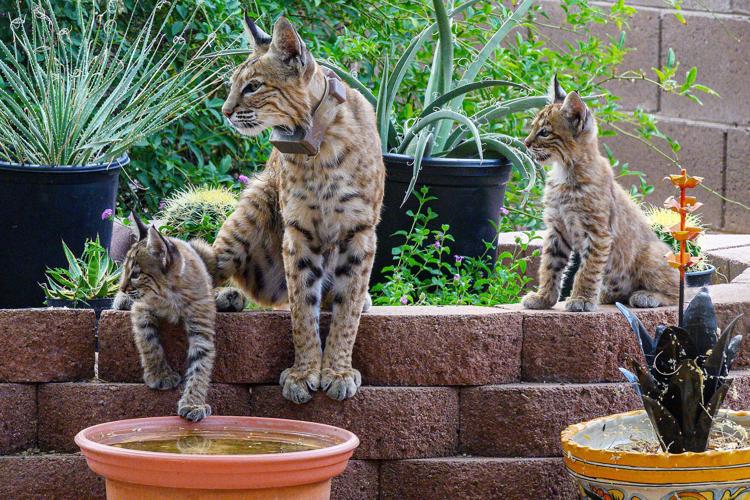
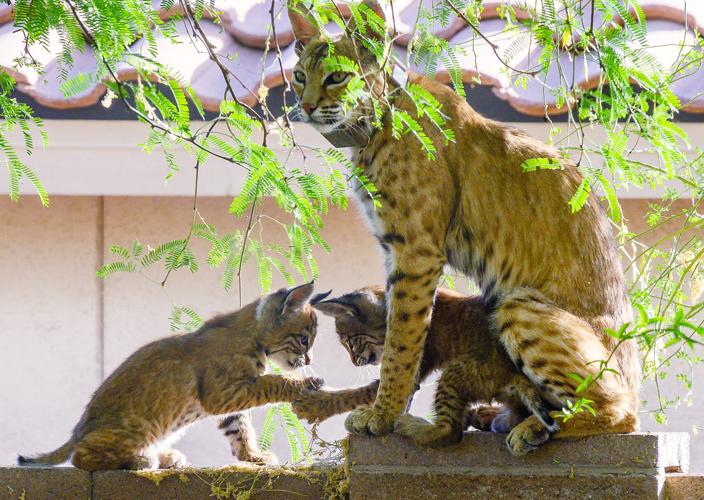
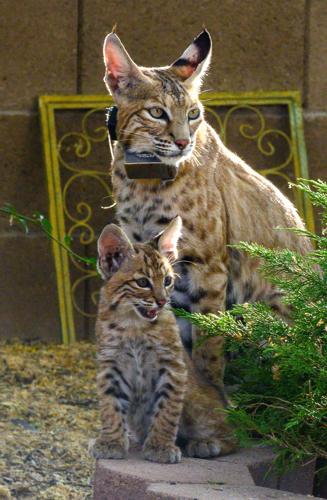
One particular mother, known as Avery, seems to return each year to the same few addresses in the Rancho Agua Dulce subdivision near Sweetwater Drive and Camino de Oeste, where she stashes her kittens on rooftops or leaves them to lounge and play in the relative safety of walled backyards while she takes a nap or goes off to find food for the family.

Two bobcat kittens and their mother, nicknamed Avery by researchers, explore the backyard of a home near Sweetwater Drive and Camino de Oeste in June of 2022. The recently completed Bobcats in Tucson research project documented denning and rearing behaviors by Avery and other urban bobcats.
But take it from someone who has handled dozens of these animals: No matter how relaxed a bobcat might look in your backyard, it still has sharp teeth and claws and no interest in becoming your pet, Mollohan said.
“There’s nothing tame about them. There’s nothing habituated about them. These are wild bobcats in every sense,” she said.
Family and food
The test subjects were trapped using specially designed cages baited with scented plush bunnies and bits of real rabbit meat.
Some of the cats were captured multiple times, either by accident or on purpose to swap out an old collar for a new one with fresh batteries.
“With Minnie, who was our little (Starr Pass) golf course female, we caught her three times in a week,” Mollohan said.
Several graduate students and faculty researchers from the University of Arizona collaborated on the project.

A bobcat nicknamed Avery and wearing a tracking collar hangs out with her kittens in the backyard of a home on the west side of Tucson in 2022.
Natalie Payne and Melanie Culver used DNA samples to establish the kinship relationships between the cats and identify any shared viruses, resulting in two scientific papers already accepted for journal publication.
Margaret Mercer and Jesse Allston sifted through the GPS data to show that the collared cats crossed an average of just over seven roads per day but generally avoided major streets in the study area, with a few exceptions. An adult male nicknamed Hal, for instance, made it across busy Ironwood Hill Drive 75 times in 10 months before he was finally struck by a vehicle and killed during his 76th crossing.
For whatever reason, Mollohan said, the bobcats seemed to show little interest in using culverts and other structures that can allow wildlife to safely avoid traffic while crossing roads.
To figure out what the cats were eating, Allie Burnett and Michael Bogan analyzed the chemical composition of fur samples and mostly found traces of wild rabbits and birds.
Mollohan said domestic cats, dogs and chickens made up less than 2% of the test subjects’ diets, despite the amount of time the bobcats spent near homes in a largely urban environment.
“I can tell you anecdotally they eat a pile of doves,” she said. “I mean, I think doves are probably their number one bird.”
The dietary analysis also tracks with what the researchers heard from the public. Out of more than 1,200 bobcat sightings submitted to the project’s website from around Tucson over the past four years, Mollohan said the team received only two credible reports of attacks involving house cats and none involving dogs.
Something fowl
Chickens are a thornier problem.
At least two of the collared cats killed during the research project were likely shot dead by residents trying to protect their backyard poultry.
In their final report, Mollohan and her fellow researchers argue that such a response is as reckless as it is futile, since highly specialized carnivores can’t be expected to distinguish between wild prey and domestic chickens. The only responsible way to keep backyard birds safe is with a predator-proof enclosure, not with a gun.
“We can change our behaviors or circumstances,” the team writes. “Bobcats cannot.”
When plotted on a map, the periodic GPS location signals revealed an unbroken patchwork of female bobcat territories, ranging in size from 1½ square miles to just over 8 square miles and interlocked like puzzle pieces, with almost no overlap among cats not directly related to each other.
The male bobcats, meanwhile, roamed across much larger and looser territories that took them through several female home ranges.

Bobcat Avery and one of her kittens is photographed in the backyard of a home in a gated community near Sweetwater Drive and Camino de Oeste in June of 2022. The cat was one of 38 that was fitted with a satellite tracking collar as part of a study of the animals on the west side of Tucson.
Apparently, only daughters are allowed to continue living at home into adulthood. Researchers did not document any cases of mother bobcats peacefully sharing their territories with their grown male offspring, which aligns with what is known about the species, Mollohan said. Male bobcats take no part in raising young and can even pose a threat to kittens under some circumstances.
In April of 2023, the research team received a report from someone who spotted two radio-collared cats, one large and one small, growling and spitting at each other near a house where Avery was stashing a new litter of kittens.
Though Mollohan can’t prove it, she is convinced that was Avery chasing off her 15-month-old son, Tippy, whose tracking collar soon showed him briskly moving south, away from the home range he once shared with his mother.
He eventually covered about 9 miles, safely crossing Ajo Way into the Drexel Heights neighborhood, before his collar dropped off as scheduled and he disappeared back into wild obscurity in late June of that year.
Tippy was the only bobcat to disperse from the study area, Mollohan said. When researchers went to recover his collar, they found it sitting on top of a pile of dove feathers.
More to learn
Mollohan knew she wanted to study Tucson’s unusual population of urban bobcats from the moment she first heard about it from a friend and fellow biologist about 15 years ago.
“I truly believe it’s one of the most unique situations in the country,” she said. “They live around the edges in a lot of places, like Phoenix for instance, but they never come into the interior (like they do here). It truly is something that Tucson should embrace and be proud of.”
Though she spent most of her professional career studying other animals, including black bears, woodrats and turkeys, Mollohan said she’s “a cat person through and through.”
“I really wanted to finish my career by making a contribution to wildcats. That’s always been where my heart is,” she said.
She got serious about the idea in 2018, when she moved back to Arizona from Ohio and began assembling a dream team of volunteer experts to help her with the research, including several retired biologists she used to work with at Game and Fish.
The Heritage Grant from the agency was mostly eaten up by equipment, including their first set of nine tracking collars, each costing about $2,600.

After her kittens were born in the spring of 2022, Avery moved them from house to house in the Rancho Agua Dulce subdivision on the west side of Tucson.
By the time they finished their field work last summer, they had expanded to 25 collars and a study area that covered more than 35 square-miles from Sunset Road in the north, to the Santa Cruz River in the east, to 36th Street in the south and to the Tucson Mountains in the west.
“Honestly, it got bigger than I could have ever imagined. The support that we got from people and from organizations was just overwhelming,” Mollohan said.
Sadly, two key members of the team didn’t make it to the end of the study: Retired biologist, author, professor and jaguar expert Dave Brown died in 2021, and ecologist Kerry Baldwin, whose long career included stints as education chief for Game and Fish and natural resources superintendent for Pima County, died in October.
Mollohan said Brown helped get the study off the ground by bringing in the nonprofit Southwest Wildlife Conservation Center in Scottsdale to serve as the umbrella group for the otherwise unaffiliated research team.
She described Baldwin as a long-time friend whose loss dealt “a huge blow” to both the project and to her personally. “Kerry and I were co-writing the final report when he died,” she said. “It has been a challenge covering all of these bases without him.”
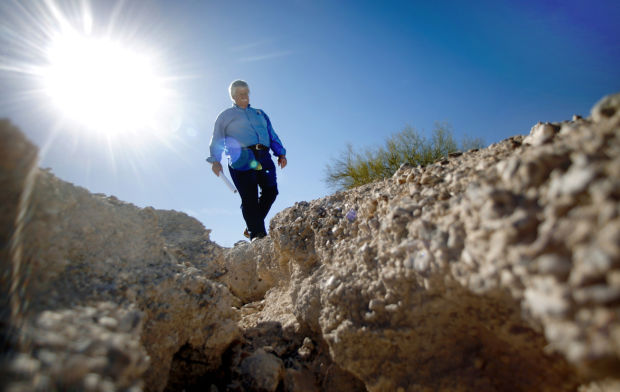
Kerry Baldwin, pictured at Sweetwater Preserve in 2014 when he was natural resources division manager for Pima County.
And there is more work to be done.
At least four more scientific papers still need to be written based on the results of the project.
Mollohan also plans to keep answering emails and updating the Bobcats in Tucson website “as long as people continue to be interested,” she said.
Eventually, she hopes to see another, similar tracking study done on bobcats living to the east of I-10, even deeper inside the urban core.
“Someone needs to do that. I think it’s that little piece that we missed (and) something that nags at me a little bit,” she said. “There are bobcats at Campbell and Grant. There are bobcats at the Arizona Inn. They’re living 100% in neighborhoods.”
Ultimately, Mollohan hopes all this research and educational outreach will lead to fewer conflicts in America’s most wildcat-rich city.
“Many, many people in Tucson live with bobcats all the time and have no issues. If you just set aside chickens and people’s fear for their pets, it’s almost a seamless integration,” she said. “We all talk about wanting to share our homes and our environments. It’s such a small little adjustment to be able to have these guys around. All it takes is awareness.”

