



A fungus responsible for killing millions of bats across North America has been confirmed in Arizona for the first time, state wildlife officials announced Thursday.
Samples collected from a cave myotis bat at Fort Huachuca last summer tested positive for the fungus that causes the deadly disease white-nose syndrome.
Arizona joins a list of 40 states and nine Canadian provinces that have confirmed the presence of the fungus known as Pseudogymnoascus destructans, or PD, since it was first discovered in caves near Albany, New York, in 2006.
White-nose syndrome does not pose a risk to people or pets, but outbreaks at some sites have killed 90% to 100% of the bats there.

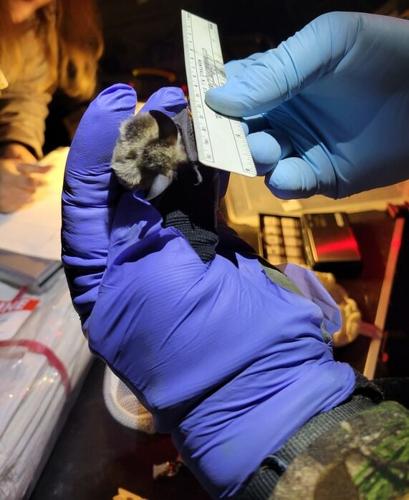
A researcher measures the wing of a bat. Samples collected from a cave myotis bat at Fort Huachuca in June have tested positive for the fungus that causes white-nose syndrome, a deadly disease for bats.
“It’s concerning, but not surprising given how Pd has been spreading from state to state over the past several years,” said Angie McIntire, state bat specialist for the Arizona Game and Fish Department. “This disease did not exist when I first began working with bats. To see new threats to our bat populations like this is disturbing.”
No cases of white-nose syndrome have been confirmed in Arizona so far.
Since 2019, trace amounts of Pd fungus have been detected in four Arizona counties — Mohave, Coconino, Yavapai and Cochise — but in amounts too small to qualify as confirmation. Among those earlier detections was a fringed myotis bat at Grand Canyon National Park.
“We will continue to conduct surveillance in the areas with trace amounts, in an ongoing effort to determine whether the fungus is present,” McIntire said.
Infected bats have turned up in New Mexico, Colorado and Texas in recent years. Now that the fungus is known to be here, McIntire said, it’s only a matter of time before Arizona records its first case of the disease it causes.
“The longer (white-nose syndrome) is in our neighboring states and the more prevalent the fungus becomes, the more we expect to see more definitive levels of fungus, and then ultimately we may start seeing the disease,” she said.
White-nose syndrome is named for the fuzzy white growth that appears on the bare skin of infected bats while they’re hibernating, resulting in changes in behavior that can cause them to burn up the fat reserves they need to survive the winter.
Any hibernating bat can contract the disease, but species like the cave myotis that shelter through the winter in cold, humid caves are especially susceptible.

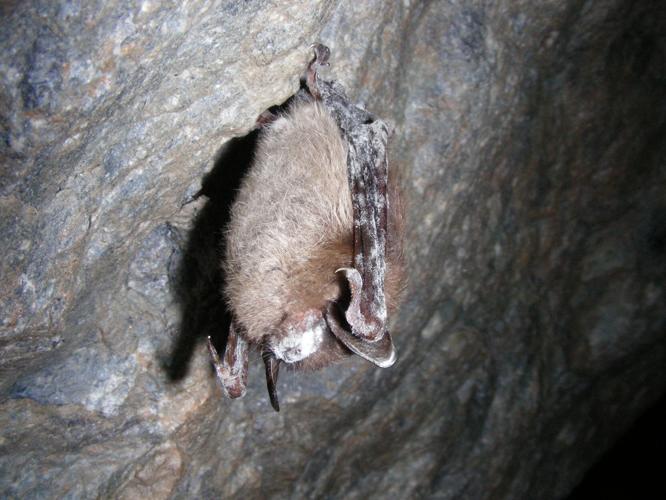
Fungus covers the skin of a little brown bat infected with white-nose syndrome in Vermont in this 2009 photo.
Thursday’s announcement came less than a month after news that endangered Mexican long-nosed bats had been confirmed in Arizona for the first time. The discovery brought the state’s total number of bat species to 29, about half of which are known to hibernate during the winter.
For more than a decade, the Game and Fish Department and its research partners have been monitoring bat populations around the state for the presence of white-nose syndrome. The samples collected are tested for fungus or disease by the Pathogen and Microbiome Institute at Northern Arizona University.
Fort Huachuca wildlife biologist Debbie Brewer said she and others at the Army base 80 miles southeast of Tucson have been watching for signs of the fungus since 2014 and sampling for DNA evidence of Pd since 2017.
“Though not unexpected, our 2024 high-level positive detection in cave myotis is highly concerning and should put other land managers in the Southwest on alert that habitat protections for this and other species of bat are warranted,” Brewer said.
Though bats are the primary way Pd spreads, human activity is also a major concern as long-living fungal spores can be inadvertently carried into caves on clothing and equipment.
State wildlife officials are asking the public to report any bats found dead, sick or acting strangely. Unusual behaviors may include not being able to fly and hanging out on the ground or low on a wall. Reports including your contact information, the location of the bat and a photo, if possible, can be emailed to bats@azgfd.gov. Live bats should not be handled, regardless of their condition.
“The news that the fungus that causes white-nose syndrome is in Arizona is heart-breaking,” said Winifred Frick, chief scientist for Bat Conservation International, a nonprofit environmental group based in Austin, Texas. “The impact of this disease on bats in North America has exceeded declines of greater than 90% of some species.”
But Frick said there is reason for hope.
“Arizona has a strong track-record of proactive conservation efforts for bats, so this detection allows us to act quickly to help the state’s bat species,” she said.

