




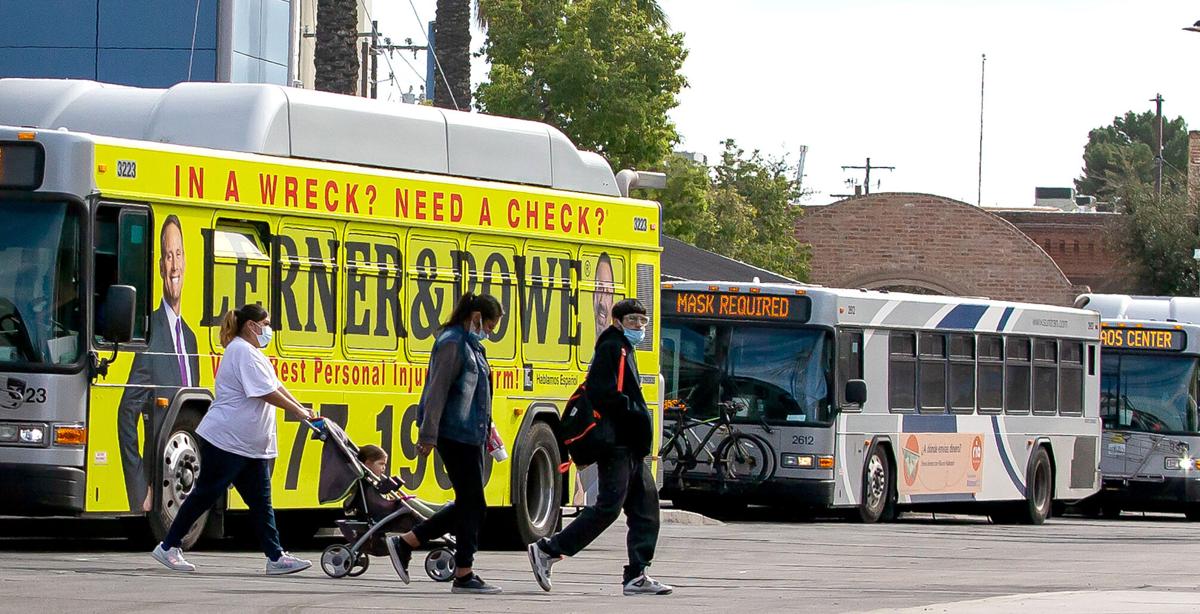
City officials are considering a permanent fare-free transit system, an initiative that is intended to keep money in the pockets of those who rely on bus, streetcar and Sun Van rides to get around — but the money typical riders could save each month is about the cost of a tank of gas.
Free transit is not an entirely new idea: Rides have been free in Tucson since early 2020 as a COVID-19 mitigation measure, and the City Council later extended that moratorium until June using federal relief funds.
"My office received a lot of phone calls from Ward 5 constituents about them losing their jobs, losing their homes, getting their water, gas and electricity shut off and those losing their businesses,” Councilman Richard Fimbres said about his push to pause fares in 2020.
But as the pandemic wanes, those federal dollars will dry up. When that happens, city officials will have to spend an extra $800,000 to $1 million of general fund money each month to run the transit system if they choose to nix fares permanently.
The monthly savings for a typical transit user? About $40.
“It really is a policy decision based on where (the council’s) priorities are going forward,” City Manager Michael Ortega said. “There are a variety of areas that are in need of dollars, but it’s a function of where that is in terms of priority for the community, those partners, but also for the mayor and City Council.”
Brian Flagg, a founding member of the Tucson Bus Riders Union, believes eliminating fares is worth the cost to city taxpayers. He said $40 in monthly savings, while relatively small, could make a significant difference to some of the city's poorest transit users.
"It's a matter of equity and what might not seem like a lot to some people is a big deal to other people who are struggling to survive," Flagg said. "Transportation to your job and other essential things is an absolute necessity. It's not a luxury, it's a necessity. It will really help people out. It's worth it."
Tucson’s pre-COVID transit fares were already inexpensive, however. The “low income” or economy rates for qualifying residents were the single lowest in the country, for example, and the city didn’t even collect enough fare money to cover its transit system costs.
But breaking even was never the goal, according to Councilman Steve Kozachik, who said the transit system was always more of a “social service” than a “revenue generator.” He added that money will always need to be pulled from the general fund to subsidize public transit; now it's just a question of "how much should be coming out of the general fund?”
Before the pandemic, the City Council's goal was to reduce that general fund loss by attracting more transit customers who would, in turn, generate more fare revenue. Officials have yet to refocus on that goal, but appealing to more riders at this point might be trickier than it was.
“We have had reports from some of our operators that we have people who are just kind of hanging out, and I don’t want to lose ridership because it turns into an unsafe environment,” said Kozachik. “I don’t want to sound heartless, but I don’t want to turn it into a taxi for the homeless who are kind of hanging out on buses and making people who would otherwise be riding feel uncomfortable riding it.”
Assaults (against riders and drivers) on city buses also tripled between 2019 and 2021 — from 21 to 64 — despite ridership decreasing by 12% in that same timeframe. The number of incidents is still low considering Sun Tran operates over 12 million bus rides each year, but the trend has consistently been on the rise since fares were paused.
Rhett Crowninshield, the city’s transit administrator, said he believes the rise in violent incidents is driven more by mask mandate outbursts and mental health issues than it is by increased homeless activity in the transit system.
“Do we see homeless people on our system? Of course. I think that’s part of what our mayor and council are trying to do, they’re trying to help them get to health care appointments, to employment opportunities, I think that’s kind of where they wanted to go with this,” Crowninshield said. “We’re trying to allow them to have some opportunities to get where they need to go.”
Kozachik said he could support the fare-free transit system if the city “can put protocols in place to make it a safe environment and welcoming to anybody who wants to get on,” though he admits he’s “not sure how you do that.”
Both Crowninshield and Steve Spade, Sun Tran’s general manager, said they’re working to improve security but did not provide specifics on what’s being done. Councilman Fimbres said he also has been working to address the problem.
“These issues have been pre-pandemic and post-pandemic so that can’t be linked to just one factor,” Fimbres said. “I am working to get more security measures at the bus stops, transit centers and other items for buses.”
Ortega will make a recommendation about whether to pursue a fare-free system after considering the financial cost-benefit, the impact on community partners such as school districts, and how the level of service might be affected.
That process will be ongoing until the city's budget discussions, when council members are expected to vote on whether to eliminate transit fares indefinitely.
“My responsibility is to provide them with that information, those data sets. I’ll give them options, provide them a recommendation, and then they ultimately make a call on it,” the city manager said. “When I scrub all of that data, then I’ll have some recommendations.”
Photos: Archive photos of transit strikes in Tucson
Transit strikes in Tucson
Updated
Striking members of Local 1167, Amalgamated Transit Workers, stop a bus exiting the Tucson Transit Corp. bus yard on Plumer Ave. in Tucson on June 5, 1968. Dan Tortorell / Tucson Citizen
Transit strikes in Tucson
Updated
A striking driver, right, gives a news photographer the evil eye after drivers voted to strike against Tucson Rapid Transit Co. in August, 1958. Tucson Citizen photo
Transit strikes in Tucson
Updated
Striking members of Local 1167, Amalgamated Transit Workers, stop a driver entering the Tucson Transit Corp. bus yard on Plumer Ave. in Tucson on June 5, 1968. Dan Tortorell / Tucson Citizen
Transit strikes in Tucson
Updated
Tucson Transit Corp. busses idled by a strike by members of Local 1167, Amalgamated Transit Workers in April, 1968. Dan Tortorell / Tucson Citizen
Transit strikes in Tucson
Updated
A Tucson Transit bus is followed by strikers with a sign claiming the driver is non-union during a strike members of Local 1167, Amalgamated Transit Workers on June 4, 1968. Bruce Hopkins / Tucson Citizen
Transit strikes in Tucson
Updated
A union "courtesy van" follows a Tucson Transit Corp. bus on Pennington Street in Tucson in April, 1969. Passengers board at bus stops and could donate a fare. By pirating passengers from the transit service, union members added to TTC's financial problems. Bruce Hopkins / Tucson Citizen
Transit strikes in Tucson
Updated
A union "courtesy van" follows a Tucson Transit Corp. bus on Pennington Street in Tucson in April, 1969. Passengers board at bus stops and could donate a fare. By pirating passengers from the transit service, union members added to TTC's financial problems. Bruce Hopkins / Tucson Citizen
Transit strikes in Tucson
Updated
Tucson Police stage at the entrance to the Sun Tran bus yard in Tucson during picketing by union members on Aug. 11, 1978. Bruce Hopkins / Tucson Citizen
Transit strikes in Tucson
Updated
A union member outside the Sun Tran bus yard takes a siesta on a warm day during a long day of picketing on Aug. 11, 1978. Bruce Hopkins / Tucson Citizen
Transit strikes in Tucson
Updated
Eleanor Hershey got three local donut shops to donate three dozen donuts to feed hungry union members on the picket line at Sun Tran in Tucson on January 17, 1980. Gary Gaynor / Tucson Citizen
Transit strikes in Tucson
Updated
A Sun Tran spokesperson details the company's offer using a flip chart during the 1980 strike. Tucson Citizen
Transit strikes in Tucson
Updated
A striking Sun Tran employee unfurled a Strike flag at the bus yard at Park and Ajo in January, 1980. He gave his name as "Bilbo F. Baggins." Sure. Gary Gaynor / Tucson Citizen
Transit strikes in Tucson
Updated
Emilio Puig passes the time playing horseshoes as union members picket Sun Tran during a strike on January 25, 1980. Joan Rennick / Tucson Citizen
Transit strikes in Tucson
Updated
Striking Sun Tran employees try to stay warm on the picket lines during a cold night in January, 1980. Gary Gaynor / Tucson Citizen
Transit strikes in Tucson
Updated
Striking Sun Tran workers on the picket lines at Park and Ajo in Tucson on a chilly January night in 1980. Gary Gaynor / Tucson Citizen
Transit strikes in Tucson
Updated
Union members clean up trash on the picket lines at Park and Ajo in Tucson on the final day of the strike against Sun Tran on Feb. 1, 1980. Gary Gaynor / Tucson Citizen
Transit strikes in Tucson
Updated
Striking Sun Tran workers gesture as a bus leaves the Laos Center in Tucson on Sept. 5, 2001, after more than 400 drivers, mechanics and other workers walked out. A.E. Araiza / Arizona Daily Star
Transit strikes in Tucson
Updated
Suntran bus driver Nina Rosales shows her support for the SunTran bus strike as she walks the crosswalk downtown in front of the Ronstadt Center at Congress and 6th Ave during a red light on Aug. 13, 1997. She was not stopping traffic. Photo by David / Arizona Daily Star
Transit strikes in Tucson
Updated
Sun Tran drivers Jack Lopez (left) and Christine Tabor call out to passing motorists near the Sun Tran entrance on South Park Avenue on July 17, 1998. Sun Tran drivers voted to go on strike if the city did not improve its offer to raise pay by nearly 12 percent. Norma Jean Gargasz / Tucson Citizen
Transit strikes in Tucson
Updated
Alfred West (left), John Seitz and Robbie Salazar,7, walk with their Teamsters picket signs in front of Ronstadt Transit Center on Aug. 14, 1997. Photo by James S. Wood / Arizona Daily Star
Transit strikes in Tucson
Updated
SunTran Drivers Bill Hale (left) and Amy Seitz (right) vote over whether to accept the new work contract at the Local 104 Teamsters hall on Aug. 19, 1997. Photo by by Linda Seeger Salazar / Arizona Daily Star
Transit strikes in Tucson
Updated
SunTran bus driver Greg Carpenter heads to his bus at the SunTran bus yard at Park and Ajo in August, 1997, after the union members voted to return to work under a new contract. The drivers had been on strike for more than a week. Photo by Linda Seeger Salazar / Arizona Daily Star
Transit strikes in Tucson
Updated
Barbara Franco, a driver for Sun Tran, hangs a large black ribbon and a U.S. flag in a tree on Sept. 12, 2001, in support of the victims of the Sept. 11 terrorist attacks. Benjie Sanders / Arizona Daily Star
Transit strikes in Tucson
Updated
Tucson city manager Mike Letcher listens during a city council meeting discussing the Sun Tran strike in Tucson, Ariz. on August 4, 2010. Photo by Greg Bryan/Arizona Daily Star
Transit strikes in Tucson
Updated
Teamsters Local 104 members are let in one-by-one until cpacity is met for a city council meeting discussing the Sun Tran strike in Tucson on August 4, 2010. Photo by Greg Bryan/Arizona Daily Star

