


Attorney General Kris Mayes says her new agreement with a mega-dairy company will cut groundwater pumping in Southeast Arizona's Willcox Basin by more than 100,000 acre-feet over the next 15 years.
"This is a real reduction in groundwater pumping," cumulative from 2026 to 2040, Mayes told a big crowd in Cochise County Thursday.
For context, 100,000 acre-feet is about as much water as Tucson Water customers consume per year.
The annual savings will be a drop in the bucket compared to the current groundwater overdraft in the Willcox Basin, which is estimated at more than 100,000 acre-feet every year. That's how much more water is pumped out of the aquifer than returned through recharge.
But it's an important first step, officials say, adding that the reduction in groundwater overpumping will be multiplied by additional measures. The Arizona Department of Water Resources separately created an Active Management Area to enact the first groundwater regulations for the Willcox Basin 13 months ago. The department has set a goal of reducing the overdraft by 50% by 2075.

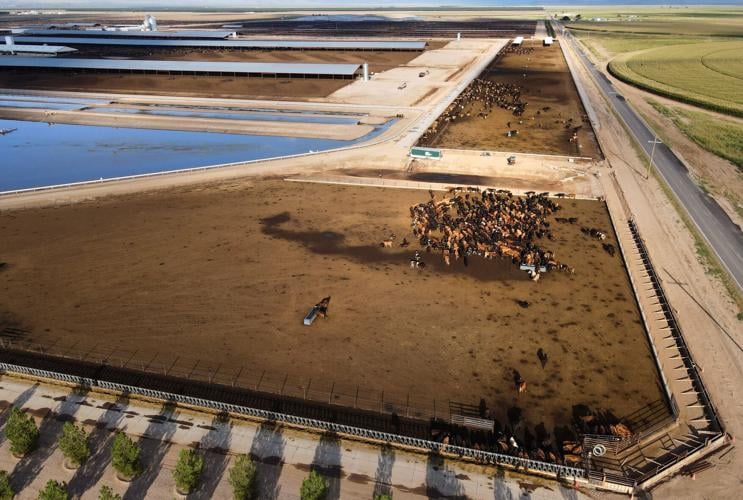
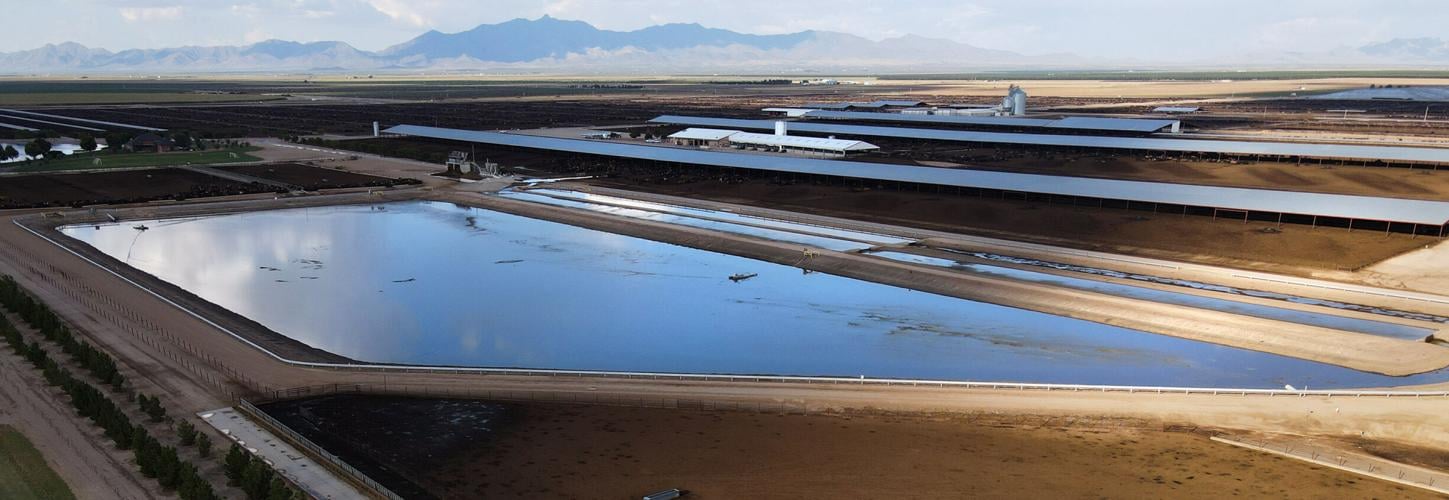
Cattle crowd together in a feed lot at Riverview LLP's Coronado Dairy in Cochise County. Riverview is by far the biggest groundwater user in the Willcox Basin, where it operates two megadairies. Under an agreement reached with Arizona's attorney general, the company will take 2,000 acres of its farmland out of production. It will also set up two funds totaling $11 million to pay residents to drill new wells or haul water because their existing wells were dried up by farms operating in the area with no regulation.
Also, Ed Curry, a local farmer and conservation advocate, says the embattled dairy company, Riverview LLP, has, on its own, already put in the works some measures that over time will reduce the region's annual overdraft by one-third.
That will be far more than the impact of its agreement with Mayes, said Curry, emphasizing that he's also an enthusiastic supporter of the attorney general's pact with Riverview.
Riverview, headquartered in Minnesota, is by far the biggest groundwater user in the Willcox Basin, where it operates two mega-dairies. The agreement Mayes announced Thursday — after a year of what she described as hard-fought negotiations with the company — will require Riverview to take 2,000 acres of its farmland out of production.
The company will also set up two funds totaling $11 million to pay residents to drill new wells or haul water because their existing wells were dried up by over-pumping by Riverview and other farms operating in the area, with no regulation.
'Changed their paradigm'
Even before signing the agreement with Mayes, Riverview on its own began changing its cropping patterns to eliminate much if not most of its summertime growing of alfalfa and other cattle feed, which require heavy water use, said Curry, a longtime chile grower in the Willcox area and a fervent advocate of stricter conservation measures for its agriculture-dominated economy.
In addition, Riverview has started bringing in cattle feed from other states, so it doesn't have to grow as much feed — and use as much water to grow it — as it was locally after first moving into the basin in 2015, said Curry, who sits on a state and local advisory committee working on groundwater issues.
Riverview attorney Brady Janzen largely confirmed Curry's statements without being quite as specific as to the precise actions the company is taking.
"I always hesitate to give exact numbers, because people always pick it apart," Janzen said. "But we're happy to share that we've made changes to crop rotations, etc., to save water."
"The agreement announced (Thursday) builds on those efforts with a structure for continued groundwater conservation and support for domestic water supplies," Janzen added.
While Riverview is taking even more substantial steps on its own, Curry told the Star on Friday, "What they did agree to (in the deal with Mayes) still changed their paradigm. When we first started dealing with them, man, they didn’t understand the desert. They thought there was a lot of water here, and (that) we'll have it for generations and when it goes it goes.
"Now, they know that's not right. They know that even their own water is in danger," said Curry.
Drilling ever-deeper wells
Mayes unveiled the deal at a rousing public meeting in the rural farming community of Sunsites, about 25 miles by car southwest of Willcox.
It generally pleased most of the at least 100 people who packed the Sunsites Community Center to get the details. For the most part, their strongest criticism was that it didn't go far enough for a groundwater basin where pumping outstrips natural recharge by a 3 to 1 ratio.

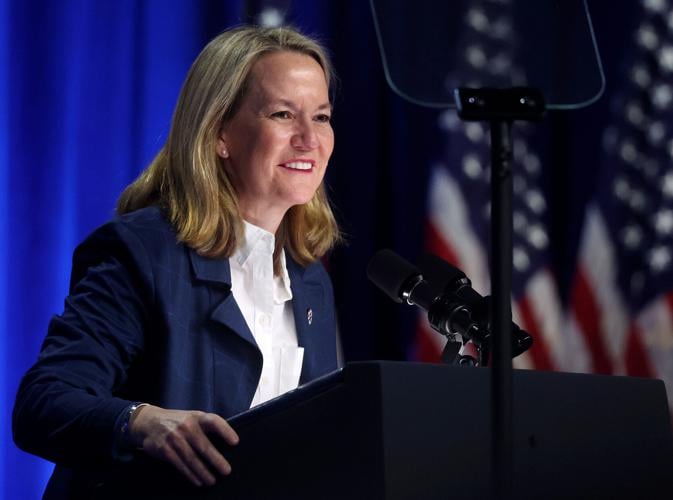
Arizona Attorney General Kris Mayes
Mayes heartily agreed with that sentiment, acknowledging it was only a first step toward winning more and more water-use cutbacks from not only the dairies but also the numerous pecan and pistachio growers who have moved into the basin over the past decade.
At the same time, some of the homeowners, and to an extent Mayes, acknowledged that Riverview's pledge to drill new and deeper wells for residents is not, or may not be, sustainable if the basin's aquifer keeps declining due to continued overpumping dominated by the area's large farms.
Many residents have said their wells have fallen as much as 200 feet since the turn of the century, as many of the farms' wells have burrowed 1,000 feet deep or even more. The dairy company's payouts for new wells will be split into two funds, one for residents living within 1.5 miles of a Riverview well, and one for those living outside that radius.
Asked how sustainable it is to keep deepening wells as the water table drops, longtime basin resident and groundwater activist Steve Kiesiel said, "That's a really good question. Right now, it kind of depends on where you live in the valley. You've gotta go to different depths to get to water now."
When he moved into his home east of the Cochise Stronghold area 32 years ago, water levels in his well were 230 feet underground, and "it was a reasonable cost to drill a well at that depth," Kiesiel said.
Today, "I’ve seen my well drop 150 feet over 32 years. I’ve had to deepen my well," Kiesiel said. "Fortunately it is a shared well, so I share expenses with neighbors. We're pumping now from almost 400 feet. That’s more expensive. If we have to drill again, we’ll be pumping water at 600 to 800 feet. That will be even more expensive."
If ADWR's new Active Management Area can achieve its goals of slashing the basin's groundwater overdraft in half, that would significantly slow the decline of people's wells, although it likely won't halt it.
The department plans to finish a management plan for the basin by early 2027. It has already set a draft goal for reducing the overdraft. By January 2029, the department plans to have a series of conservation requirements in place for farms.
Its efforts to draw up conservation requirements will start when ADWR establishes the amount of grandfathered rights for irrigation that existing farms have, department spokesman Doug MacEachern said. That should be done by October 2026.
A key step toward achieving all of those goals will come at the end of March, when ADWR gets water use totals from all farmers and other large water users in the basin. That will be the first time such information will be available. Farmers were not required to disclose their water use before the Willcox Basin AMA was created.
Riverview estimated its annual water use at about 110,000 acre-feet a year for a 2022 article on the website Circle of Blue, which covers water issues. It also estimated that it was growing crops on about 38,000 acres. The company declined to respond to questions from the Star about its current farming acreage or its water use.

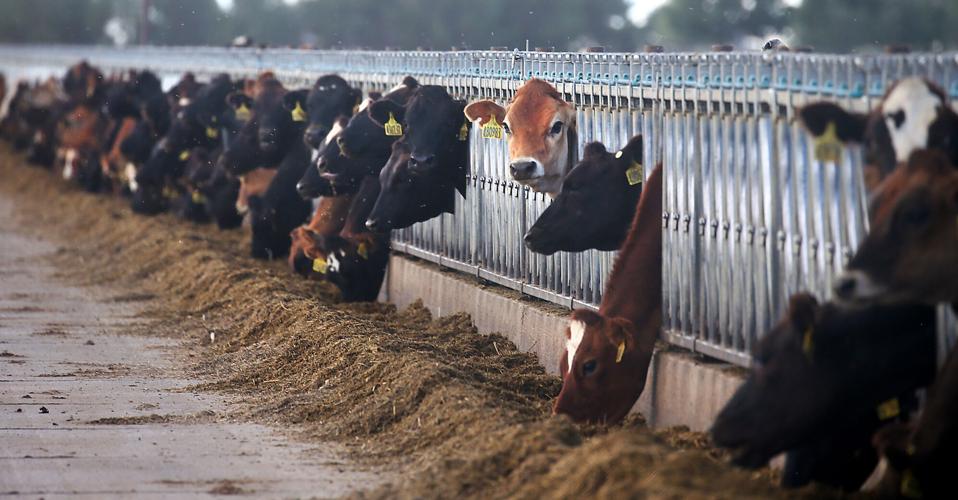
Cattle feed at Coronado Dairy in the Willcox area.
But if the 2022 estimate of crop acreage is accurate, the 2,000-acre reduction approved under the agreement with Mayes would reduce Riverview's cropland by about 5%.
'There is much more to be done'
At Thursday's meeting, Mayes said she was inspired to push for the agreement with Riverview by a visit she made to the Sunsites area in February 2024 to hear residents' water concerns.
"I stood here in this room, filled with members of this community and I heard countless stories of wells that had gone dry and roads and houses damaged by land subsidence" and fissures, Mayes said.
"My office has been busy trying to address the problem with the tools available. For the past year and a half, we've investigated the actions of the Riverview dairy, and their owners engaged with us in an attempt to come to compromise," she said.
She added that her office hired a hydrologist to evaluate Riverview's impacts in southeast Arizona, and a second hydrologist to evaluate the impacts of pumping in western Arizona's La Paz County by the Saudi-based company Fondomonte. Mayes is suing Fondomonte on allegations it is a public nuisance. She said this was the first time in her office's history that it hired a hydrologist to evaluate the impacts of pumping.
"Do I think this is a perfect deal, the perfect agreement? No. It’s not everything I was looking for by a long shot," Mayes said. "It's also not the end of the story of our involvement in this valley. There is much more to be done. But I do think this is the first of its kind of an agreement, not just in the state, but anywhere in the country."
Reacting to Mayes' remarks, basin resident Judy Bernard told the crowd that after being involved in water-saving efforts there since 2009, "I have to commend you on the work you've done. The good old boys have done nothing for us out there. Nothing. You've done wonders," Bernard said to loud applause.
But Victoria Sky, who lives in the Turkey Creek area of the basin near one of Riverview's two dairies, was far less satisfied with the agreement.
"I've lived on Turkey Creek for about 20 years. It ran until they showed up," Sky said of Riverview. "We had ground snakes, lizards and turtles. Now we have no more turtles because there is no more water.
"They effectively stopped Turkey Creek from running. What about the wildlife? This is a travesty right here; I’m here to protect them. It’s horrible to live with this. There's nothing in the agreement to protect the wildlife."
‘"I think it does," responded Mayes, reiterating, "This is not the perfect agreement."
'A shakedown of business'
One person at the session who was clearly unhappy with Mayes' agreement was Cochise County Supervisor Frank Antenori, whose district includes Sulphur Springs Valley. He was passing out leaflets accusing the attorney general of "extorting" Riverview.
"She was using it as a way to buy votes. It was a shakedown of business for her political benefit," said Antenori, a Republican and a former state legislator representing eastern Pima County before moving to the Sulphur Springs Valley a decade ago. "Riverview offered to do mitigation, to drill wells for people, to help with wells. They offered to form a water district and pay for some of the infrastructure, and pay for commercial wells.
"They've been trying to be good neighbors. And now they're being portrayed as a bogeyman," Antenori said in an interview after Mayes, a Democrat up for reelection this year, had left the community center to return to Phoenix.

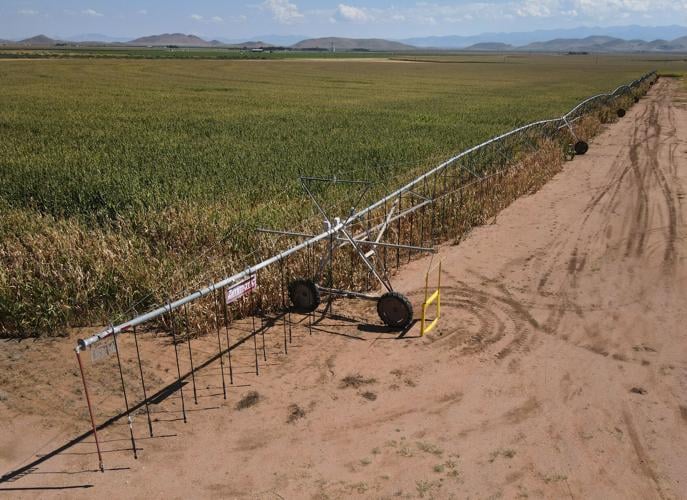
A center pivot for irrigation stands in a field owned by Riverview LLP, where it grows feed for its cattle. The dairy company has now agreed to a plan to reduce its groundwater pumping in the Willcox area.
Antenori said he completely agrees that the Willcox Basin and the valley have a water problem, but he believes it should be tackled voluntarily rather than with regulations and forced legal settlements.
"I'm trying to expand business so I don't have to raise property taxes," he said. "I want to keep taxes low. To do that we need to keep businesses in rather than kick them out."
Mayes, however, told the crowd that she, too, wants to take some voluntary action of a different kind to help the valley's groundwater supply. She would like to see legislation passed to grant farmers financial incentives of some kind to encourage them to fallow land in water-short areas such as the Willcox Basin.
"Let’s face it. We are going to need to get fallowing in other parts of the state. We’ve found a way to do that here," Mayes said.
"It's something the Legislature could work on. .. Things like incentivizing fallowing is something I think we are going to have to move toward to really, aggressively get to this, and I say to you let’s support leaders who want to get us there," she said. "What has happened here is maybe a spark that leads to that happening on a statewide level."
New fund will help residents 'in dire need'
One couple in Thursday's crowd that was happy with Mayes' agreement with Riverview was Rona McMillan and her husband, Mark Jorve.
They are wine growers and wine makers at their home on 20 acres in the Kansas Settlement area, lying southeast of Willcox, five miles north of Riverview's Coronado Dairy and adjacent to much of Riverview's farmland.
"We were going to land here, where you have power, the infrastructure there to support us, and we thought water to support the vineyard," McMillan said Thursday evening at the couple's home. "There were only three tasting rooms in the whole area and now maybe there are 15. It was an opportunity for us to come in at the beginning of the industry here."

Water basins at Coronado Dairy in Willcox, which pumps groundwater for its operations.
But two years ago, they drilled a new well and installed a new pump at a total cost exceeding $100,000 after neighbors told them their own wells' water levels had been declining. One of them said his well was pumping "air," Jorve recalled.
"We knew we would have to drill deeper. That was the lore out here. But every time we measured our well, it had not moved. But it turned out the device used to measure it was not accurate," Jorve said. "The well driller gave us this shocking information — he told us the water level was at 400 feet. We thought it was at 320."
That meant the water level had dropped 80 feet in 12 years, nearly 7 feet a year, McMillan said. And since the new well was drilled, their water level has dropped another 20 feet — 10 feet a year.
The couple could afford to drill the new well, but they had to take out a loan to cover part of the cost, they said. While they said they don't need money from Riverview today, McMillan said the new fund will help people in dire need right now.
"There are people who are suffering. They've had to haul water, going into a station in Willcox filling up tanks and taking it back home," she said. "It is definitely helpful to have that money available to help people who cannot afford to somehow get water."
While this agreement won't by itself substantially slash the regional overdraft, "to me, anything that keeps the momentum going towards water conservation, it's gotta be a good thing," Jorve said.

