



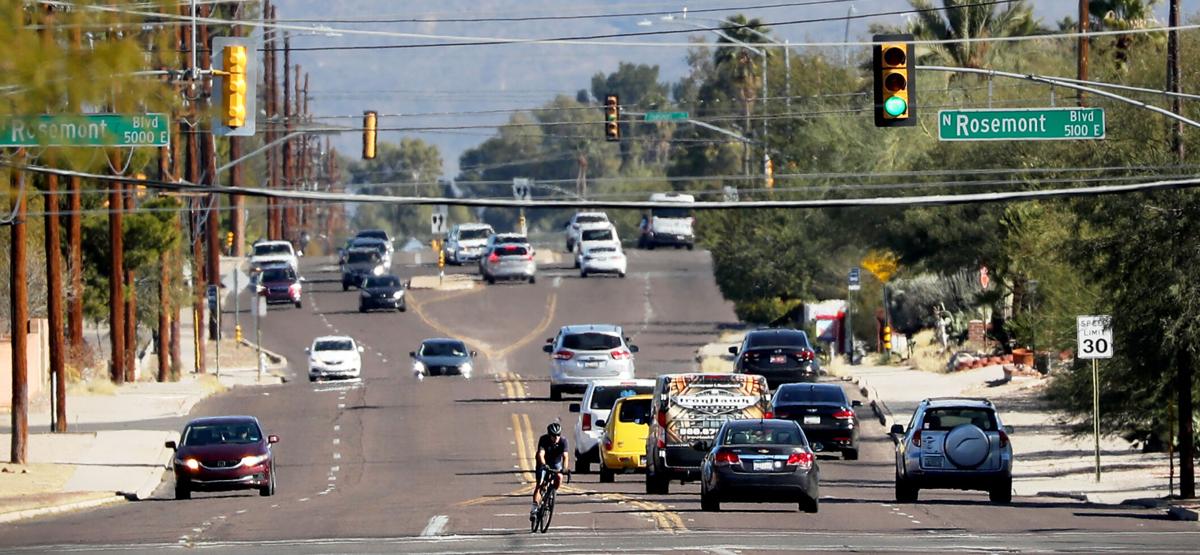
Drive down East Fifth Street at the wrong time of day and you’ll feel that uncomfortable closeness.
Drivers going the same as you pass tightly, right lane or left, and cars come at you fast just across the double-yellow stripes. It’s a commuter street that, by Tucson standards, is too narrow to play that role.
As for biking, don’t try it unless you have a death wish. Walking can be a challenge too: There are sidewalks bordering the traffic for some stretches, and dirt paths through the cactus elsewhere.
Earlier this year, city of Tucson transportation officials were selling an idea to fix these problems, one that seemed to please people: Put East Fifth Street on a “road diet” by reducing the number of lanes between North Wilmot Road and either North Campbell Avenue or North Country Club Road. In other words, make it embody a “complete street,” as described in the city’s 2019 complete streets ordinance, slowing traffic and accommodating pedestrians and other users.
The number of travel lanes each direction would go down from two to one, but there would be a left turn lane for the whole stretch, rather than just at the busiest intersections. There would also be bike lanes on each edge of the road, “buffered” by two feet from the traffic, and sidewalks for the whole length.
City transportation staffer Ryan Fagan presented the idea to the neighborhood associations along this stretch of East Fifth Street. The neighborhood groups liked the idea, and an online city survey found 75% support among the 1,334 people who answered.
So we’re going to have that road diet in 2023, right? Well, maybe not. Maybe not at all.
New director at transportation
Back in 2021, when the process of reconsidering East 5th Street got rolling, Diana Alarcon was director of the city’s Department of Transportation and Mobility, but she left for Nashville in January. In April, Sam Credio, already a staffer in Tucson’s department, was named the new director.
In an interview, Credio told me he thinks he’s the fourth director to consider a road diet on this stretch of road.
After he took over, the department hired a traffic engineering firm, Kittelson & Associates, to conduct a new analysis of the traffic effects. Now, Credio and the department are warning that the new study shows future congestion and access to the street could make the road diet a bad idea.
“Traffic operations were going to be challenging at signalized intersections, especially West of Country Club,” Credio said, citing the study’s conclusions.
Pulling onto East Fifth Street or East Sixth Street could also be an issue, Credio said.
“Basically, if you’re waiting to pull onto — this was Sixth Street in particular — in some cases you might have to wait up to 10 minutes to find a gap.”
“My recommendation was that we not road diet 5th/6th by simply restriping it.”Among other ideas, the city ought to consider reworking the signals at some of the intersections, adding left-turn arrows and making other changes, he said.
City suggested road diet
When I heard of the road diet proposal earlier this year, I thought it was a great idea. I’ve had the distinct discomfort of driving this stretch of East Fifth Street hundreds of times and walked along it dozens of times. My kids, when they learned to drive, found it scarier than Tucson’s main arteries, always threatening to bump the curbs as they steered right to avoid the drivers passing them closely in the left lane.
Now I’m frustrated by how this process has played out.
For one thing, the city clearly sold the idea of reducing the lanes on this stretch of road in its public meetings earlier this year. Fagan, who presented the plan at meetings with various groups, explained one key justification this way during a meeting in March:
“A long term trend that we’re seeing on 5th and 6th Street is that traffic volumes have been decreasing for about the last 20 years or so. Around 1998, the traffic volume was around 20,000 vehicles per day. Now it’s around 15,000 vehicles per day. This puts this well inside the guidelines of the Federal Highway administration for reconfiguration.”
Ellen Wheeler, president of the Miramonte Neighborhood Association, attended one such city session and came away feeling good about the change.
“They did a presentation, and basically the information provided indicated that traffic was way down on 5th Street/6th Street and it would be feasible to do,” she said. “They were positive about it.”
The Miramonte association, which has East Fifth Street as its southern border, between North Alvernon and North Country Club, voted to support the planned road diet. They were not alone.
“I was involved in seven or eight neighborhood outreach meetings,” said City Council member Steve Kozachik, whose ward includes this stretch of road. “It was nothing short of advocacy on the part of the DMT.”
“Nobody, at any time, said throughout the course of those conversations, that DTM was doing another data analysis to see what their opinion would be.”
Aim for ‘complete street’
Now, you can’t fault a new director for department actions that took place before he ran the place. But there is a principle at stake — the idea of complete streets enshrined in the city’s ordinance — and some things that don’t sit right.
For example, there is the confusion about whether we are dealing with the stretch of road between Wilmot and Country Club, or Wilmot and Campbell. My initial understanding was that this road diet was only proposed to go as far west as Country Club, which makes sense, because that is where the road bends south into Sixth Street.
Credio noted the city has money, under Prop. 407, to improve walkability along East Fifth Street between Campbell and Alvernon. That money will go toward adding sidewalks, improving crossings, adding lighting and improving landscaping.
It’s under Prop. 101 that the city has money to reconstruct the pavement of East Fifth between North Country Club and Wilmot. They’re two different, overlapping projects.
If you listen to Credio and read the Kittelson report, you’ll find that most of the projected problems with road dieting occur between Country Club and Campbell. So, rather than getting bogged down in the report, one can easily look at it and conclude: Let’s end the road diet at Country Club.
In addition it is possible to test the road diet without committing to it permanently. Once the road is reconstructed, Kozachik wants the city to paint the stripes in the proposed way — one lane of traffic each way, with bike lanes and a center turning — and leave it for six to nine months.
Credio acknowledged that is a possibility, though he is concerned about increased collisions at the major intersections. He also wants broader public consultation.
I suspect it would be a big adjustment for people who regularly drive along East Fifth Street, especially those who commute to the UA or take kids to any of the schools along the road.
But people will adjust. Broadway is just a half-mile south, and Speedway is just a half-mile north. Both can handle more traffic.
And if we really meant it about Complete Streets, this is just the sort of place to try. Miranda Schubert, co-chair of the city’s Complete Streets Coordinating Council, said the council has yet to consider the new traffic report, but she is still excited about creating a complete street on East Fifth.
“Of course there will be challenges,” she said. “There are design difficulties. There are different levels of compliance. Complete streets should still be the default approach.”
I still see it that way, too. East Fifth is a classic case of a street doing too much for car drivers and not enough for everyone else.
It’s time to try a different approach.
Cyclovia Tucson returned with a new 5-mile route on Sunday Oct. 30. The event encourages Tucsonans to take to the streets and enjoy outdoor recreational activities. Living Streets Alliance hosts Cyclovia twice a year and has several event hubs where Tucsonans can enjoy local food trucks, music and outdoor activities. Video by Pascal Albright / Arizona Daily Star

