


You may have seen the ads on TV, on social media, or even on billboards as hundreds of thousands of dollars are spent to support the RTA Next transportation plan.
"A uniquely frustrating species," a voice with a strangled British accent intones over video of a car tire hitting a pothole. "It is the Southern Arizona pothole."
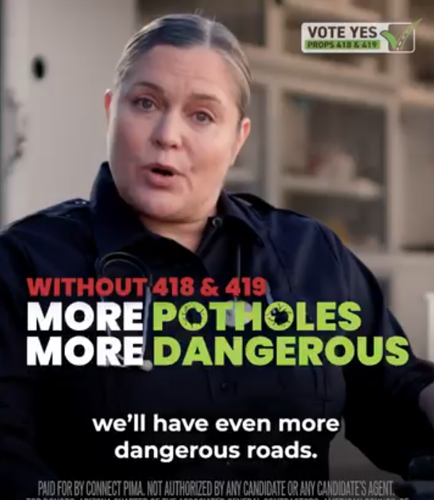
Then a woman in an apparent public-safety uniform says, "If Prop. 418 and Prop. 419 don't pass, we'll have even more dangerous roads."

Arizona Daily Star columnist Tim Steller
On the screen, these words appear:
WITHOUT 418 & 419
MORE POTHOLES
MORE DANGEROUS
The ad, from a political action committee called Connect Pima, is misleading. Repairing potholes isn't something directly addressed by Propositions 418 and 419, the two propositions that would extend a countywide, half-cent-per-dollar sales tax.
But it's not entirely wrong. And it brings up one of the unique characteristics of the 20-year transportation plan Pima County residents will be voting on in the runup to a March 10 election day.
This new RTA Next plan puts sales-tax money toward what the plan calls "rehabilitation" of the main roads and collector roads in the Tucson area. This was a way to avoid putting road "maintenance" in the plan, which is not allowed by law, but still move some money toward the city of Tucson's degraded main streets in order to attract support from city leaders and voters and make the plan's spending more equitable.
"It addressed one of the biggest complaints, both in polling of what citizens want, and what they said in the past: 'You don't have any way of taking care of the roads,' " said RTA board member Ted Maxwell.
"It was put in place to address that a lot of our arterial roads are beyond repair," he added. "I mean they're either in poor or fair condition. The potholes — you can fix potholes, but they're going to come back."
While most of the RTA Next plan's $2.67 billion in outlays go to road projects and transit, $177 million is set aside for rehabilitation of main arteries and collector roads. This was something the city of Tucson asked for, since many of the older main roads in the city don't need expansion or redesign — they just need rebuilding.
That's what the $177 million would do: Strip down these roads from curb to curb and rebuild them. The idea is to give each rehabilitated road 10 or more years of new life.
Under the plan, the city would get $139.6 million of that $177 million. Pima County would get $10 million, while South Tucson gets $8 million, and Marana, Oro Valley, Sahuarita and the Tohono O'odham Nation would each get $5 million.
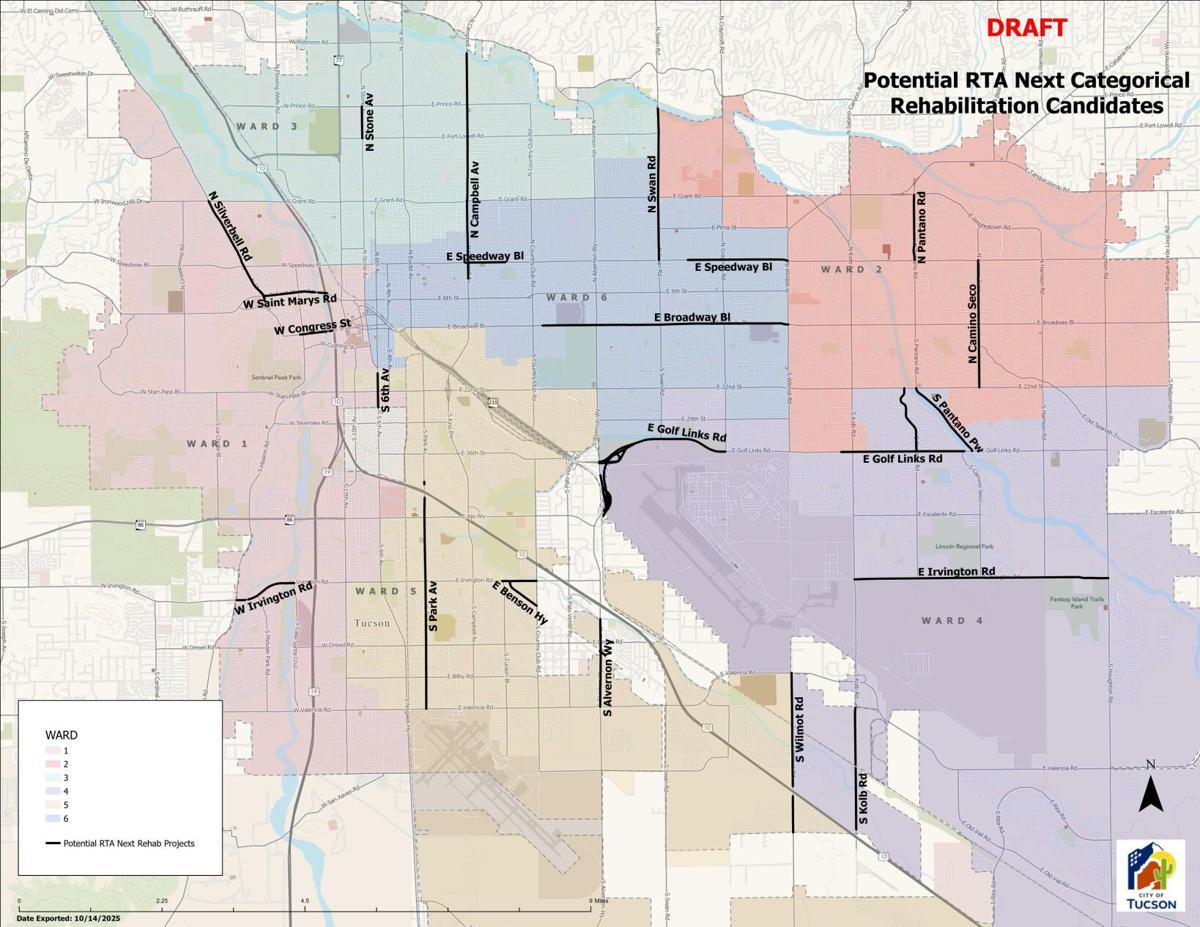
Where exactly the money would be spent is unclear. The city has created a map showing 20 stretches of main roads that could receive rehabilitation under the plan. They include stretches of East Irvington Road, North Stone Avenue, South Park Avenue, East Broadway and North Swan Road, among others.
The idea that the road rehabilitation will be substantial strikes Ruth Reiman as specious. She's a former RTA employee, longtime critic of the authority and leader of Tucson Deserves Better, the entity mounting a campaign against Props. 418 and 419.
The rehabilitation part of the plan, Reiman said, "is giving them (the city of Tucson) money they needed to make it look more equitable for them."
"This is to appease the city. It’s not a lot of money and probably won’t do much. But it’s something — just not pothole repair."
One of the reasons that it won't do much, Reiman said, is that construction costs continue to soar. By the time much money is available, it will buy even less than we're hoping for now.
It is true, though, that the $177.6 million for road rehabilitation could be an underestimate. The RTA planners put conservative estimates in the plan so as to avoid the fate of the last 20-year plan, which ends June 30. That plan fell short of expected revenues, leaving planned projects undone.

An ad playing prolifically on social media, as well as television, suggests that Propositions 418 and 419 will repair potholes. That's not really true, but it would put around $200 million toward major rebuilds of some arterial roads, mostly in the city of Tucson.
The plan lists potential additional revenue, beyond the $177.6 milliion, of $80 million more for road rehabilitation. Initially, 75% of any revenue beyond what's expected will go to the city of Tucson and the remaining 25% to other jurisdictions, Maxwell explained. That remains true up until the city reaches a maximum of 55% of total plan spending.
In the meantime, the city of Tucson is engaged in a 10-year citywide road repair program that is paid for by a sales tax extension voters passed in 2022. That is expected to put around $590 million toward improvements of neighborhood streets across Tucson proper.
These Prop. 411 repairs are probably closer to what residents think of when they think of fixing potholes than what is in the RTA Next plan. This new regional plan would not render the Southern Arizona Pothole extinct, but it would kill off a good number on some poor stretches of main roads in Tucson.

