

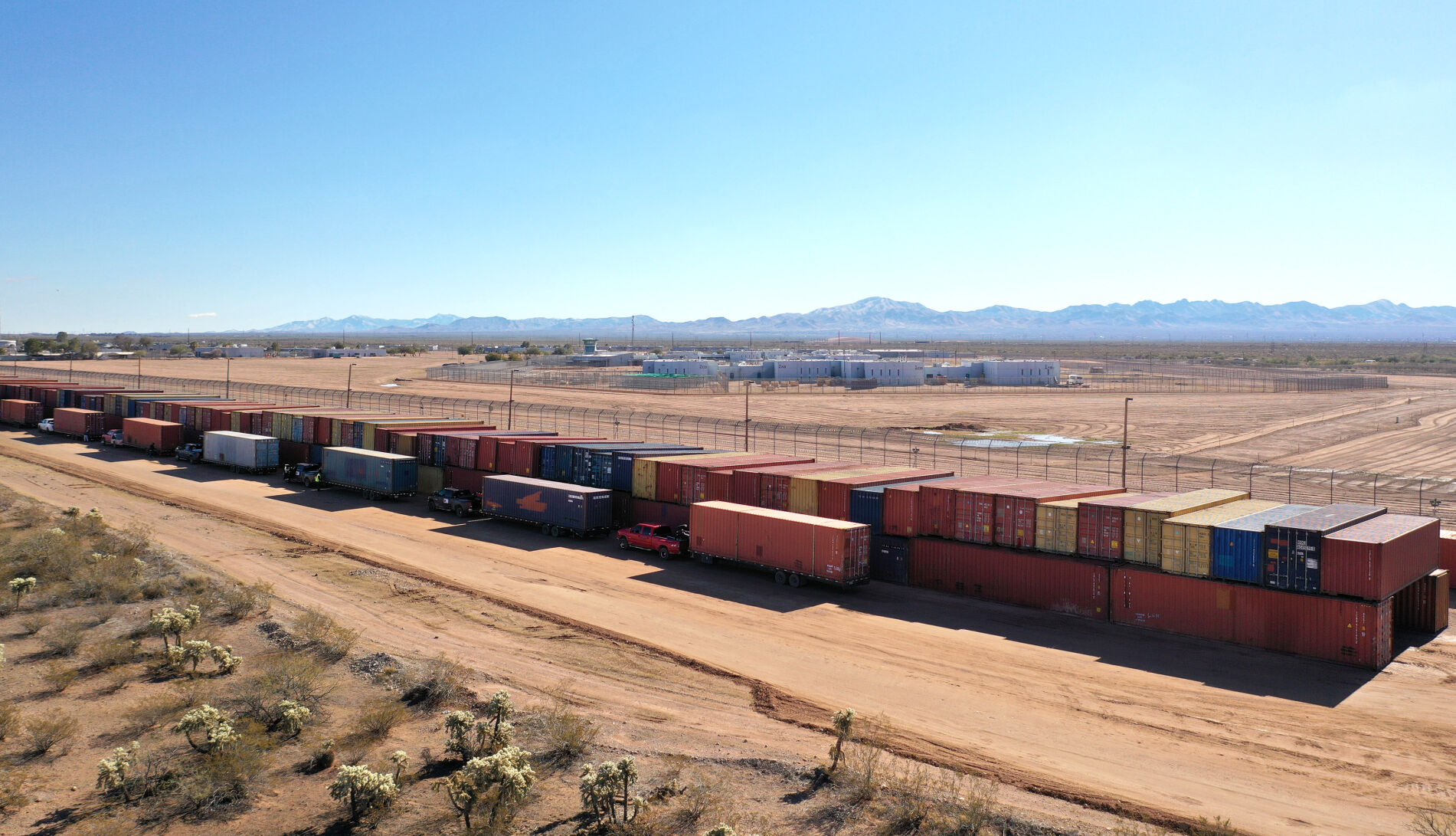

Arizona is moving shipping containers formerly intended for Gov. Doug Ducey’s border barrier from a staging area just north of Huachuca City to the State Prison Complex in Tucson, now that the governor halted the construction under pressure from U.S. officials and area protesters.
The Governor’s Office confirmed it is moving the crates from one staging area to another, but would not comment on why. Ducey, who leaves office in early January, sent a letter to U.S. officials Tuesday saying the state has ceased the construction. The containers are apparently being moved to the prison complex for storage.
Moving the containers dragged enough mud onto Arizona 90 that a lane had to be closed for public safety reasons.
The shipping crate transfer began Wednesday, and the Arizona Department of Transportation closed the lane due to mud on the road. On Thursday afternoon, the state agency said it is working with the governor’s contractor to clean the area “that is currently closed to ensure safety for the driving public,” which is about a quarter-mile long near milepost 311.
Ducey’s project had been building unauthorized border barriers on federal land since August, spending more than $123.6 million in taxpayer funds. The Biden administration asked a federal judge Wednesday to let it remove the hundreds of double-stacked storage containers and to bill Arizona for the costs.
Trucks had previously been taking the containers south to the border. But Ducey began having the containers transferred from the staging area, which is about an hour north of the border, on Wednesday, two days after the federal government informed him of its intent to sue and more than a week after protesters brought barrier construction in Coronado National Forest in Cochise County to a standstill.
A Tucson-based conservation group also intends to sue Ducey, saying he is violating federal law by blocking streams and washes along the U.S.-Mexico border with the hundreds of shipping containers, a lawsuit that could transfer to incoming governor Katie Hobbs, a Democrat elected in November. Ducey, a Republican, couldn’t seek a third term due to state term limits.
“The reality is that when one governor makes a mess for another, it’s the following governor who has to clean it up,” said Robin Silver, a co-founder of the Center for Biological Diversity, which filed the notice. “So she’s going to now be responsible. It’s going to be more expensive to clean it up than it was to deploy because it’s easier to move stuff around than it is to repair damage.”
The Governor’s Office had no comment on the Center’s intent to sue.
Ducey’s letter Tuesday to federal officials said, “Arizona’s border barrier was always intended to be a temporary solution until the federal government erects a permanent solution. ... Arizona agencies and contractors stand ready to assist in the removal of the barriers, but the federal government owes it to Arizonans and all Americans to release a timeline on when construction will begin and details about how it will secure the border while construction is underway.”
The Biden administration has said it intends to close small gaps in the federal border wall built under the Trump administration, including closing 27 gaps and gates located within Sasabe, Nogales and Naco, in work expected to begin in mid-2023.
‘Most important conservation area’
The Center for Biological Diversity filed a 60-day notice of intent to sue on Wednesday against both Ducey and emergency management contractor AshBritt, Inc., saying they violated the Clean Water Act with the earthmoving, stream and wash modification, and deployment of shipping containers to Coronado National Forest land.
Repairing what was altered in the Coronado includes not only removing the crates but also environmental measures such as recontouring streams, Silver said.
A state contract with AshBritt shows the nearly $124 million price tag for the barrier material and construction in Yuma, Nogales and on the Coronado in Cochise County, which alone has cost nearly $93 million.
While Ducey intended the Coronado barrier to stretch 10 miles, it reached about 3.5 miles before construction was stopped last week by a small group of protesters.
After rains and a snowfall on the Coronado, there have been areas of water pooling, created by the shipping crates blocking the natural water flow. Conservationists say it’s not clear yet if or how the crates will affect the San Pedro River, an important water source in the area.
On the Mexico side of where the crates have gone up in the Coronado is Rancho Los Fresnos, 10,000 acres of grasslands in the upper San Pedro River watershed, bought by U.S.-based, global conservation nonprofit The Nature Conservancy in 2005, according to High Country News.
The area where Ducey put the shipping crate barrier without following any environmental regulations, federal or otherwise, is part of a region that conservationists consider very important.
“The Huachuca Mountains, the San Rafael Valley, this whole area in general, through our own analysis is ranked by many measures as the most important conservation area in the entire Southwest,” said Damian Rawoot, The Nature Conservancy’s Land and Water Protection Manager for Southern Arizona. “This is an area that’s really important for biodiversity conservation and for connectivity” for the movement of species.
That region is a narrow corridor that allows species’ movement from the subtropical Sierra Madre in northern Mexico all the way to the cooler Rocky Mountains, which is what makes it such an important place for wildlife movement, Rawoot said.
The Nature Conservancy took an interest in Rancho Los Fresnos because of the importance of that connectivity across the U.S.-Mexico border region. Also, Rancho Los Fresnos is part of the headwaters of the San Pedro River.
There’s no doubt that physical barriers inhibit species movement, Rawoot said, adding that the conservancy was heartened that when the border wall was being built during the Trump administration, that 11-mile stretch of land was left with just a vehicle barrier that animals can still move through with relative ease.
That region is far from urban spaces and there are long lines of sight, making it a less frequent place for migrants to cross the border undocumented.
How the shipping crate barrier could affect the San Pedro or other streams and washes in the area is a complex question, but there’s no doubt it and similar barriers have many impacts, Rewoot said.
“Even putting a physical barrier on a landscape like that causes changes in the hydrology, water, water movement,” he said. “Water flows where it wants, and so you start putting barriers — I know there’s been big flood events all over in places that border barriers have impacted.”
Trucks with shipping crates originally intended for a border barrier leave a staging ground near Whetstone and head north.

