

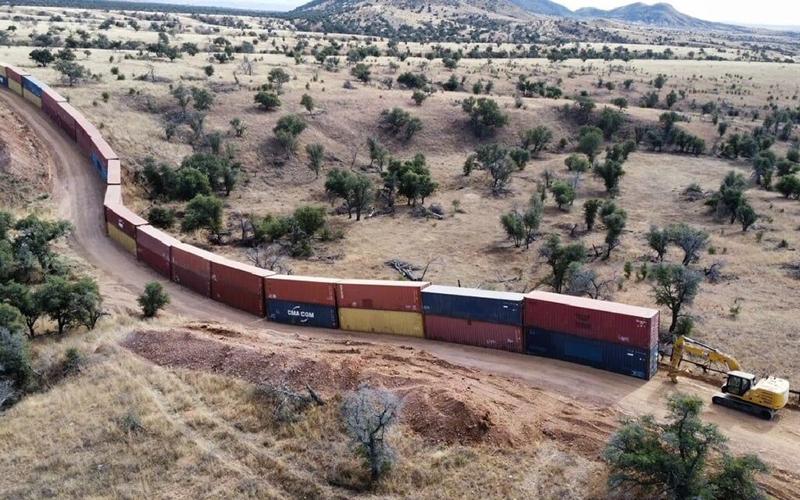
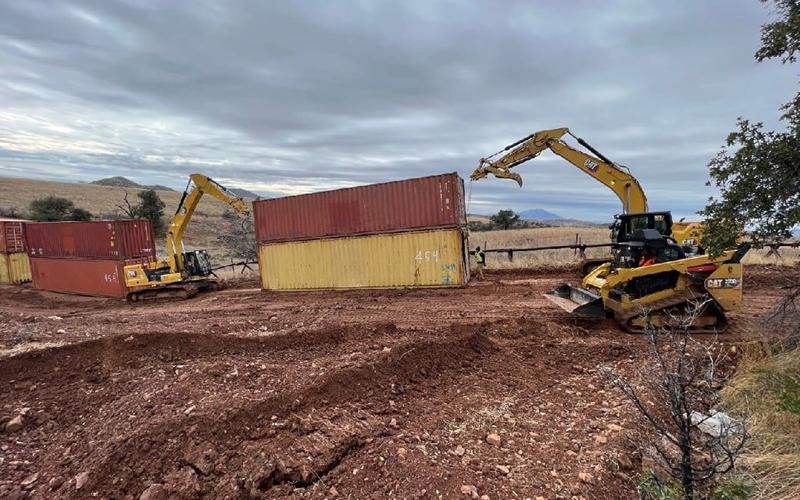
If you ever wanted your very own shipping container, you’ll soon get the chance, courtesy of former Gov. Doug Ducey’s short-lived effort to build a border wall out of them.
But you won’t get your pick of color, you have to arrange to have it shipped, and the seller — the state of Arizona — is warning that they aren’t in the greatest shape.
You’ll also have to wait your turn until after government agencies and nonprofit organizations get first crack at them, expected to occur by Oct. 1.
Still, there should be plenty left of the approximately 2,200 shipping containers that Ducey had the state purchase so he could erect miles of containers to fill gaps left in the border wall started by former President Donald Trump.
And the asking price is far less than the state paid to buy them last year, even without considering the $100 million in taxpayer funds spent to erect them.
Ducey was forced to agree to remove the containers — at the cost of another $76 million of taxpayer funds — after the U.S. government sued the state for trespassing on federal property.
So now the state is stuck with all of these containers it bought solely for the project, which now are simply gathering dust on the grounds of the state prison in Tucson.
It’s trying to get rid of them — suggesting they can be “repurposed’’ for housing, offices or classrooms — to recoup some of those expenses.
Gaps led to no-bid contract
Trump promised to build a “big, beautiful wall’’ between the United States and Mexico but there were still gaps when he left office at the end of 2020. On his first day in office, President Joe Biden called an immediate halt to further construction.
Last July the U.S. Department of Homeland Security announced it had authorized Customs and Border Protection to seal some of the openings, including a 3,820-foot gap near Yuma.
That didn’t stop Ducey, Trump’s fellow Republican, from issuing an executive order just weeks later, directing those gaps be filled with a line of 130 shipping containers, stacked two high, at state expense.
Ducey later announced a separate and more extensive contract to fill a 10-mile gap along the border south of Sierra Vista in Coronado National Forest. His administration also gave a no-bid contract to AshBritt Management & Logistics.
All that came to a halt when Ducey, after being sued, agreed just days before he left office in December to remove the containers. The state agreed to pay AshBritt even more money to undo what it had just put up.
Corrosion and other damage
The containers range in age from 10 to 20 years.
The most expensive one the state is offering is 40 feet long, eight feet wide and eight-feet-six-inches tall. It’s listed as Grade C, which means the exterior will have “extensive corrosion with a multitude of dents’’ and may have prior repairs or patches, and the interior has markings, scratches and corrosion.
That will set you back $2,000.
If one with extensive corrosion or holes, as well as major damage, is OK, there are some Grade D 40-foot containers for $1,500.
Need something smaller? A Grade C 20-foot container will set you back $1,000 while $500 will buy a Grade D in the same size.
But there are only about 100 of these smaller sizes available.
Mostly bought for storage, so far
The state Department of Administration, which is marketing the items, says they can be used for housing, offices, classrooms or other occupancy.
But, depending on where they are put and how they are used, there are a host of other hurdles, such as oversight from local officials and zoning. Any plans to take the containers to a facility to be converted to housing for placement offsite requires that the facility to be licensed and certified by the Arizona Department of Housing.
So far, though, that hasn’t been the interest of takers.
Virtually all of the approximately 100 containers already snatched up have been bought by other state agencies that want them for storage, said Megan Rose, spokeswoman for the Department of Administration.
But the Herald/Review reports that Bisbee Public Works Director Matt Guerney has ordered 13 Grade C containers in different sizes.
He said they are needed for storage space for equipment and supplies for parks, streets, sewage, sanitation and the fire department.
The price tag for Bisbee‘s order is $27,820.
State to take a big loss
If the state gets rid of all the containers, it will be at a loss — even discounting the construction costs.
The Department of Emergency and Military Affairs, which made the purchase, doesn’t have a breakdown of what each container cost. But the total price tag was more than $13.8 million.
Even assuming all the containers being offered for sale are 40-foot Grade C, that would put the maximum recouped at just $4.2 million. The final figure is likely to be less, given there are less expensive Grade D containers and smaller ones.
Daniel Scarpinato, who was Ducey’s chief of staff, told Capitol Media Services his former boss “stands by the project.’’
He said it served its purpose, resulting in a commitment by federal officials to start closing gaps.
“This effort was never meant to be a permanent solution,’’ Scarpinato said. “But it did result in getting the (Biden) administration’s attention when almost nothing else would.”
Democratic Gov. Katie Hobbs’ press aide, Christian Slater, has a different take.
“It was a publicity stunt and it wasted taxpayer dollars,” he said.
Asylum-seekers continue to cross into the U.S. despite Arizona completing its effort to bolster the border wall with shipping containers near the farming community of Yuma. The finished effort to close 3,820-feet of gaps was announced by Gov. Doug Ducey in a statement Wednesday.
Arizona Governor Doug Ducey shared a video Thursday morning showing the progress of a shipping-crate border barrier being built in Southern Arizona west of the Coronado National Memorial. According to Ducey, nearly one mile of the planned 10-mile structure has been erected. Video courtesy Doug Ducey.

