



In the months leading up to Tucson’s sales-tax vote on March 11, business groups rallied against it.
The Southern Arizona Leadership Council opposed it.
The Tucson Crime Free Coalition spoke out against it.

Tim Steller
The Tucson Metro Chamber of Commerce organized an opposition front, bringing in big donors from several industry groups to mount a winning campaign against Prop. 414.
Together, these groups helped convince voters that this was a bad idea that could hurt the local economy by raising our sales tax to the highest among large Arizona jurisdictions.
Even the Phoenix-based Arizona Free Enterprise Club celebrated the proposition’s defeat.
“Voters from all sides of the political aisle made the correct decision in Tucson today,” the club’s Scott Mussi said in a written statement after the vote. “This tax increase was another failed attempt by Tucson’s radical leaders to take more tax dollars from hard-working men and women to fund an insatiable leftist agenda.”
Now, though, something much bigger is going on in the economy than a half-cent, 10-year sales tax would ever have amounted to. The tariffs President Trump imposed against Canada, Mexico and China in March, and the new ones imposed on countries around the world this month, have sent shock waves through the global economy.
Suddenly, as a result of this rash and unilateral decision, J.P. Morgan is putting the chance at 60% that the United States and global economy will enter a recession this year. They directly blame Trump’s tariffs.
“Disruptive U.S. policies have been recognized as the biggest risk to the global outlook all year,” J.P. Morgan said in a note on Thursday.
On Friday, Federal Reserve chairman Jay Powell said he expects higher inflation and lower growth as a result of the tariffs. Between a stock market dive, higher inflation and a possible recession, all of us can expect to be hurt, at least in the short term.
Tariffs are taxes
Tariffs are, after all, simply taxes — taxes on imports. These new tariffs represent one of the biggest tax increases in many decades.
The chief intention is to bring back manufacturing jobs to the United States — maybe that will work, maybe it won’t. It’s also unclear whether any jobs that return will provide the financial security that manufacturing work brought in the 1950s and 1960s, when housing was cheap, tax rates were high, health care was affordable, and unions were strong.
Trump has also said he wants to replace the revenue from income taxes with tariff revenue, allowing for tax cuts.
The short-term pain seems much more clear than the long-term gain.
It made me wonder: Where do the entities who opposed Prop. 414 stand on these import taxes, which are a bigger threat to Tucson’s economy than the half-cent tax was?
The Tucson chamber hasn’t taken any position on the tariffs. President and CEO Michael Guymon said the group usually defers to the Arizona Chamber of Commerce and Industry on such large-scale issues. More from them in a minute.

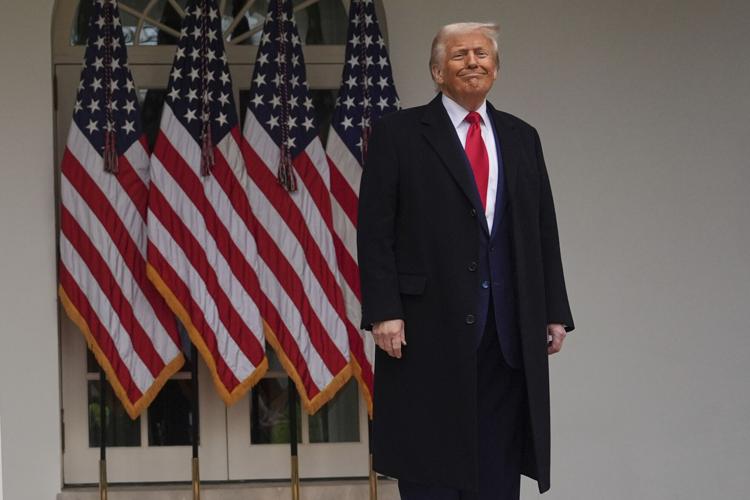
President Donald Trump departs after signing an executive order at an event to announce new tariffs Wednesday in the Rose Garden of the White House.
The Arizona Multihousing Association put $40,000 toward the metro chamber’s campaign against Prop. 414. They didn’t respond to my request for comment on the tariffs. Neither did the Tucson Association of Realtors, which put $25,000 toward the anti-414 campaign. The Tucson Crime Free Coalition told me they only deal with local issues.
The Arizona Free Enterprise Club, which you would think would naturally be opposed to tariffs, didn't respond to my text and hasn't spoken out on Trump's actions.
The Arizona Tourism and Lodging Association, which contributed $40,000 to the effort, did comment, though.
“We typically don’t take a position on tariff policy because tariffs are taxes on imported things, not people,” said Garrick Taylor, speaking for the association. “We’re going to be concerned about anything that’s going to put upward pressure on the cost of living and makes travel more costly and difficult.”
“Tariffs remain in effect on our friends in Canada and Mexico,” Taylor noted. “Mexico and Canada are not just our neighbors geographically, but they’re our friends, and they’re our No. 1 and No. 2 source of foreign visitation to Arizona.”
Visitation from Canada has dropped, he said. Canadians are reacting not just to tariffs but also the threat made by Trump to take over their country, as I’ve reported before.
One leader speaks out
Auto dealer Jim Click, who contributed to anti-414 efforts, also was willing to speak when I called him about tariffs. He said he’s confident about the car business for now, because adequate inventory is in place and the Fords his dealerships sell are more domestically made than many other brands.
“I’m telling my guys it’s business as usual,” Click said. “We’ve got plenty of product right now to sell.”
But he has questions about the long-term effects of tariffs. It’s especially difficult in an industry like autos, where parts are made in so many places.
“We need stability,” Click said. “The markets are asking for that. The dealer is asking for that. Most importantly, the consumer needs it. We need to know, where is this all going to end up.”
These may not be frontal critiques of Trump’s economic policies, which have taken us from a strong place in 2024 to a perilous one in 2025, but they are a start. As Politico reported Friday, business people broadly hate the tariffs but are scared to say anything publicly and risk the wrath of this vindictive administration.
I was thankful to find out that Danny Seiden, President and CEO of the Arizona Chamber, did speak out in radio interviews on Phoenix station KTAR Friday. He pointed out that the last new tariff imposition of this size, the Smoot-Hawley Act of 1930, contributed to the Great Depression.
“This is to me an unforced error,” Seiden said in one interview. He added in a later one, “Tariffs are bad. Tariffs are not good policy.”
Indeed, they have an especially large impact in Arizona, a state ranked 6th among all states, for the value of its imports and exports as a part of state GDP.
We need more of the direct critiques Seiden offered. We can debate what effects Prop. 414’s tax increase would have had, but now it’s clear the big danger to Tucson’s and Arizona’s economy comes from inflation and a global recession due to Trump’s sudden tax increases — his global tariff scheme.

