


The nonprofit agency operating Tucson International Airport will soon start work on a detailed investigation of the extent of groundwater contamination by potentially cancer-causing PFAS compounds that were historically used on its property.
The investigation is due to a new agreement the Tucson Airport Authority signed with the U.S. Environmental Protection Agency.
Its purpose will be “to determine the nature and extent of contamination and any threat to the public health, welfare, or the environment caused by any release or threatened release of PFAS hazardous substances, pollutants, or contaminants” from airport property, the agreement says.
The agreement also commits the authority to conduct a feasibility study after the investigation to determine the best cleanup options if warranted. The agreement will be carried out under the federal Superfund program in which toxic waste sites are cleaned up under EPA’s oversight.
The PFAS compounds, scientifically linked to a wide array of potential health effects, are called “forever chemicals” because they don’t typically break down in water or soil. The toxic compound was historically used in firefighting foam at the airport and two Air Force facilities nearby.

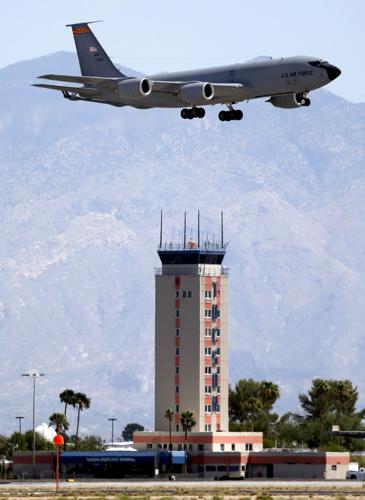
An Arizona Air National Guard KC-135 refueling tanker makes a low pass over the iconic control tower at Tucson International Airport in 2014.
Contamination of the groundwater by PFAS was discovered about five years ago to have moved north of the airport property to city of Tucson-owned wells on the city’s south side. Those wells haven’t been used for drinking for many years.
But city, state and federal authorities have wanted to get these wells cleaned up for a long time, not least because that groundwater may be needed in the future if and when major cuts occur in the city’s Colorado River water, its main drinking water supply. Because of the PFAS contamination, Tucson Water no longer delivers polluted groundwater that’s cleaned up at its south-side water treatment plant to residents, which has eliminated about 8% of the city’s potential drinking water supply, EPA said.
“It is essential that Tucson residents can continue to rely on groundwater as a safe source for drinking water,” said EPA Pacific Southwest Regional Administrator Martha Guzman. “This agreement demonstrates the Tucson Airport Authority’s commitment to share responsibility for protecting public health, and our recognition that such a commitment must be backed up by action.”
In the new agreement, EPA wrote that because PFAS levels in groundwater are so high in the general Tucson International Superfund area — which includes the airport and the two nearby Air Force facilities — the Tucson Water utility continues to face increasing costs to remove the compounds from contaminated water coming into its treatment plant on the south side.
The plant now uses granular activated carbon filters both to remove PFAS and as part of an overall process to treat the groundwater for another pollutant, 1,4-dioxane. But because PFAS levels of groundwater coming to the plant continue to increase, the city has to change the carbon filters multiple times a year compared to every three to five years in the past, EPA said.
Worse, projections indicate that as PFAS levels keep increasing in water coming into the plant, there is a high risk this contamination will eventually overwhelm the filters’ ability to reduce the contamination, EPA said.
The airport authority has released a preliminary assessment of the potential for PFAS contamination on the property, providing the first publicly available look at the use of the toxic compound there.
Released in September, the assessment concluded the 8,343-acre Tucson International Airport site contains 38 potential “areas of concern” that could have had past use of firefighting foam containing various PFAS compounds. The report recommended further inspection of 35 of them to determine their potential to have released PFAS compounds into the environment.
“From a community standpoint, this is a great thing,” said Yolanda Herrera, a longtime south-side Tucson resident and activist. “We’ve been asking for this action for years. We are very grateful it’s finally happening.” She co-chairs the Unified Community Advisory Board, which officially monitors ongoing groundwater cleanups on the south side. Those include the removal of the probable cancer-causing solvent trichloroethylene (TCE) from groundwater, ongoing since the mid-1990s.
“It’s just another step in the right direction. I hope the other parties will do the same,” said Herrera. “We’d like to see this (cleanup) happen yesterday.”
By “other parties,” she was referring to the Morris Air National Guard Base just northeast of the airport and Air Force Plant 44 just south of it. The U.S. Air Force, which runs both properties, has already prepared preliminary assessments like the one the airport authority just released. It’s now conducting remedial investigations of potential and actual groundwater contamination at both sites.
But the Air Force is also challenging an EPA order from May 2024 to prepare a detailed plan to clean up that contamination. The Air Force has said the pollution isn’t an imminent health threat and that state and local officials are already addressing the PFAS contamination.
The new airport-EPA agreement lays out a fairly detailed timetable for when the authority must carry out individual actions in its probe, but doesn’t require cleanup itself. The agreement doesn’t set a deadline for finishing the investigation but says such investigations typically last “multiple years.”
Fourteen days after the agreement takes effect, the authority’s first step will be to designate a community involvement coordinator to handle interactions with the public and media and to participate in EPA-run meetings on the investigation. Within 60 days, the authority will notify EPA of the names, titles, and qualifications of contractors, subcontractors, consultants and laboratories it will use. In 90 days, the authority must prepare a plan for how it will conduct the investigation.
The agreement was signed on Aug. 28 by Danette Bewley, the authority’s president and CEO, and on Sept. 20 by Michael Montgomery, director of the Superfund and Emergency Management Decision of EPA’s San Francisco regional office.
PFAS compounds are a large family of synthetic organic substances first produced in the late 1930s. These substances contain a series of partially or fully fluorinated carbons. Because of the carbon-fluorine bond, these compounds don’t readily degrade through natural processes.
“They are thermally, chemically, and biologically stable” and don’t naturally biodegrade, the airport authority wrote in its new assessment.
Scientific studies have found that exposure, even at low levels, of certain PFAS chemicals may result in adverse health impacts to the immune system, the cardiovascular system, human development such as decreased birth weight and suppression of vaccine response in children, the EPA-airport authority agreement said.
“Furthermore, studies have linked oral exposure to adverse health effects on the liver, the kidneys, and the immune system, as well as cancer,” EPA wrote. “Studies have found, following oral exposure, adverse health effects on the thyroid, reproductive organs and tissues, and developing fetuses.”
But use of PFAS was not only common but federally required for decades at not just the Tucson airport, but at the Morris Air National Guard base and at other military bases around the U.S., the airport authority’s assessment said.
Since the late 1960s, PFAS have been included in formulations of firefighting foam, known as aqueous film forming foam, the airport authority said. It offers quick extinguishment of certain kinds of fires because it retains water and separates fuel from fire ignition sources.
Its use was required at military bases and many airports including Tucson International from 1970 on, the authority said. But since September 2019, the airport has abandoned the kind of PFAS compounds used historically — known as long-chain compounds that are persistent, toxic and bioaccumulative — in favor of what’s known as short-chain PFAS compounds.
Those have been approved under an EPA stewardship program and are considered less toxic and less likely to bioaccumulate in humans, the authority said.

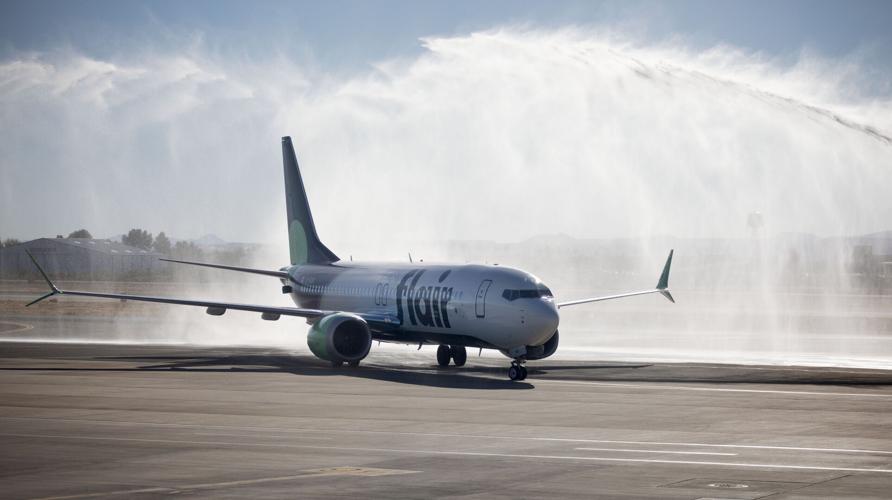
Firetrucks from the Tucson International Airport fire department create a water arch to welcome in the inaugural flight of Flair Airlines in 2022.
Based on interviews with past and present airport personnel and on searches of historical records and other documents, the authority concluded that at more than 30 of the 38 potential PFAS release sites examined, firefighting foam was known to have been used. Another seven areas contained hose stands for use of the firefighting foam, although the assessment didn’t say the foam had been used in those areas.
PFAS may have been used or was assumed to be used in six other areas on the airport, the assessment said. Releases of PFAS were known to occur in six areas due to leaks, spills or other discharges. The firefighting foam was used in “fire emergencies” at four of the sites, the assessment said.
In response to questions from the Star, the authority said it had been working on its PFAS assessment since June 2023. Its assessment comes much later than the Morris Air National Guard base’s assessment that was published more than five years ago and found widespread groundwater contamination underneath the base.
Asked why its assessment came so much later, the authority didn’t respond directly.
It said it had “voluntarily proceeded” to conduct the assessment starting in 2023, pursuant to federal Superfund rules, before EPA added PFAS compounds to its list of hazardous substances earlier this year.
“This was done in an effort to carefully and scientifically approach gathering PFAS data from airport property and to add to the regional data collected by other agencies. We expect the combined data from all participating agencies will give a more comprehensive picture of possible locations and concentrations of PFAS compounds in the airport area,” the authority said.
Generally, the authority expects that to address the issue of PFAS at the airport, collaborative efforts with EPA, the Arizona Department of Environmental Quality, the Air Force and the city of Tucson for testing, mitigation and remediation “will be ongoing.”
Development of a regional Conceptual Site Model, a visualization of the site, and a comprehensive cleanup plan “will take time,” the authority said.

