


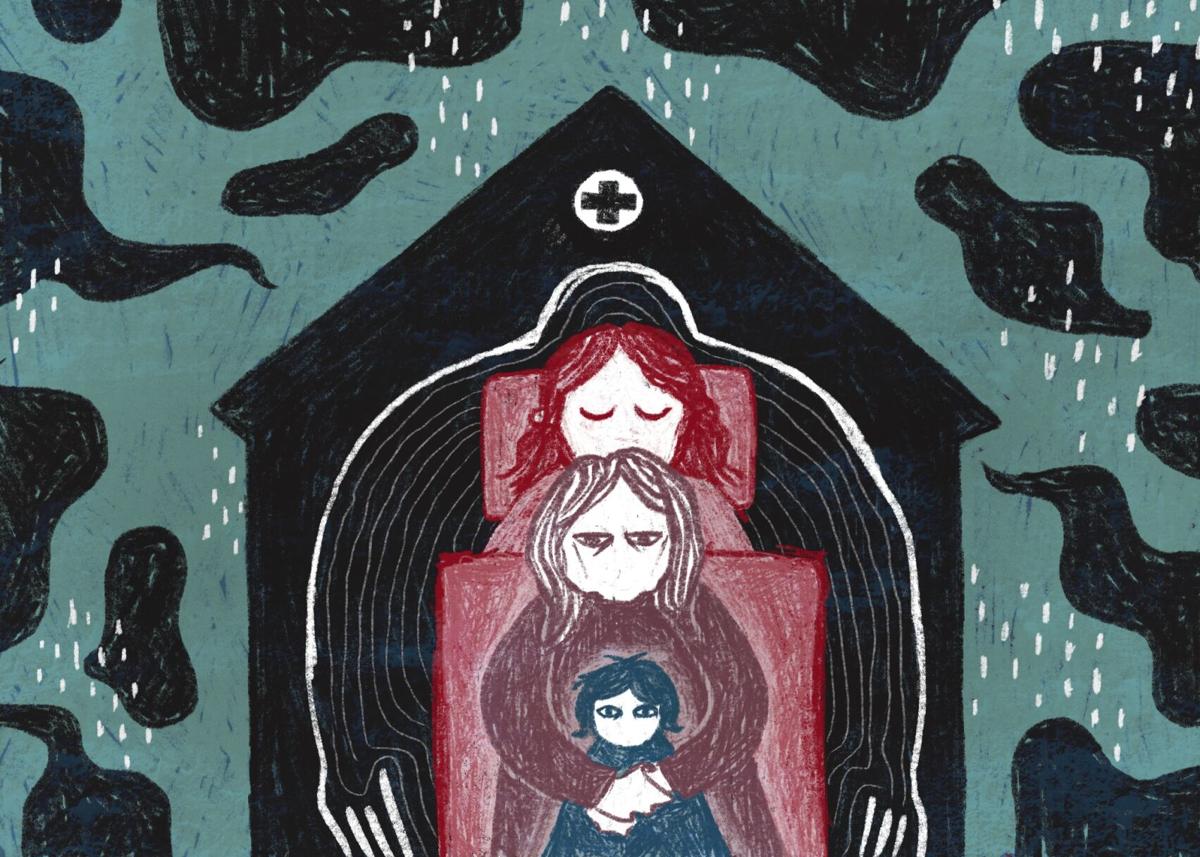
Mildred never thought her daughter would be a mother.
Then the phone rang on a Saturday morning. An unfamiliar woman identified herself as an employee at Hacienda HealthCare, the Phoenix facility where Mildred’s daughter had lived since she was 2 years old.
“Oh, Mildred, I just wanna let you know, did you know you’re a grandma?”
“I said, ‘What are you talking about?’ “
“And she said, ‘Yeah, she had a baby boy.’ “
Mildred remembers yelling, but almost four years later, she’s not sure of exactly what she said. She does recall one thing very clearly.
“I threw my phone across the room.”
‘I kept her at home as long as I could’
Days later, on New Year’s Eve 2018, news broke that a woman with profound intellectual disabilities had given birth at a long-term care facility.
Within weeks, an employee was arrested and charged with sexual assault. He’s now in prison. Mildred and her family have settled lawsuits against Hacienda HealthCare and the state.
But things will never be settled for Mildred.
On a warm day in fall 2022, the older woman sits in the conference room of her lawyer’s north Phoenix office. KJZZ and the Arizona Daily Star are using her first name only, to protect her privacy. This is the first time she has spoken to a journalist.
Mildred wears a blue T-shirt and jeans, her salt-and-pepper hair held back by a sparkly headband. Her eyes fill with tears as she talks about her daughter, the fourth of seven children.
The girl had her first seizure when she was 2 weeks old. Mildred knew something was wrong, but she didn’t know what to call it.
“I would be going to her, taking her to her appointments, and tried to explain to the doctors, the nurses, what she was doing, turning blue, shaking, her eyes rolling up,” she said.
Mildred and her family live in the San Carlos Apache Indian community, several hours from any big health care facilities. Eventually, the family was sent to Phoenix, where the little girl had a seizure in front of a doctor, who was then able to diagnose her.
“I kept her home as long as I could,” Mildred said. “But then she started developing respiratory problems.”
The doctors convinced Mildred and her husband to put the girl in a state-funded care facility in Phoenix called Hacienda HealthCare. She was just 2 years old. Mildred described it as the “hardest day of my life.”
“I was reassured that she’ll be taken care of, they’ll care for her. And I did say that to them, you know, I cared for her as much as I could at home. So now you take care of her.”
The girl grew up at Hacienda. Mildred was happy with her daughter’s care. She kept a close eye on her when she visited, checking for sores, bruises, even ear wax. She and her husband requested that their daughter never be left alone with a male caregiver.
The family visited on Christmas Eve 2018. Mildred noticed her daughter’s feet were swollen. She mentioned it to the staff. She called the next day and was told the younger woman was scheduled to see a doctor.
“And that was it. I never got a call back saying why her feet were swollen until the 29th.”
Her grandson’s birthday.
Mildred rushed to Phoenix.
“That’s where that part of our life changed.”
Her daughter was recovering in the hospital. The little boy was nearby.
At first, Mildred wasn’t sure she even wanted to see the infant. She prayed about it, then went to the ICU, where the baby was being weaned off of his mother’s seizure medications.
“He was just laying there all small, facing the other way, we just saw the back of his head. And we saw him, talked to him in Apache, apologized to him for how he came, but told him that he’s ours. I said, ‘He’s going home with us. He’s mine. This is my flesh and blood. No matter how he came, he’s my flesh and blood.’”
Mildred pulls out her phone to show photos of a beautiful, healthy child with big eyes and dark hair. He loves spicy food. He’s always surrounded by family.
“He calls all of us Mama. Me, my older daughter, the aunties.”
From his youngest days, Mildred has brought the boy along to visit his mother, who now lives in another care facility in Phoenix. He calls her Mama, too.
Mildred worries about the day her grandson finds out about his father.
“Every day, every morning, every time I look at him.”
‘Ask questions’
In the months following the Hacienda HealthCare incident, advocates called for reform in Arizona facilities that care for people with intellectual and developmental disabilities, or IDD.
But the reality is that there are fewer than 200 Arizonans with IDD living in institutional settings. Another 45,000 live in the community — with family, on their own, or in small group home settings. They qualify for health care, job training, recreational programs and caregiving services.
No matter where they live, Arizonans with IDD are not safe — not according to reports collected by the state, which document everything from a scratch to a rape. An analysis by KJZZ and the Arizona Daily Star of more than 10,000 “incident reports” made to the Arizona Division of Developmental Disabilities in 2019 and 2020 revealed more than 4,000 charges of neglect and hundreds of serious physical and sexual abuse allegations. Often, there’s no resolution to these complaints.
Among the incident reports is one documenting the birth of a full-term baby boy to a 29-year-old woman with a seizure disorder and needs so significant she cannot walk, talk or care for herself in any way. She does respond to sound and light, making it even harder to consider that she was likely raped multiple times by a man caring for her.
Whether in an institution charged with providing constant oversight or out in the world, bad things are happening to some of the state’s most vulnerable residents. Family members, advocates, medical personnel — just about anyone close to people with IDD already knows this. But it took the rape at Hacienda HealthCare to get the world’s attention.
Even that has not resulted in much change. A task force examined the problem for years, a few laws were passed, some funding was increased. But almost four years later, a public education campaign still has not been put in place. It’s almost impossible to find detailed information about a potential living setting for a loved one. Family members and guardians are kept in the dark about even the most basic information, something Mildred said happened to her many times.
Her best advice to other families: “Ask questions.”
“Ask questions, just basically, ‘How she’s doing? What is she doing today,’” Mildred said. “Asking how they are as a human being.”
‘She made it home to us’
Today, Mildred’s daughter lives in a state-run facility in Phoenix. It’s smaller than Hacienda, tucked into an inner city neighborhood.
She really likes quiet, her mom said.
“When we’re there, we’re loud,” Mildred said, laughing. But it’s important to her that her daughter be with her people and around her family’s traditions.
“I sing to her in Apache, and I told the supervisor there at the home to play her some traditional music,” she said. She bought her daughter a fancy television set and asked the staff to put in Wi-Fi.
“So they play YouTube and they get that traditional music going on, even the crown dancing, what we do.”
Earlier this year, Mildred’s daughter came home for a visit. Mildred and her husband, Joe, had been chosen as godparents for a young woman in the community, and there was a big celebration. The older woman’s eyes shine as she recalls sending a traditional dress for her daughter to wear.
By the time the van made it to the reservation, the ceremony was over.
“So she couldn’t hear any of the music, but she was home with us, and we were just all happy. Family just gathered around the van and wanted to take a peek at her. And she was kind of like dozing off.”
The family was together. They took pictures. Mildred’s daughter was never taken from the van.
“I told them, ‘I don’t want her getting off.’ It was dusty that day. I don’t want her getting sick, you know? So she stayed like maybe for two hours, and they took her home, and we were just all waving at the van.
“She made it home to us.”
Chronic pain - pain that persists for more than three months despite treatment - is a leading cause of disability worldwide.
 Unsafe: For Arizona's disabled, abuse can happen anywhere, by anyone
