


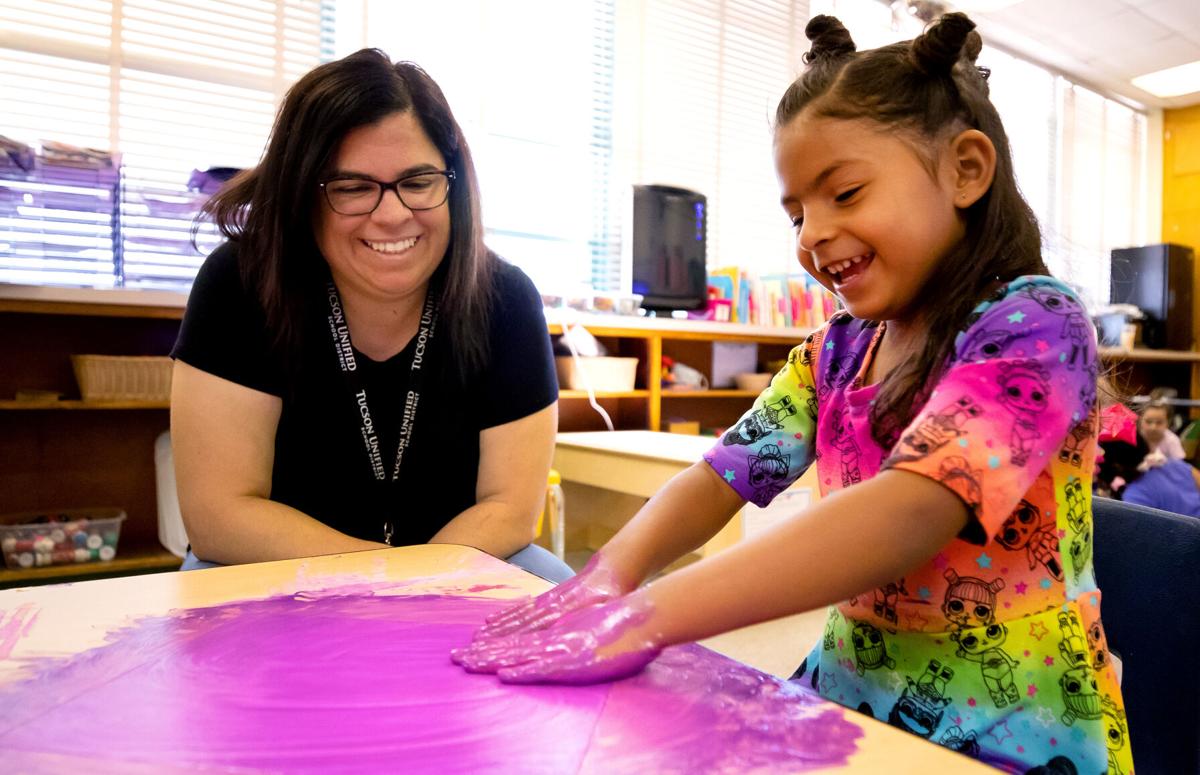
In a preschool classroom at Annie W. Kellond Elementary, a group of 4- and 5-year-olds sits on carpet squares and goes through the sounds of the alphabet.
After the class finishes with “Z is for zipper,” the children’s faces light up as teacher Holly Davis reminds them that after this week, they’ll go on to become kindergarteners. It’s the last week of school and the preschoolers have been preparing for the next step all year.
For Clare Bohme, the past year’s learning experience made her 5-year-old son, David Hubbard IV, more than ready to take on kindergarten.
The class of about a dozen attends the preschool class for free through the Pima County Early Education Program Scholarships, or PEEPS, which provides preschool funding to low-income families.
“I’m an hourly employee, so it didn’t make sense to pay for daycare, it made more sense for me to stay home. I would essentially only be working to pay for child care, and it just didn’t make any sense,” Bohme said. “(The PEEPS program) did give me the opportunity to go back into the work force. I wouldn’t have had that opportunity if David was here with me.”
David has learned his ABCs and the colors in both sign language and Spanish in his first year of school.
“He really has done amazing in that class and learned so, so much. It’s definitely a huge advantage to get into kindergarten,” Bohme said.
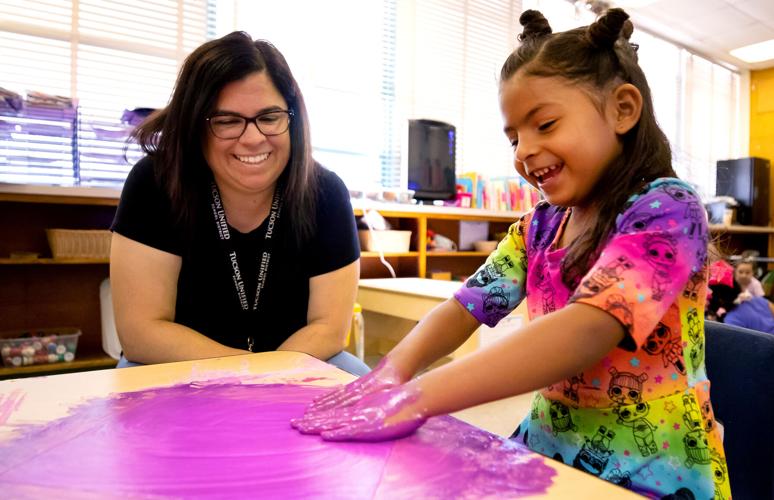
Preschoolers learn and play during Holly Davis's preschool class at Annie W. Kellond Elementary School in Tucson, Ariz. on May 23, 2022. Davis, along with assistant teacher Bethany Lehane, teach the only preschool class at Annie W. Kellond Elementary School that is offered to low-income families through Pima County's Early Education Program.
The Pima County Board of Supervisors voted to begin the early education program in May 2021 with the goal of increasing the number of 3- to 5-year-olds enrolled in early childhood programs while creating more quality preschools for them to attend.
Market rates for a full-day preschool tuition average between $7,920 and $9,240 a year in the region, according to the county. Although research shows attending preschool often results in long-term benefits for a child, the high cost can pose a significant barrier.
The PEEPS initiative started with a $10 million investment of general fund dollars to pay for new preschool classes for the first school year in August 2021. After receipt of American Rescue Plan dollars, the board decided to devote $30.2 million of the federal funding to run the program for three years.
The program has also seen investment from local jurisdictions sponsoring classes within their school districts. The city of Tucson has put $1 million into the program for one year, Marana has contributed $274,345 for two years and Oro Valley has contributed $100,00 for three years of the program.
The county’s PEEPS program provides early education in a variety of ways, including funding preschool classes at local school districts and further subsidizing existing early childcare programs.
The program served 685 children across the county as of its latest quarterly report analyzing results up to March 31. The county plans to reimburse about $6.2 million to childcare providers for the first year of operations.
To qualify for a PEEPS scholarship, a family must receive an income at or below 200% of the Federal Poverty Level, which is currently $53,000 for a family of four.
While the pandemic has exacerbated staffing issues, and subsequently enrollment in the program’s first year of implementation, plans are in the works to use federal dollars, and eventually property taxes, to grow access to early child care programs long term.
“It’s been a great experience, and they learned a lot in the short amount of time that we’ve had them,” Davis, the PEEPS preschool teacher at Kellond Elementary said. “Some parents, their kids wouldn’t have been able to go to preschool without this opportunity.”

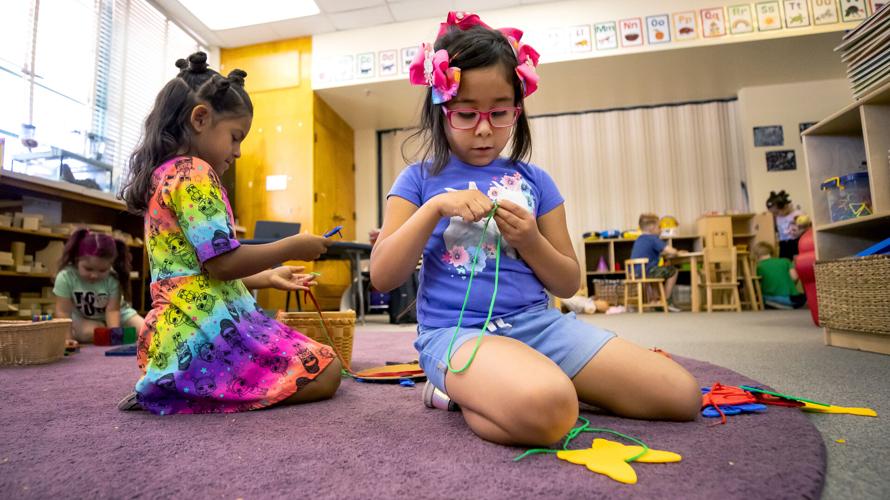
Dyani Valenica, 5, right, and Molly Gomez, 5, play with some string during Holly Davis' preschool class at Annie W. Kellond Elementary School.
PEEPS’ first year
Early childhood education advocates have long pushed for lowering barriers to preschool education in Pima County.
In 2017, advocates put forth a funding plan that would have increased the city’s sales tax by a half-cent to pay for preschool subsidies, but Tucson voters turned down the ballot initiative called Strong Start Tucson.
“Almost everyone said, ‘Yes, we think this is an important thing to do, but we don’t like that particular arrangement,’” said Penelope Jacks, who was part of the coalition pushing for the ballot measure.
Jacks, co-chair of Preschool Promise, a coalition of Pima County residents calling for more high-quality preschool classes across the region, said the group continued advocating with the county to get their mission “across the finish line.”
“We are totally advocates for the (PEEPS) program,” she said. “We are thrilled with the public schools having stepped up and lots of kids are attending.”
In its first year, the PEEPS program has funded 11 preschool classes across six local school districts. The program paid $6,600 per child.
The starting goal of the PEEPS program was to serve 1,200 children in year one, but low staffing and pandemic-induced classroom closures stymied that goal.
The average preschool teacher in Arizona made an average wage of $14 per hour, or a yearly salary of $32,930 as of May 2021, according to the Bureau of Labor Statistics.
“The low salary issue has been an issue for a long time prior to COVID. For decades this has been an underfunded industry,” said Nicole Fyffe, the assistant to the county administrator who has worked on the program since its inception. “But with COVID, it became even worse because teachers are being underpaid. Why on earth would they want to go into the classroom during that time?”
The program saw several classroom closures in January and February as the Omicron variant spread, and the 3- to 5-year-old children attending PEEPS classes aren’t eligible for the COVID-19 vaccine.
“Some (child-care providers) spent more time closing in January of this year than they did the year and a half prior because Omicron really caused havoc for them,” Fyffe said. “We just need to get back up to where we were prior to COVID before we can start this large expansion.”

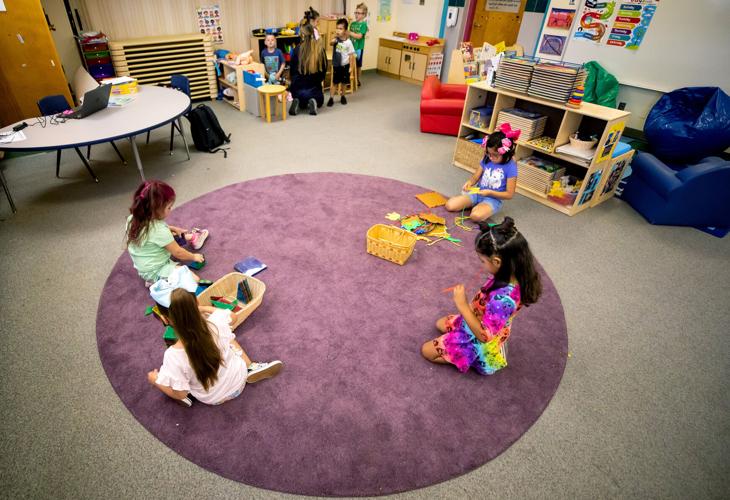
Preschoolers play with blocks, string and kitchen toys during preschool class at Annie W. Kellond Elementary School.
The Tucson Unified School District planned to open eight PEEPS classrooms at the beginning of the school year, but only opened three due to the “nationwide employment crisis,” according to Reem Kievit, TUSD’s director of community schools and preschool programs.
The impact of those three classrooms, however, has not gone unnoticed.
“It has been a huge blessing to reach those families who otherwise would not have access,” Kievit said. “I think every kid that ends up getting into one of these programs, whether it’s within our district or somewhere else in Pima County, is really something to celebrate.”
The county’s tackling the staffing issue by increasing reimbursement rates for districts’ PEEPS classes and requiring them to put the extra funding into teacher compensation. Fyffe said the districts will come back with a report on how they plan to use the funds to increase staff recruitment and retention.
The county plans to increase its per-child reimbursement rates for school districts to $8,641, a nearly 30% increase from the current rate. According to Kievit, TUSD plans to provide its PEEPS teachers’ retention bonuses for continuing into the next school year.
While demand for the PEEPS program slowed during the pandemic, Fyffe said enrollment is starting to ramp up for next school year.
TUSD is seeing plenty of applications for the four more PEEPS classrooms it plans to open next year, Kievit said. And through a pilot program of a sliding scale for scholarships, she hopes more interested families who don’t fully meet the program’s guidelines will be able to participate.
“We are seeing lots and lots of applications. However, believe it or not, a lot of those applications are families who don’t qualify and want to pay tuition,” she said.
At TUSD’s Schumaker Infant and Early Learning Center, 12 students are enrolled in the PEEPS class, but 19 who don’t financially qualify are on a waitlist, according to Kievit. Next year, the county’s starting a program with TUSD where those who make more than 200% of the national poverty level will pay tuition based on the percentage of their income above that amount.
The Board of Supervisors is set to approve TUSD’s new PEEPS contract on June 7, which allows families with income levels up to 300% of the federal poverty level to qualify for the program.
Expanding access
Local school districts aren’t the only way the PEEPS program provides preschool education. It also puts funds toward Head Start, a federal program that provides free early education programs for families with low incomes.
The county anticipates spending $1.1 million on extending half-day Head Start classes to full-day programs as it wraps up its first year. According to Erin Lyons, the CEO of the organization that runs Head Start, Child-Parent Centers, 205 children across 11 classrooms have benefitted from the extended day classes in Pima County.
“This is something that parents have expressed a need for. Instead of a half-day, to go to a longer day just for their own schedules,” Lyons said. “Based on research, it’s in the best interest of children to have a little bit longer than just four hours just for more in-depth curriculum work.”
The eligibility criteria for Head Start are more stringent than the PEEPS program, as qualifying families must make 100% or below of the federal poverty level.
“The county wants to make sure that families are accessing the program that they’re most eligible for. In other words, if they’re eligible for Head Start, that they’re taking advantage of that Head Start slot and not a PEEPS slot, so the PEEPS slot is open for another family,” Lyons said.
PEEPS also awarded 380 preschool scholarships at $7,300 each to different providers through First Things First, a statewide agency that provides childcare grants to low-income families. The program is funded through a tobacco tax and has a limited number of scholarships statewide, but the county has sponsored more to increase quality preschools in the region.

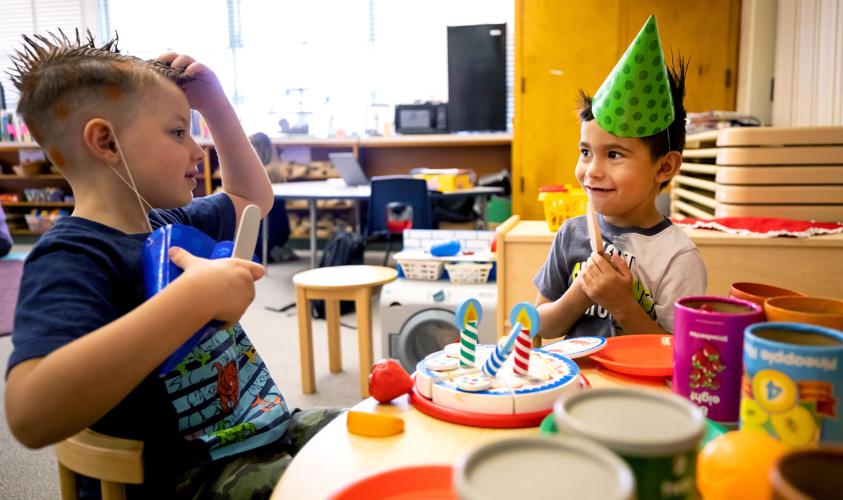
Samuel Barela, 4, right, sings "Happy Birthday" to Phineas Lee, 5, while playing in the play kitchen during class.
While increasing the number of children in high-quality programs is a key goal of the PEEPS program, it can’t be fulfilled without enough qualified centers for children to attend.
“With the money that we had, we probably could have funded maybe 1,200 kids,” Jacks from Preschool Promise said. “But because of the pandemic, so many childcare centers closed that there aren’t seats for all those children. So our focus is slightly switched to increasing capacity, making sure there are more high-quality seats for more children to attend.”
First Things First also rates preschools through its Quality First program based on key factors such as learning environments and teacher-child interactions.
The program coaches providers to help increase their quality ratings. As of the last PEEPS report, the program cleared the list of preschools waiting to receive a rating and added 15 high-quality learning programs to the county.
Providing additional funding for First Things First scholarships has allowed PEEPS to fund a mixed delivery system of preschools, which can include family home care providers and childcare centers in addition to public schools.
“A lot of those non-school district-based programs are open at alternative hours. So for parents who are working full days or working evenings, it’s unlikely that school district-based preschools are going to be able to serve those needs,” Fyffe said.
Long-term plans
As the first year of the PEEPS program subsides, county officials are planning ways to sustain the program over time.
While the county earmarked $30.2 million to run the program for three years using federal American Rescue Plan dollars, it’s planning to use property taxes to continue the program when those funds run out.
This year’s recommended county budget proposes a one-cent increase in secondary library property taxes to begin collecting a reserve to pay for PEEPS.
The county’s also hoping Tucson will help pay for its portion of the PEEPS classes in city limits. City Council is considering dedicating another $1 million as it budgets for the next fiscal year.
“Our budgets are moral documents and investing in our children’s future is a value we all share,” Mayor Regina Romero said in an email. “These resources expanded numerous high quality early education programs across three of our local school districts. I am recommending we continue to invest $1 million of our city’s budget to keep this momentum going.”
As participants look back at the first year of PEEPS, the resounding message is the impact the funding has made.
“I just want the world to know how important these programs are, how valuable they are, and how appreciative we are as a district for the funding,” Kievit said. “It’s so critical and crucial in order to provide that quality programming.”

