

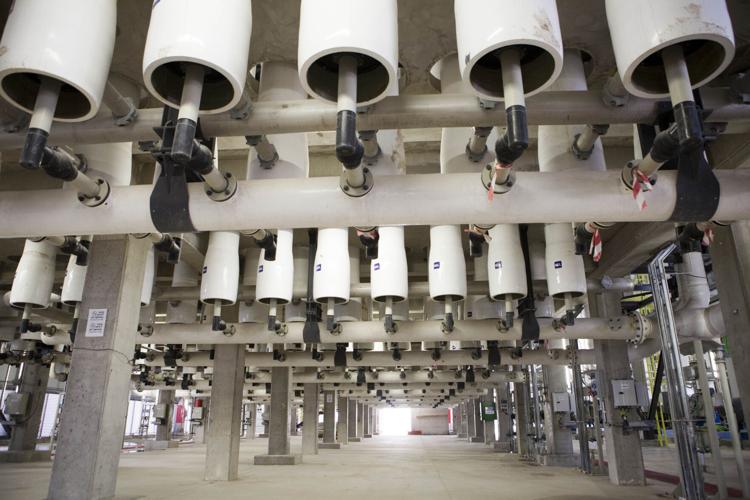




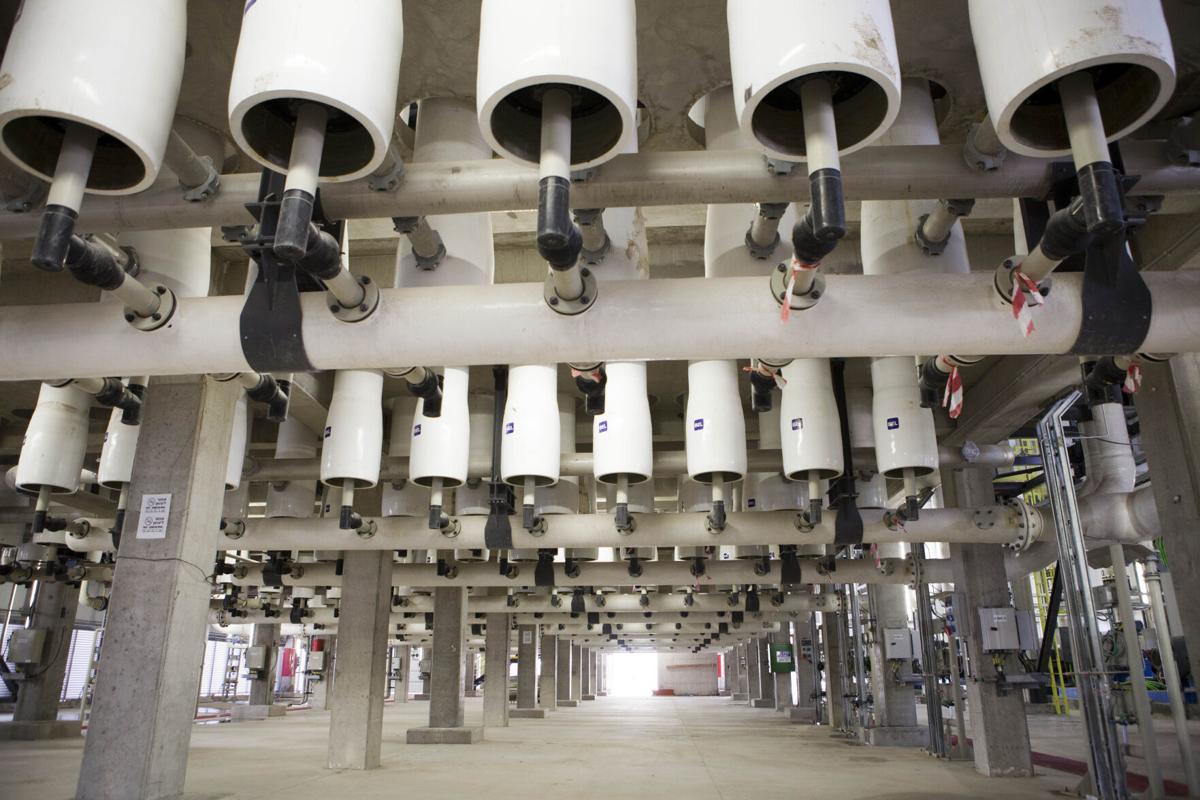
An Arizona state water agency has dropped a controversial arrangement it made with an Israeli firm to negotiate terms for building a $5.5 billion water desalination plant in Mexico.
Instead, the Water Infrastructure Finance Authority of Arizona will seek competitive bids for a company or other entity to build a water importation project — which may or may not be a desalination plant.
The authority has decided not to proceed with measures its governing board adopted in December to start the process of seeking a formal agreement with Israeli-based IDE Technologies to build a desalination plant along the Sea of Cortez on the Sonoran coast.
Israel-based IDE Technologies proposed building a 200-mile-long pipeline to bring desalted water from coastal Puerto Peñasco to central Arizona. Then, it would be deposited into the Central Arizona Project canal system for delivery to Tucson, Phoenix, Nogales and possibly other southern Arizona areas.
The authority board had agreed in December to first analyze the desalination proposal and then discuss with company officials a possible agreement to buy and import from 300,000 to 1 million acre-feet of desalinated water annually.
But the state agency decided during the first half of 2023 that before considering a specific project, it will seek bids starting in early 2024 from entities interested in building water-augmentation projects such as a desalination plant, pipelines to Arizona from the Missouri or Mississippi rivers or another water importation proposal.
Before it does that, the authority first needs formal state approval of a new set of rules and guidelines for how it will judge and select projects. A package of proposed rules is now “sitting at the governor’s office,” awaiting approval, said Chuck Podolak, the authority’s executive director.
“The (authority) board wants to see a competitive process, and that doesn’t leave room for dealing with an unsolicited proposal outside of the rules established for such a process,” Chelsea McGuire, an authority spokeswoman, told the Star.
“The board’s direction to me is very very clear: create one or more projects to import water and do a competitive process,” Podolak said.
Widespread criticism for original plan
The authority, commonly known as WIFA, changed its stance in the face of stinging criticism of its board’s December vote from a wide variety of people and interest groups. Legislators of both parties, environmentalists, Sonoran officials and other “public interest” organizations had decried they felt was a rush to judgment on the IDE proposal.
Now, the agency officials’ change of heart will take the focus off the past, hurried process and put it on the tough issues to be addressed with a water-importation project. Those are led by the high cost of such a project, its energy use and its environmental impacts, particularly the disposal of highly saline wastewater into the ocean after the original salty water is purified in desalination.
Two critics from that time welcomed the agency’s changing stance, calling it a positive step to increase public confidence. But one critic, Sandy Bahr of the Sierra Club, said the group intends to keep fighting water importation, calling it an environmentally unsustainable practice.
The other critic, longtime water researcher and attorney Kathleen Ferris, said some form of water importation is inevitable, given what she sees as Arizona’s longtime posture of promoting and supporting growth.
Podolak said of importation, “I think it will happen. I think we will successfully import additional supplies. I believe we can make importation work.”
“They’re all fraught. They’re all expensive. I think it’s too soon to write off any of those,” Podolak said of the various water importation schemes that have previously been floated.
‘Urgency’ cited in board’s quick vote
The authority board’s vote in December to pursue IDE’s proposal came at a time when the authority had no policies for reviewing such ideas and had yet to appoint a new executive director. Podolak, was hired by the board a couple hours after it voted to give serious consideration to the IDE project.
Podolak is a former natural resources policy adviser to ex-U.S. Sen. Jeff Flake and former Gov. Doug Ducey. Most recently, he was director of rights and contracts for the quasi-public Phoenix utility the Salt River Project.
The criticism came because the board vote to negotiate with IDE came only a few days after many legislators and the general public had become aware of the proposal.
Board chairman David Beckham said at the time that the board needed to move quickly because the Arizona Commerce Authority Director, Sandra Watson, told him there was “urgency involved” to get the project moving. It turned out that much of the urgency stemmed from a desire by IDE officials to garner a sign of support from the board the day before company officials were to submit a formal proposal to the Bureau of Land Management for review because the pipeline was to run through some BLM land.
A few days after the board’s vote, the Commerce Authority told the Star, “The project is a game-changer for Arizona’s future, with the potential to deliver over 1 million acre-feet of water a year. The project has undergone numerous years of planning and preparation.”
But the board’s speedy action sparked suspicion among legislators and others that the arrangement smacked of a “backroom deal.” That was something legislative leaders had sought to avoid when they agreed in 2021 to spend up to $1 billion on building big water augmentation projects along with $200 million on water conservation projects.
Explaining the authority’s change of position, Podolak recently told the Star that when he was interviewing for the job with the governing board before IDE’s proposal was publicly known, “I made it clear we had to earn the trust of the public and the Legislature.”
“The existence of WIFA is not guaranteed,” he said. “If we didn’t do this in a straightforward, transparent, trust building way, this whole process could go for naught.”
“If IDE had not come in, I still think I would have run this organization the same way,” Podolak said.
But now, “we’re doing it in the shadow of the IDE proposal,” said Podolak, referring to the authority’s changed stance. “I think it means we’re extra aware of the public perception and the need to be transparent and thorough.”
While it would be inaccurate to say the authority reacted to public criticism last winter, “It made us do it under a microscope and injected a sense of skepticism in people who are watching us.”
Now, IDE’s “past engagement with us provides them no inside track,” Podolak said.
Jordan Rose, a Phoenix attorney who represented IDE as the authority board dealt with its proposal in December, didn’t return an email from the Star seeking comment on the board’s changed position.
Board members also felt vote rushed
Not only was the board affected by the public sentiment toward its speedy consideration of the IDE proposal last December, some board members agreed with the public’s view that the process was moving too fast, said board member Tim Thomure, who is a deputy Tucson city manager and former Tucson Water director.
“I don’t think that anyone from the board would disagree with the public view that this seems rushed and we don’t know the rules of the game,” Thomure told the Star. “How could the board act on this proposal? We’d barely been seated as a board. We didn’t have an executive director. We had no direct policies or procedures. We responded to what was solicited to us. We put it in on a path that would lead to it getting vetted.
“The WIFA board was more consistent with public opinion than what the public felt. The board members were in the same position as the public, with no prior knowledge of this proposal till the week it was submitted.”
Asked why the board would approve a plan to negotiate with IDE if he and other board member felt it was rushed, Thomure replied that the board had crafted what members thought was a path to acknowledge that proposal, “but not commit to anything and also to have the ability to consider it when the time was right.”
“It turns out out now it’s better to put it into a process for establishing all proposals. At the time, we felt it was important to act in some manner with regard to that proposal,” he said.
To augment, or sustain state’s water supply
“Now, I think the state of Arizona has a duty to heavily consider and perhaps invest in a large-scale water augmentation project, maybe this one or any number of different alternatives,” Thomure said. “I do think in Arizona’s future as a state, that there’s a need. I don’t think there is a crisis, but there is a need for augmentation.
He thinks the security of Arizona’s water supply is going to be threatened more and more in the future, due to impacts of climate change, he said.
“They will affect demand patterns in the state more and more over time,” he said. “As the climate gets hotter, the demand for water will go up. It could be true in agricultural sector and also would be true in the M&I (municipal and industrial) sector. The need for cooling will go up, therefore the demand for water will go up.”
But Bahr said about water importation that, “we’ve said for a long time we ought not to rob Peter to pay Paul.”
“That’s what these augmentation proposals are about: where can we swipe water and move it to Arizona and to fuel our unsustainable growth and unsustainable agriculture by it’s very nature,” said Bahr, director of the Sierra Club’s Grand Canyon chapter.
“We think the focus ought to be on how we can create a sustainable water future here in Arizona ,without pumping the groundwater dry and destroying our remaining flowing rivers, rather than how can we keep doing everything the same and just add water,” Bahr said.
“Let’s not think about changing sprawl development. Let’s not think about how we grow alfalfa in the desert. Just grow more water,” is how Bahr characterized the state’s current approach to water policy.
No ‘right’ to pollute water supplies
Ferris, the water researcher and attorney, said she has reservations about desalination because of its high cost and potential environmental impacts. But she said she thinks it’s inevitable because of state officials’ ongoing commitment to economic and population growth — an attitude she likened to a religious belief.
“That we must grow to keep our economy strong? Yes, you hear everyone saying it. It’s just become a real mantra,” said Ferris, a former Arizona Department of Water Resources Director who now is a researcher for Arizona State University’s Kyl Center for Water Policy.
One thing she said she believes is that those who will benefit from an augmentation project must pay for it, without additional government subsidies.
“It’s not the state’s responsibility. It’s up to the people who benefit from this project to pay for it,” said Ferris. She added that a Mexican desalination project shouldn’t be allowed unless it can be shown the brine wastewater left over after the process won’t damage the Sea of Cortez once it’s returned there.
“We don’t have the right to pollute other peoples water supplies for the benefit of growth. We have to be good neighbors, whether that neighbor is Mexico or California.”
Ferris’ Kyl Center colleague, senior research director Kathryn Sorensen, said she has concerns about the cost of water importation and said it doesn’t need to be looked at immediately. But it’s reasonable to look at all alternatives to see what’s available to meet the state’s ongoing water challenges, she said.
“Humans always do outlandish things. London literally paved over its rivers. Washington, D.C. paved its swamps. Why is that not outlandish? Humans are always manipulating the water cycle. I don’t think one form of manipulation is more outlandish than another form.”
Optimistic Arizona will find way to import water
Podolak, the water authority director, said he sees a “confluence of factors” making large-scale importation doable in Arizona.
“We have seen the regulatory feedback mechanism, from the 1980 Groundwater Management Act,” that led ADWR in June to stop allowing new subdivisions in Phoenix to be certified as having an assured water supply based on groundwater use, he said. The law requires that new subdivisions in urban areas prove they have a supply lasting 100 years.
“We’re serious about having long-term supplies in place before building,” he said. “Up until very recently, we hadn’t seen projects turned down, for assured water certificates.”
Plus, there’s the growing realization throughout the entire Colorado River Basin that the hydrology of the river’s current hydrology, now prone to serious water shortfalls, “doesn’t match the expectations that most people had of the Colorado River” in the past, he said.
“Until three to four years ago, we had this thing called excess water running down the CAP canal. We don’t have any excess water now,” Podolak said.
“I think that puts us in a place where we can put into place” a large scale importation project, he said.
On environmental issues, he said the authority will be “starting from scratch” on them in considering importation projects.
“Yes, all that has to be taken into account at the right time. It’s absolutely clear that a federal EIS (environmental impact statement) will be required. None of those can be done without an EIS. We can’t have a viable project until it can clear regulatory hurdles.”
He recently told the New York Times that “Desal in Mexico is a highly likely outcome for Arizona,” mission. He said whatever water project gets built “will seem crazy and ambitious — until it’s complete. And that’s our history in Arizona.”
He told the Star that his optimism is broader than that.
“I am optimistic that Arizona will successfully import new supplies, and at this point I am open minded as to the kind of project, the source of the water, and who our partners will be,” he said.

