


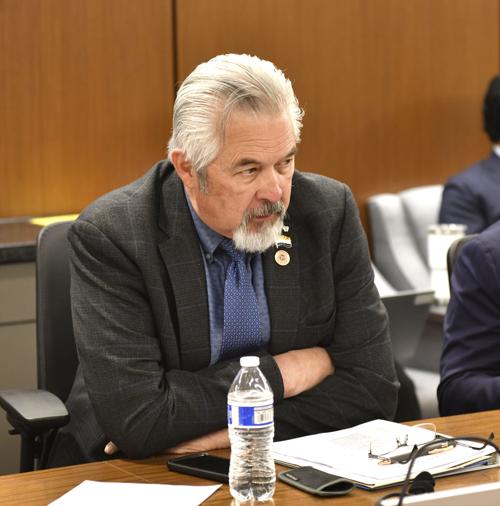
PHOENIX — The way Sen. Frank Carroll sees it, some share of air pollution in Arizona is due to emissions from other states and even other countries, including China.
So the Sun City West Republican wants to empower Attorney General Kris Mayes to sue any person from any other state or country whose emissions damage the air quality here.
Carroll contends the evidence is clear.
Exhibit No. 1, he said, is that during COVID the state was pretty much shut down, with traffic at a minimum. Yet he said air quality monitors showed no real decline in ozone levels.
Some of it may be coming from our West Coast neighbors, but the real culprits appear to be Mexico and China, Carroll said.
But potential lawsuits are just part of what’s in his Senate Bill 1128, which awaits a vote by the full Senate
Carroll also wants to direct the Arizona Department of Environmental Quality, which writes the implementation plans to bring Arizona into compliance with federal air quality laws, to now start considering the “best interests of the taxpayer’’ as well as what are called “transportation emissions that originate outside of this state.’’
That provision concerns Sen. Priya Sundareshan, D-Tucson, who said the legislation seems to be looking for an excuse for why air quality in many part of the states fails to meet standards.
“We can’t just be talking about who else is to blame,’’ she said when the measure was approved last week on a party-line vote by the Senate Committee on Natural Resources.
And Sen. Theresa Hatathlie, D-Tuba City, said Arizona has a record of creating environmental issues and then not dealing with them, such as in the mining of uranium, lithium and hydrogen. Her own father, she said, died of cancer from uranium poisoning.
“We’re so eager to point fingers elsewhere when there’s three fingers pointing right back to this government and this state,’’ Hatathlie said.
Sandy Bahr, president of the Grand Canyon Chapter of the Sierra Club, pointed out that Arizona has its own sources of pollution that may drift elsewhere. She said this measure could start a legal war of sorts, opening the door to other states filing suit against individuals and corporations here.
Carroll, however, said it’s important the state recognize that the air quality problems here are not all homemade — and the burden of dealing with them should not fall entirely on the state.
“Those emissions are moving on the air streams that pass over Arizona,’’ he said. It’s on record, Carroll said, saying there are figures from the U.S. Chamber of Commerce about ozone and particulate matter coming into this country.
He said it’s not just an Arizona problem, as areas around the Great Lakes are affected by Canadian sources.
“And, believe it or not, the Southeast experiences particulate drift that comes in from the African continent,’’ Carroll said.
The federal government makes Arizona and each state responsible for taking actions within their own borders to reduce pollution, even if the sources are elsewhere, he said. Carroll claims the figure is as high as 70% to 80%, “yet we’re held 100% responsible.’’
“The people here in Arizona are suffering financially and affecting our growth because we’re forced to deal with something that we’ve got no control over,’’ he said. He said that includes everything from penalties for violating the standards in the Federal Clean Air Act, to health-care costs often picked up by employers.
Greg Blackie, lobbyist for the Arizona Free Enterprise Club, said that’s potentially just the beginning. He said the Maricopa Association of Governments, which is responsible for regional planning, came up with a series of options several years ago to reduce pollution. Blackie said these ranged from banning gasoline-powered cars and even gas-powered lawn mowers, steps he said “are not in the best interest of the taxpayers or residents.’’
But Blackie said his organization considers the part of the bill empowering Mayes to sue out-of-state and out-of-country polluters is a bad idea.
Instead, he told lawmakers at the hearing that Arizona should be working with other states. And the target would be the federal Environmental Protection Agency, he said.
“The EPA has created the problem,’’ he said, by not allowing states to exclude interstate pollution when determining if they comply with the Clean Air Act.
Krista Osterberg, a lobbyist with ADEQ, said there already are provisions in the federal law that allow states to account for pollution that originates from other countries. But she said it’s not that simple.
“You need to be able to demonstrate specifically that the area would be in attainment if not for the international transport,’’ Osterberg said. She said it would be a “challenge’’ for the state to prove that any air quality violations here would not have occurred had there been no pollution from China, Mexico or other countries.
And there’s a more practical question: Who, exactly, would the attorney general sue if she thinks Arizona is being affected by the emissions of another country?
Carroll acknowledged that part of the legislation may need work. He said it might be preferable for Arizona to join with other states to force the EPA, with its federal reach, to take action against a foreign nation.
“The idea is to get all the states together,’’ Carroll said.
There’s another potential issue with the bill, unrelated to the right of the attorney general to sue. It requires ADEQ, when crafting the plan for the state to comply with air quality standards, to consider “the effects of solar radiation and any associated heat increases.’’
But Osterberg pointed out the Legislature enacted a law in 2008 specifically forbidding any state agency from adopting or regulating “greenhouse gases.’’ She said that could create a legal obstacle to ADEQ trying to determine how much these gases affect Arizona’s ability to comply with air quality standards.
Tucson's Top Stories: February 3 Get your morning recap of today's local news and read the full stories here: tucne.ws/morning

