


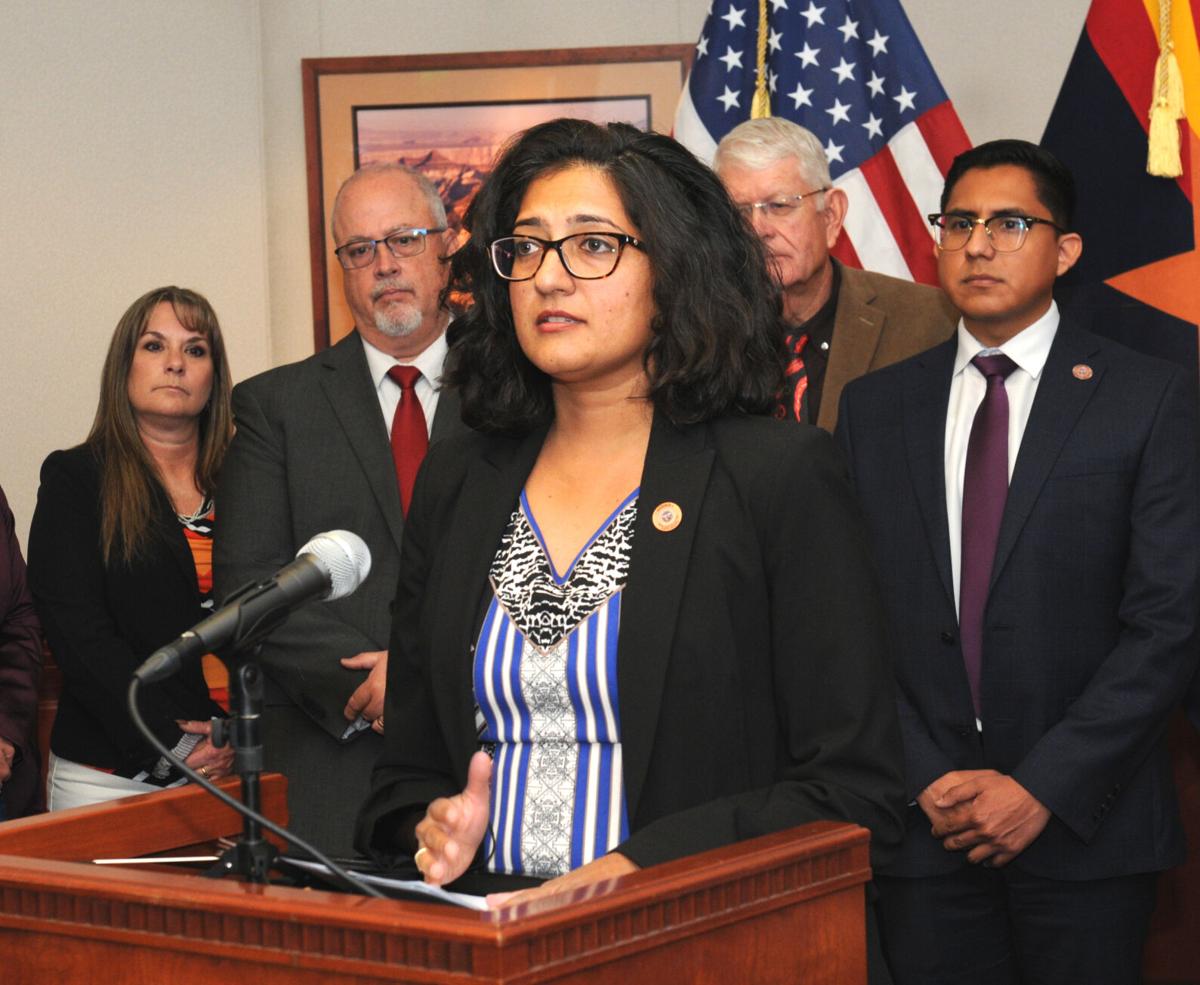
PHOENIX — Backed by elected officials from rural areas, Democratic lawmakers unveiled a plan they say would provide protections against groundwater drying up.
The proposed legislation would create five new “rural groundwater management areas’’ where members of local councils could set limits on new pumping. Residents of other areas of the state also could establish their own RGMAs.
Senate Bill 1457 and House Bill 2714 also contain provisions for voluntary water conservation.
Senate Minority Leader Priya Sundareshan, a Tucson Democrat, acknowledged that a similar plan last year went nowhere in the Republican-controlled Legislature. But Republicans, who advanced their own plan last year to protect agricultural interests, had no better luck in coming up with a deal acceptable to a majority of lawmakers.
What’s different this year is there appears to be a sense of urgency, particularly for elected officials of the affected areas, which are largely Republican. They say that unless something is done, and soon, there will be no coming back
Travis Lingenfelter, chairman of the Mohave County Board of Supervisors, says that’s true in the Hualapai Basin on which Kingman sits — one of the areas currently with no regulations on who can pump groundwater and how much.
“We’ve had Saudi, United Arab Emirates and central California corporations who are no longer permitted to over-extract groundwater from where they are from,’’ he said. “They’ve collectively purchased over 78,000 acres in the Hualapai Valley basin and are currently cultivating 16,500 of those acres for export agriculture.’’
Lingenfelter said they have collectively drilled more than 100 wells exempt from regulation, with 16 of those capable of pumping between 3,000 and 3,500 gallons per minute. A single well with a 3,500 gpm capacity can extract more than 4 millions of groundwater a day.
Those wells are larger than anything owned by Kingman.
“These entities are pumping water at an unsustainable scale,’’ Lingenfelter said, saying users extract 30,000 more acre-feet of water a year than is recharged.
An acre-foot of water is about 326,000 gallons and considered capable of supporting two to three families a year.
Willcox Mayor Greg Hancock said the problem is already here, as wells of individual homeowners are going dry and the ground is collapsing as there is “a race to the bottom to deepen wells.’’
And Prescott Mayor Phil Goode, in lending his support for the Democratic plan, urged lawmakers to avoid making this political.
“I am a conservative, active Republican,’’ he said. “But this issue is not a partisan issue. Last time I checked, there wasn’t Democratic water and Republican water.’’
This measure would allow rural supervisors to “control their growth, control their future, and be able to have a broad policy that protects a balance of interests between business development, agriculture and rural communities’ ability to provide future water for current needs and future needs,” Goode said.
When the state’s historic 1980 Groundwater Act was passed, to address the overdraft in five urban areas, “active management areas’’ were created in Tucson, Pinal, Santa Cruz, Phoenix and Prescott, with requirements to curb pumping.
But the bipartisan plan left the rest of the state unregulated.
That gap came into sharp focus when Fondomonte, a Saudi-owned company, bought and leased large tracts of land in the Ranegras Plain in La Paz County to grow alfalfa to be shipped back to feed dairy cattle in the home country.
They did that because Saudi Arabia prohibits such farming in its desert. But Arizona has no regulations in the area.
La Paz County Supervisor Holly Irwin said there’s nothing in the legislation to stop that. “It’s private property,’’ she said. “They’re there. They bought the property.’’
But she said this plan would keep the problem of groundwater depletion from getting worse.
“This will prevent any future massive or big water user to be able to come in and do this type of operation,’’ Irwin said, as that basin would be one of the five that would be formed automatically into a rural groundwater management area.
“We need the local control, which has been lacking for years,’’ she said. “We need to be able to decide what’s going to happen within their own counties and put something together from a local perspective.’’
The other areas are in the Hualapai Valley — Lingerfelter’s concern — and in Gila Bend, San Simon and Willcox.
The Arizona Department of Water Resources, using a provision in the 1980 law, has imposed an AMA on the Willcox basin.
But Hancock, the Willcox mayor, said there are serious issues with the plan. As established, he said, it could restrict the ability of agricultural interests to grow.
“Wine is a big industry in Willcox,’’ Hancock said. “Under the AMA, they’re kind of stuck at where they’re at. There’s no room for growth.’’
By contrast, Hancock said, allowing residents to create a rural groundwater management district — something not now allowed — would be more flexible “and we might be able to grow our wine industry.’’
The question of local flexibility could be a sticking point.
Last year’s Republican plan would have created a complex legal and governmental process to allow designation of rural management districts. It would have allowed some mandatory conservation measures while protecting the rights of farms to pump groundwater.
That proved unacceptable to Democrats, who wanted a simpler process with fewer hurdles to create a district and to give council members more regulatory authority.
There also was a dispute over who should serve on each area’s water council, who would appoint them and whether they had to live within the area.
Sundareshan said this year’s bill is different in that it starts with the benefit of input from both sides. There have been compromises, she said, calling her bill and the mirror legislation sponsored by Rep. Chris Mathis, D-Tucson, “the starting point for rural groundwater legislation.’’
Much of the heavy lifting for Republicans and their allies will be by Rep. Gail Griffin. The Hereford Republican, who has championed various bills designed to deal with water supply, chairs the House Committee on Natural Resources, Energy and Water, through which any plan must pass.
Democratic Gov. Katie Hobbs said she met with Griffin on Wednesday.
“I would characterize that meeting as positive,’’ Hobbs said. “I don’t want to put words in the representative’s mouth. But I feel we both left the meeting with at least a basic agreement that something needs to happen this year.’’
Griffin would not comment on the meeting. She said she will read the 88-page bill before expressing any opinions.
Hobbs is exerting pressure on lawmakers to come to a deal.
“There is no denying that we are at a critical juncture at managing our water resources,’’ she said. “And it’s imperative that we take action right now (so) we have the water we need to thrive now and into the future.’’
That came with a warning. Hobbs said she will use the powers she has to act if lawmakers reject a plan. That power includes what she did through the Department of Water Resources to order creation of an active management area — the kind of control that Hancock said is too rigid.
Tucson's Top Stories: January 30 Get your morning recap of today's local news and read the full stories here: tucne.ws/morning

