



Nearly eight years ago, Ralph Score of eastern Cochise County was watering his trees when the water stopped pouring from his hose. He walked inside, turned on a faucet and only a trickle came out.
Three or four years later, fellow county resident Steven Edington heard an obnoxious, rumbling noise coming from his well, recalling it as “kind of like what you hear from an electric box when something is running but nothing is working.” Again, no water was coming from his fixtures, inside or outside his family home.
Their families now rely on water hauled to their homes near the unincorporated Sunsites community southwest of Willcox because of their dried-up wells. They’re among 909 residents in the Willcox area who recently signed petitions seeking a November vote on whether to bring in state regulation over groundwater pumping in their area, which has historically operated uncontrolled.
The petitions seek creation of a state-run Active Management Area in the Willcox groundwater basin to oversee and try to limit pumping.
The Cochise County elections and recorder’s offices will review the signatures to determine their validity.
The 909 signatures, 41% more than required under state law to put the measure on the ballot, were submitted to the elections office on March 18 by a group calling itself Arizona Water Defenders. The group continues gathering signatures aimed at forcing a separate vote on creating a water management area for the Douglas Basin, which lies just south of the Willcox Basin.
If enough of the current batch of signatures are determined to be valid, the County Board of Supervisors would have to decide by Aug. 30 to make the election call. County Elections Director Lisa Marra said she doesn’t know if the board has discretion on whether to call an election.
Those supporting an Active Management Area say it’s long overdue, that farmers there have had their way for too long, and that the groundwater supply can’t support the community much longer without regulation.
Others are more wary, fearful that controls over agricultural pumping will ultimately put many farmers out of business — a fear that a leading supporter of the proposal dismisses as nonsense.
Still others, including a few in the agriculture industry, are neutral for now, concerned about possible economic impacts of regulation, but also concerned about their community’s future if the water table keeps falling as it’s done for the last 80 years.
Unregulated rural pumping
The Willcox Basin covers 1,911 square miles, stretching from the Dragoon Mountains on the west to the Chiricahua and Dos Cabeza Mountains on the east, and from the Elfrida area on the south to a section of Graham County on the north.
Creation of a management area there would be a first for Arizona since the state enacted its pioneering Groundwater Management Act back in 1980. That law created five management areas including those for Tucson and Phoenix, but all centered on at least one urban area, unlike the rural Willcox Basin.
Rural Arizona was largely untouched by the groundwater law. But the law did allow the Arizona Department of Water Resources and voters in rural counties to create such management areas under certain circumstances.
Agricultural pumping has lowered the Willcox Basin’s aquifer by a range of 200 to 300 feet since 1940, a 2018 state study found.
Not only is groundwater pumping unregulated in rural areas across Arizona, the state doesn’t require metering of individual or business water use in them, unlike urban areas.
The ADWR study predicted overpumping could lower the aquifer up to 917 feet in the Willcox Basin by 2115 from 1940 levels. It concluded that currently, pumping exceeds natural replenishment of the aquifer by four times.
The study didn’t look at how many wells have dried up but anecdotal accounts have placed it at at least 100.
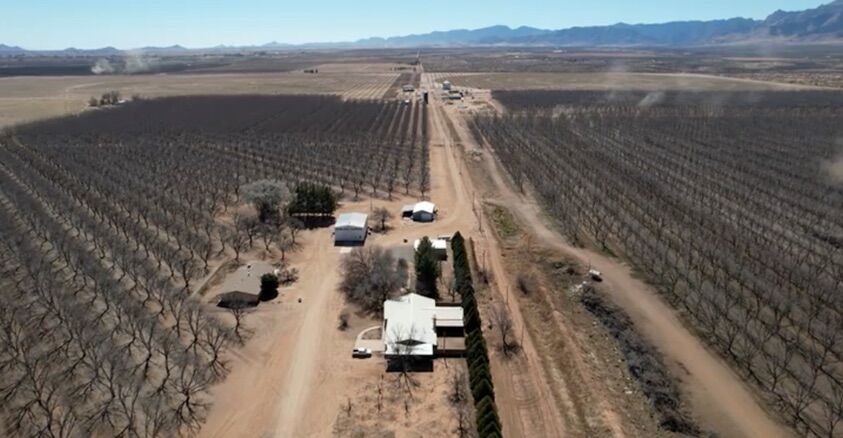
Overpumping has generally increased in the past few years, due to drilling of numerous deep to very deep irrigation wells, ranging from 1,000- to 2,000-plus-feet deep in a few cases, as more nut and alfalfa growers have moved in.
“This is an area where there is no other source of water,” said Rebekah Wilce, Arizona Water Defenders’ treasurer, in explaining why the group launched the initiative drive. “People can’t afford to drill new wells. Concern has been increasing the last 10 years or more. It’s really at a (fever) pitch now.
“The nitty-gritty is that no one wants to see agriculture go away. It’s really important and been here a long time, but to have common sense limitations on what those really high capacity wells can do seems really necessary,” Wilce added.
But the lack of an alternative water supply is one reason Cochise County Supervisor Peggy Judd, who says she’s neutral on the management area issue, believes many farmers will be opposed. That’s also why she is concerned about possible economic impacts.
While she agrees something must be done to relieve pumping’s pressure on the aquifer, she said she fears an Active Management Area could ultimately force farm production to be cut in half there.
“I’ve told people organizing for an AMA it will be challenging to get the votes, because of the large agricultural economy that we have here,” Judd said.
“Every one of our businesses in town depends on ag. We have a feed store, we have fertilizer companies and multiple irrigation companies. Our workers, our employers here are largely related to ag. Go to any restaurant in town — you have pickup trucks from the farms.
“It will be a challenge to carry out the AMA because the only way we can cut back our water use is through agriculture.
“We don’t have any other way to get water (to the region) and no other source of income,” Judd said.
Hauling water to homes
Ralph Score has lived in the Willcox Basin since 1999, in what’s known as the Stronghold area, lying about 3.5 miles south of U.S. 191.
He said his well, first drilled in 1958, had been deepened from 250 feet to 400 feet in 1985.
After it went dry, two efforts by different parties to revive it failed. He couldn’t deepen the well further for technical reasons related to the size of its piping and other infrastructure. He couldn’t afford to drill a new well at a cost of $40,000, he said.
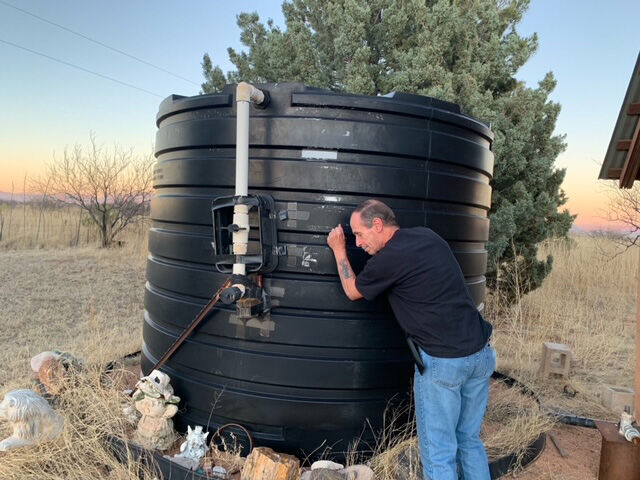
He now gets water hauled to his house from private wells lying 20 miles east of his house. He pays about 10 cents a gallon to have around 1,200 gallons brought every six weeks to his home, where he stores the water in a large, cylindrical tank.
Score has been able to afford hauling water because he works full-time for a telecommunications company. But he said he knows others for whom hauling water is a “big hit” because they’re retired, living on fixed incomes.
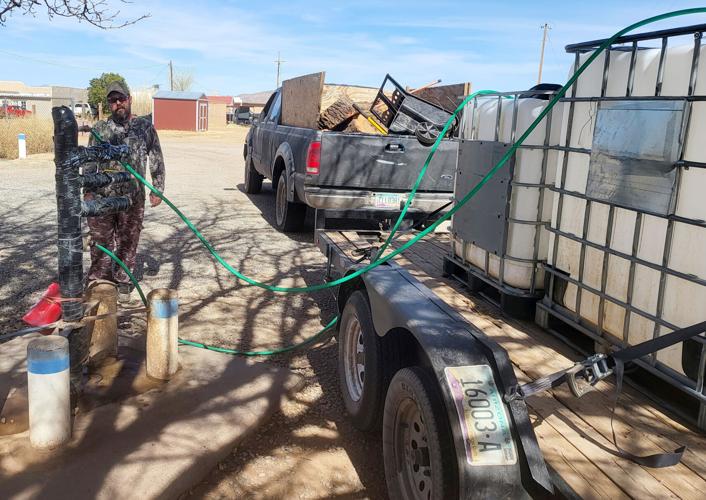
Steven Edington, who lives about a mile east of the Dragoon Mountains in the community of Pearce, said he pays $120 a month to haul water himself. He drives 10 miles round trip, twice weekly, to bring 1,200 gallons a week in a flatbed trailer to his home that he shares with two to three others at various times.
It “sucks” having to haul the water, said Edington, but he chose to live in that house because his grandparents had lived there. As the owner of a tree trimming and removal service for a year, he said he can’t afford to drill a new well now, although “I will someday be able to afford it” after his business gets further along.
“I have stock animals, a donkey, a horse, a cow and my cow just had a baby,” Edington said. “I have black tanks that gravity-feed to animals, using a hose. We don’t have enough water to grow a garden.”
“The problem is that anybody here can come drill a well and we have no control over it,” he said.
Score added, “I don’t blame farmers for being farmers. But when you are in an obvious drought, to me, when you’re buying a bunch of property and sinking wells and pumping like there’s no end, I don’t think they understand that this is not an endless supply.”
“Producing food, creating jobs”
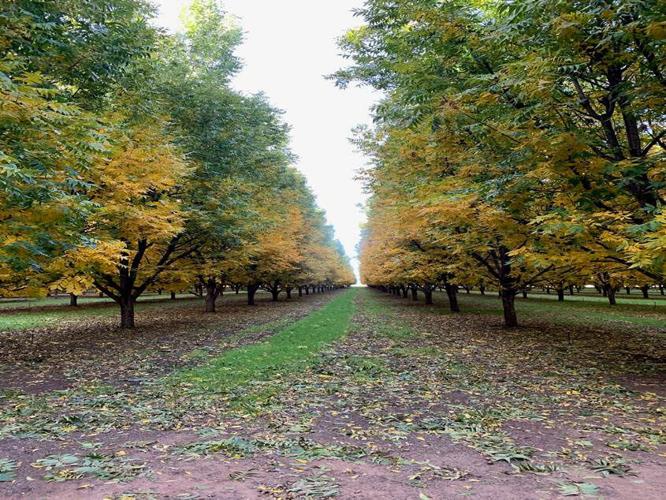
Nav Athwal is president of an asset management company that owns TriNut Farms, which grows mostly pecans on 1,000 acres in two areas of the Willcox Basin and on 800 acres in the Douglas Basin.
He splits his time between Southeast Arizona and California’s Central Valley, where his company has almond growing operations.
Having watched groundwater levels fall significantly in both states, he said he fully understands the need for regulation. But he said he doesn’t know what stance he’ll take on an Active Management Area in the Arizona basins.
In California, farmers live under the 2014 Sustainable Groundwater Management Law, which requires them to balance pumping with recharge of the aquifer by 2040.
In the Douglas Basin, new irrigation of land is restricted because the area is regulated as a state Irrigation Non-Expansion Area, but existing pumping is unregulated.
“All I know, with an AMA we will be monitoring our pumping. I understand the basic concept, but I don’t understand what does that mean for me, my employees, my fellow farmers,” Athwal said.
“I have 20 employees. If it (the management area) only restricts new pumping, I’m all for it. If it means you use 2 acre-feet when I need 4 acre-feet I’m going to oppose it. With no surface water here, I’m going to have to fire a lot of people and restructure my organization.”
He said he’s already employing subsurface drip irrigation on most of his Arizona orchards and using “a very efficient sprinkler system” on the rest, with no thirstier flood irrigation.
“I’m not wasting water today. I’m producing food, creating jobs for folks that work so they can provide for their families and aren’t spending time doing things that are bad for the community.
“If it’s going to take a lot of my productive farmland out and fallow that ground and impact my business, I’ll of course be part of the opposition. But I’m not sure, based on the details provided so far,” Athwal said.
Would ban new irrigation
The basin’s biggest employer and water user by far, Minnesota-based Riverview LLP, which owns two major dairies in the area, is staying neutral on the Active Management Area issue, said company spokesman Kevin Wulf. He didn’t respond to a request from the Star to elaborate on that viewpoint.
A former county supervisor, Richard Searle, who grows pistachios on 20 acres in the Cochise Stronghold area, spoke somewhat favorably about an Active Management Area.
“We have an issue. Is an AMA the right solution? It probably isn’t, but something needs to be done. It’s a step in the right direction, even though it’s not the best solution,” he said.
The Active Management Areas in Phoenix and Tucson were structured around the idea that Central Arizona Project water from the Colorado River would augment local groundwater supplies, he said.
“Well, there’s no way to augment the water in the Sulphur Springs Valley, so that’s probably not the right tool to fix the problem,” Searle said. “It will address the problem. Depending on what the goals are for an AMA, sooner or later it will have to be brought to sustainability, or a lot of water will have to be turned off.”
Another farming industry representative warned that if creation of a management area leads to the same goal of safe yield, or the balancing of pumping and recharge, that exists in Phoenix and Tucson, “it will kill the economy down here.”
Supporters of a water management area need to look at all the revenue to the county that is paid in taxes, he said.
“If they do safe yield, we’ll be relegated to probably 10% of our current farming. That won’t support Willcox. If that’s what they decide, fine,” the representative said.
“We could be jumping to conclusions. But ultimately that could happen. It may not be 2 years from now. It may be 5 years from now or 10 years from now. But ultimately it could happen.”
The representative spoke on condition of anonymity. He was involved in a 2015 effort to establish a less sweeping form of groundwater regulation in that area, which eventually died following a bitter controversy. “We got beat up so bad that last time, I’ll let others comment publicly now.”
But Kathleen Ferris, a prominent water researcher who was Arizona Department of Water Resources director in the mid-1980s, vehemently disputed the concern about putting existing farmers out of business as “just crap.”
Ferris, now chief counsel and former director of the Phoenix-based Arizona Municipal Water Users Association, strongly supports an Active Management Area for the Willcox Basin.
“These folks are hurting down there. The state, the government has done nothing for them,” Ferris said. “They are trying to take matters into their own hands and get some limits on groundwater pumping down there.”
There’s no guarantee a management area there would even have a goal to reach safe yield. A decision on goal-setting would be in the ADWR director’s hands, she said.
But even a safe yield goal wouldn’t lead to a quick shutdown of pumping, Ferris said. The only immediate result of creating an Active Management Area would be to ban new irrigation there, she said. The management areas that now exist were given until 2025 to achieve safe yield when the 1980 law was passed.
Existing farmers would be grandfathered in, although they would face conservation requirements, she said. The aim would be to put farmers onto more efficient irrigation methods, not shut them down, Ferris said.
“Unfortunately, it’s gotten to the point where so much groundwater has been pumped, that if it continues to be pumped at the same level it will be really hard to stop the overdraft,” Ferris said. “It could limit overpumping.
“They can’t stop all current cultivation but they can stop the incessant drumbeat of new land into cultivation.”

