
A tornado touched down on Tucson’s southeast side Tuesday night, officials say.
The tornado struck ground about 10:45 p.m. near South Kolb and East Valencia roads, said Julia Tetrault, a meteorologist with the National Weather Service in Tucson.
See what today's weather forecast looks like in Tucson.
Residents in the area alerted the weather service about extreme weather.
No major damage was reported and no one was injured, Tetrault said.
Crews from the weather service headed to the scene Wednesday afternoon to survey the area for damage, and to determine the severity of the storm.
Tetrault said they recorded what materials were damaged, how they were constructed and how strong the winds were to create the damage. They worked to determine how localized the tornado was, and how powerfully it ripped through its path.
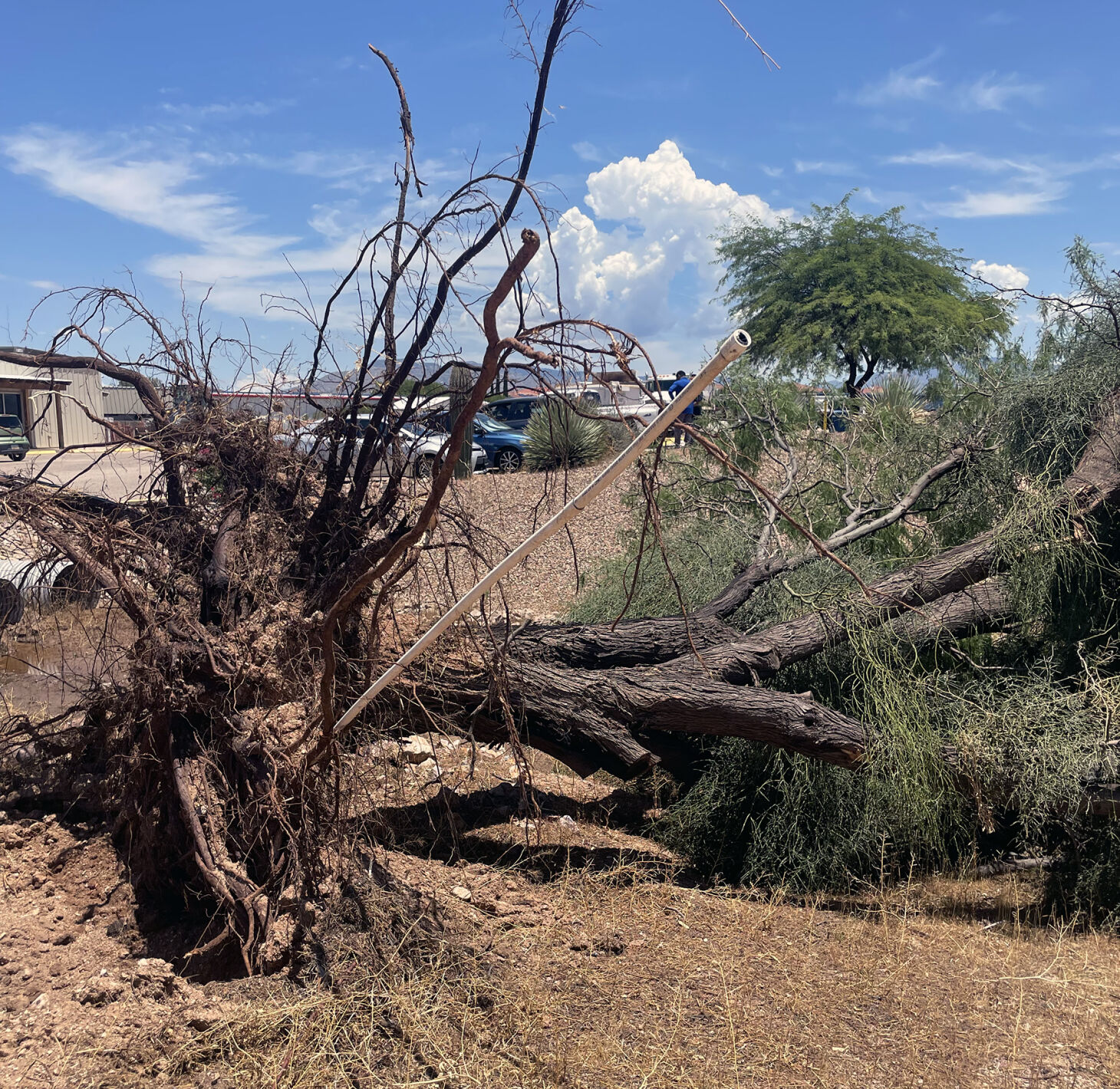
Among the damages cited: several downed and uprooted trees, uprooted metal poles, shingles ripped from roofs of homes in the area and a shipping container which was tossed about 40 feet in the air and went through a light fence with metal posts.
A bunch of black or dusty “bands” that extended from the sky to the ground on the horizon were seen, a Tucsonan said in a comment on X.
Numerous residents also said they were shocked to have a tornado so close to them with no warning on social media.
Questionable rotations were caught on radar around that time. It was very weak and didn’t persist very long, said meteorologist Dalton Van-Stratten.
The tornado rating was recorded Wednesday afternoon. It was classed as an EF 1 tornado, whose speed range is generally between 86 and 110 mph, said Van-Stratten. Its length was about 3.25 miles, he said.
While the strength of the tornado rotations were still being analyzed Wednesday, the weather service says the highest wind gusts at the airport — where Tucson’s official weather date is measured — was 42 mph, Van-Stratten said. Generally, wind gusts at 65 mph is the average speed recorded during tornados.
When looking to call for a tornado warning, we look for 35 mph of rotations which can be measured on the radar, said Van-Stratten. While caveats and radars are an estimate, we try to confirm that information with what can be seen on the ground visually, he said.
According to Van-Stratten, the weather conditions for a tornado include warm, moist air which can rise up and be steered into a rotation.
To detect a tornado, forecasters look for strong rotations low in the atmosphere to understand what’s happening on the ground, he said. And since low-level rotations aren’t always easily detectable, forecasters also often look for mid-level rotations too.
Tornados in the Tucson area are not a frequent occurrence, Tetrault said.
They occur here about once or twice a year during monsoon season, and they are often difficult to track and warn residents about in advance.