


After watching videos of a Delta Air Lines jet catch fire while landing and flip over on a Toronto runway, it's fair to wonder how anyone survived.
Aviation experts said it was not surprising that all 76 passengers and four crew members walked away from Monday's disaster, with 21 people suffering minor injuries and only one still hospitalized Wednesday. It's a credit, they said, to advances in plane design as well as a crew that flawlessly executed an evacuation plan.
"When I first saw (footage of) that aircraft upside down at the airport, I was like: 'How can that happen? And how can anybody survive that?'" said Michael McCormick, an assistant professor and program coordinator for air traffic management at Embry-Riddle Aeronautical University in Daytona Beach, Florida. "It was absolutely astounding to watch the people actually climbing out."

A Delta Air Lines plane lies upside down Tuesday at Toronto Pearson Airport.
But McCormick and others said the fact there were only minor injuries shows that passenger jet design and engineering greatly improved over time.
Fuel tanks are stored in the wings, so the wings are designed to break off in a crash to remove a seriously explosive hazard, he said. The tail-like fin of a plane known as a vertical stabilizer is frangible — or easily broken — meaning an aircraft that flips over can stay flat on the ground and passengers and crew are able to evacuate, he said.
"Aviation is and remains the safest form of transportation," McCormick said, adding it was no fluke 80 people were able to walk away from the Toronto crash. "That is because the safety of aviation is constantly improving."
Jeff Guzzetti, an airline safety consultant and a former investigator for the Federal Aviation Administration and the National Transportation Safety Board, said the seats and seat belts also helped prevent fatalities. He noted that passenger jet seats are designed to withstand impacts of up to 16 times the force of gravity and the seat belts restrained the passengers who were suspended upside down as the plane slid to a halt on the runway at Toronto Pearson International Airport.
"The odds of getting injured or killed in an commercial airline accident is far less than driving in your car," Guzzetti said.
Experts also credited the crew, who calmly and quickly shepherded many of the passengers off the plane before emergency crews arrived on the scene. Deborah Flint, CEO of Greater Toronto Airports Authority, called the flight crew "heroes," while their boss, Delta CEO Ed Bastian, praised their response as a "testament to the safety that's embedded in the systems."
"It's horrifying. When you look at the video you can imagine when I received the text minutes after it happened, hearing that there was a regional jet upside down on an active runway with 80 people on board, how I felt without knowing it, what was transpiring," Bastian said in an interview with CBS Mornings.
"But the reality is that safety is embedded into our system," he said. "Air travel in the United States is the safest form of transportation and travel there is. Period. And it's because we train for events like this."
Flight 4819 from Minneapolis to Toronto, operated by Delta subsidiary Endeavor Air, crashed about 2:30 p.m. Monday. Videos show the plane hitting the runway hard, bursting into flames then skidding along the tarmac and flipping over.
"All of a sudden, everything just kind of went sideways and the next thing I know, it's kind of a blink and I'm upside down still strapped in," Peter Carlson, who was traveling to Toronto for a paramedics conference, told CBC News.
Other videos appear to show passengers scrambling out of an upside-down cabin as workers assist them off the plane onto the snowy tarmac while emergency crews hose the aircraft with water.

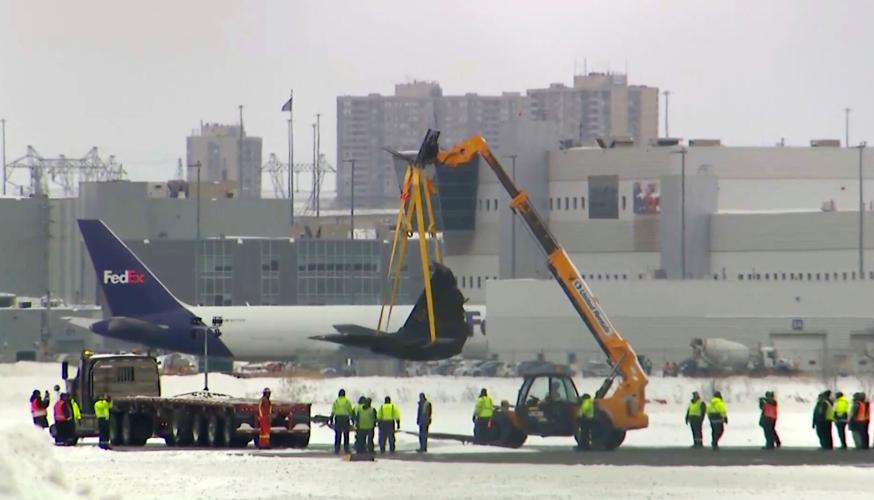
A crane lifts debris of a plane Wednesday at Toronto Pearson Airport.
Some passengers "who have been harmed as a result of the crash" retained the law firm Rochon Genova, according to Vincent Genova, head of the company's Aviation Litigation Group.
"Our clients, similar to many other passengers, suffered personal injuries of a serious nature that required hospital attention," Genova said in a statement. "With our involvement, we expect to reach a timely and fair resolution for these clients and others who reach out to us."
A Canadian investigator refused to comment on preliminary theories, though aviation experts told the Associated Press they likely will consider weather conditions, as well as the possibility of human error or an aircraft malfunction.
"At this point, it's far too early to say what the cause of this accident might be," Ken Webster, a senior investigator for the Transportation Safety Board of Canada, said in a video statement Tuesday. He said investigators will examine the wreckage and runway, and the cockpit voice and flight data recorders are being analyzed.



