

WASHINGTON — President Donald Trump said Saturday that he would raise the global tariff he wants to impose to 15%, up from 10% he announced a day earlier.
Trump said in a social media post that he made the decision "Based on a thorough, detailed, and complete review of the ridiculous, poorly written, and extraordinarily anti-American decision on Tariffs issued yesterday" by the U.S. Supreme Court.
After the court ruled 6-3 that he didn't have the emergency power to impose many sweeping tariffs, Trump signed an executive order Friday night that enabled him to bypass Congress and impose a 10% tax on imports from around the world. The catch is that those tariffs would be limited to just 150 days, unless they are extended legislatively.

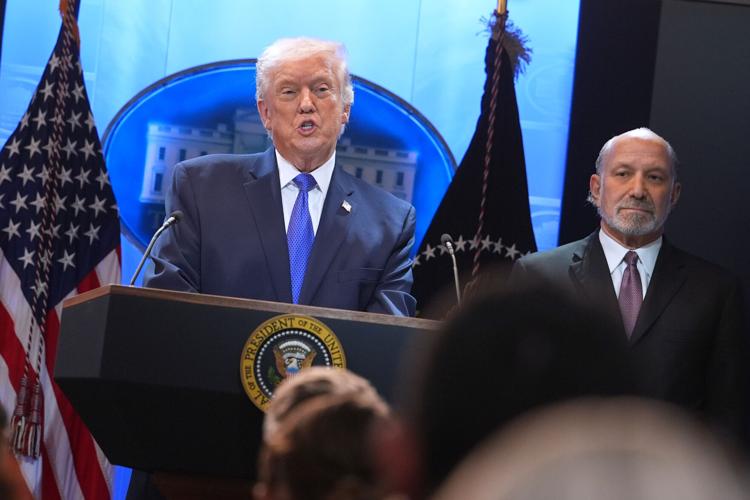
President Donald Trump speaks Friday during a news briefing at the White House in Washington, as Commerce Secretary Howard Lutnik looks on.
“During the next short number of months, the Trump Administration will determine and issue the new and legally permissible Tariffs, which will continue our extraordinarily successful process of Making America Great Again,” Trump wrote on his social media platform.
Under the order Trump signed Friday night, the 10% tariff was scheduled to take effect Tuesday. The White House did not immediately respond to a message inquiring when the president would sign an updated order.
The president said Friday he also would pursue tariffs through other sections of federal law that require an investigation by the Commerce Department.
Democrats spoke out quickly on Trump's new tariff threat. Democrats on the House Ways and Means Committee accused Trump of “pickpocketing the American people” with his newly announced higher tariff.
“A little over 24 hours after his tariffs were ruled illegal, he’s doing anything he can to make sure he can still jack up your costs,” they wrote on social media.

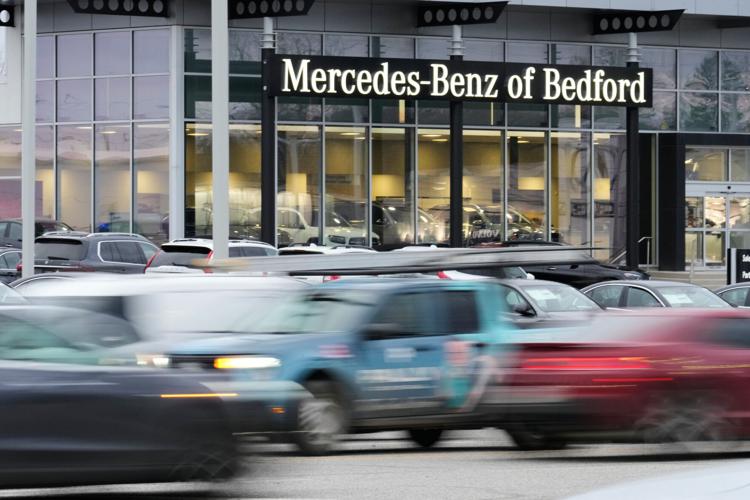
Cars drive by a Mercedes-Benz dealership Friday in Bedford, Ohio.
Global leaders, businesses pore over fallout of more US tariff shifts
It marked yet another shift in the U.S. tariff posture since Trump returned to office 13 months ago, upending dozens of trading relationships with the world's biggest economy.
Officials were going over the language of bilateral or multilateral deals struck with the U.S. in recent months, as business and governments around the world pored over the possible fallout from moves in Washington on the global economy — even as they braced for new swings.
South Korean trade officials scrambled Saturday to assess the effects of the ruling. The emergency meeting announced by the Trade Ministry in Seoul came as officials from South Korea to South America and beyond acknowledged tariffs would remain on some specific exports to the U.S., such as automobiles and steel, that aren't affected by the U.S. high court's decision.

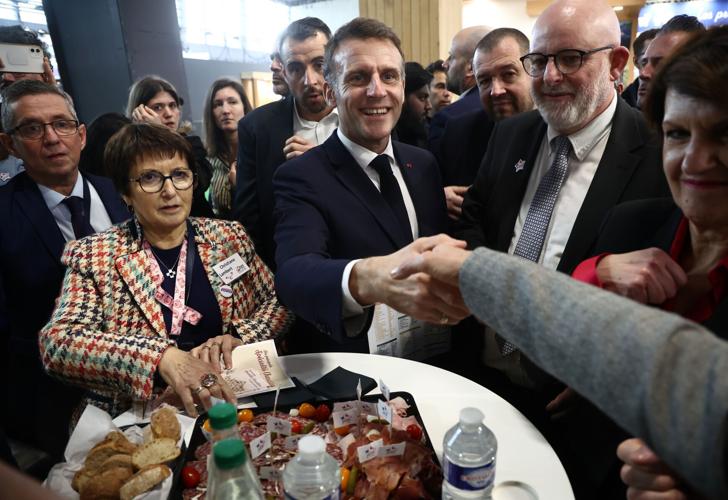
French President Emmanuel Macron, center, with Christiane Lambert, left, attend the International Agriculture Fair during the opening day Saturday in Paris.
In Paris, French President Emmanuel Macron hailed the checks and balances in the United States, praising the "rule of law" during a visit to a Paris agricultural fair: "It's a good thing to have powers and counter-powers in democracies. We should welcome that." However, he cautioned against any triumphalism.
"I note that President Trump, a few hours ago, said he had reworked some measures to introduce new tariffs, more limited ones, but applying to everyone," Macron said. "So we'll look closely at the exact consequences, what can be done, and we will adapt."

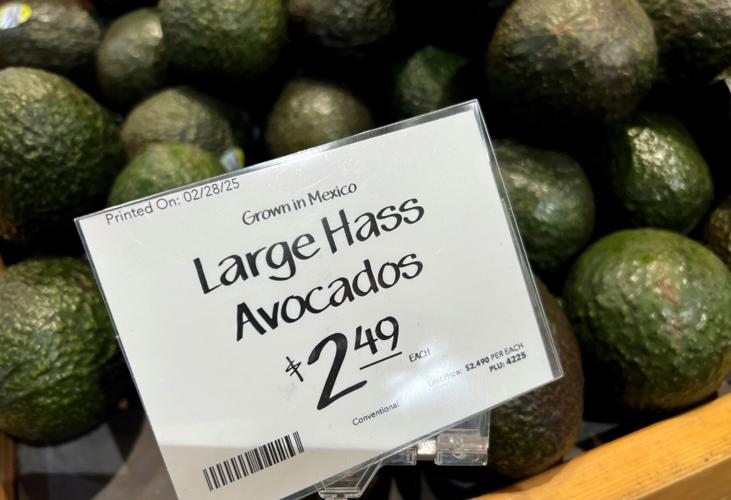
Avocados imported from Mexico are for sale March 5 in a supermarket in Miami.
Businesses brace south of the border — and beyond
Alluding to the new tariff threat, Sergio Bermúdez, head of an industrial parks company in Ciudad Juárez, Mexico, along the Texas border, said Trump "says a lot of things, and many of them aren't true. All of the businesses I know are analyzing, trying to figure out how it's going to affect them."
The effects could be felt especially in Juarez: Much of its economy depends on factories producing goods to export to consumers in the U.S., the result of decades of free trade between the U.S. and Mexico.
The policy shifts in the U.S. over the past year made many global business leaders cautious, as they struggled to forecast and saw investment take a hit.
Economy Secretary Marcelo Ebrard on Friday said Mexico was watching the tariffs with a "cool head," noting 85% of Mexico's exports face no tariff, largely because of the United States-Mexico-Canada agreement. He plans a trip to the U.S. to meet with economic officials next week.
CEO Alan Russell of Tecma, which helps American businesses set up operations in Mexico, saw his job grow increasingly complicated over the past year — his company's workload surged as much as fourfold as it grapples with new import requirements. He worries the latest U.S. moves will only make things more difficult.
"We wake up every day with new challenges. That word 'uncertainty' has been the greatest enemy," said Russell, who is American. "The difficult part has been not being clear what the rules are today or what they're going to be tomorrow."

The Supreme Court struck down President Donald Trump's far-reaching global tariffs on Friday, delivering a stinging loss that prompted a fierce attack on the court he helped shape. The ruling was significant because it marked "a rare instance" of the Supreme Court acting as "a check on executive authority", FRANCE 24's Douglas Herbert said. Herbert noted that the decision demonstrated the court's willingness to exercise its independence on certain issues, even though it had sided with Trump on previous cases.
Looking for a piece of possible tariff refunds
Some U.S. importers who paid what may turn out to be excess tariffs are looking for possible refunds — likely a very complex process — and some foreign companies may want to get their piece, too.
Bernd Lange, chairman of the European Parliament's trade committee, insisted on Deutschland radio that excess tariffs "must be refunded." He estimates German companies or their U.S. importers alone overpaid more than $118 billion.
Swissmem, a top technology industry association in Switzerland, hailed a "good decision" from the Supreme Court, writing on social media that its exports to the U.S. fell 18% in the fourth quarter alone — a period when Switzerland was facing much higher U.S. tariffs than most neighboring countries in Europe.
"The high tariffs have severely damaged the tech industry," Swissmem President Martin Hirzel said Friday on social media, while acknowledging the dust is far from settled.
Photos: A look at global trade

FILE - Swiss chocolate bars from the brands Favarger, Villars, Cailler and Swiss-Dream are photographed in a souvenir shop window on Thursday, April 10, 2025, in Geneva. (Martial Trezzini/Keystone via AP)

FILE - Watches in the Omega shop window at the Bahnhofsstrasse in Zuerich, Switzerland, on Thursday, April 10, 2025. (Til Buergy/Keystone via AP)

FILE - A view of Gruy're AOP cheese wheels in the Gruy're AOP maturing cellars of Fromco, part of the Emmi Group, on Tuesday, May 6, 2025 in Moudon in the canton of Vaud. (Jean-Christophe Bott/Keystone via AP)

FILE - An employee at On tidies up sports shoes from the On sports brand in the On store on Wednesday, Jan. 22, 2025, at On's headquarters in Zurich. (Gaetan Bally/Keystone via AP)

A container is loaded on a truck at the Civitavecchia Harbour, Italy, Thursday, Aug. 7, 2025. (AP Photo/Gregorio Borgia)

A man works at a leather factory at Dharavi in Mumbai, India, Thursday, Aug. 7, 2025. (AP Photo/Rajanish Kakade)

Vehicles for export are parked at a port in Pyeongtaek, South Korea, Thursday, Aug. 7, 2025. (AP Photo/Ahn Young-joon)

An Indian customer, reflected on a mirror, tries a gold necklace at a jewelry shop in Lucknow, India, Thursday, Aug. 7, 2025. (AP Photo/Rajesh Kumar Singh)

An employee sorts medicines in a medicine wholesale shop in Guwahati, India, Thursday, Aug. 7, 2025. (AP Photo/Anupam Nath)

Trucks navigate along stacks of containers at the Manila North Harbour Port in Manila, Philippines on Thursday, Aug. 7, 2025. (AP Photo/Aaron Favila)

A truck navigates along stacks of containers at the Manila North Harbour Port in Manila, Philippines on Thursday, Aug. 7, 2025. (AP Photo/Aaron Favila)

An employee holds U.S. dollar notes at a money changer in Jakarta, Indonesia, Thursday, Aug. 7, 2025. (AP Photo/Tatan Syuflana)

A man watches stock prices displayed on an electronic board at the Indonesia Stock Exchange in Jakarta, Indonesia, Thursday, Aug. 7, 2025. (AP Photo/Tatan Syuflana)

A crane works on stacks of containers at the Bangkok Port in Bangkok, Thailand, Wednesday, Aug. 6, 2025. (AP Photo/Sakchai Lalit)

A crane unloads a shipping container from a truck at IPC Container Terminal at Tanjung Priok Port in Jakarta, Indonesia, Wednesday, Aug. 6, 2025. (AP Photo/Achmad Ibrahim)

A worker waits for customers at Roopam Sarees, which sells clothing imported from India, on Thursday, July 31, 2025, in Berkeley, Calif. (AP Photo/Noah Berger)

Sen. Minority Leader Chuck Schumer of N.Y., speaks during a news conference on tariffs on Capitol Hill, Thursday, July 31, 2025, in Washington. (AP Photo/Mariam Zuhaib)

Cargo containers line a shipping terminal at the Port of Oakland on Thursday, July 31, 2025, in Oakland, Calif. (AP Photo/Noah Berger)

A worker assembles steel decking in the construction of a housing project, Thursday, July 31, 2025, in Portland, Maine. (AP Photo/Robert F. Bukaty)

A welder works on steel decking during construction of a housing project, Thursday, July 31, 2025, in Portland, Maine. (AP Photo/Robert F. Bukaty)

New cars are parked in a lot at the International Car Operators terminal in the Port of Zeebrugge, Belgium, Thursday, July 31, 2025. (AP Photo/Virginia Mayo)

The Atlantic Navigator II departs from the Port of Baltimore, Thursday, July 31, 2025, in Baltimore. (AP Photo/Stephanie Scarbrough)

A South Korean protester holds up a banner during a rally against U.S. President Donald Trump's tariffs policy on South Korea, near the U.S. Embassy in Seoul, South Korea, Wednesday, July 30, 2025. The signs at bottom read "We can't give you a penny." (AP Photo/Ahn Young-joon)

Workers prep bulk bags of sugar to be loaded on a container ship at the port of Santos, Brazil, Tuesday, July 29, 2025. (AP Photo/Andre Penner)

Workers load a truck with the last boxes filled with clothes from the empty Tzicc clothing factory following the threat of U.S.-imposed tariffs in Maseru, Lesotho, Tuesday, July 22, 2025. (AP Photo/Bram Janssen)

A sewing machine is covered by a sheet inside the empty Tzicc clothing factory following the threat of U.S.-imposed tariffs in Maseru, Lesotho, Tuesday, July 22, 2025. (AP Photo/Bram Janssen)

A woman works in a Celine shop, Monday, July 28, 2025 in Paris. (AP Photo/Thomas Padilla)

Customers and influencers try on new Korean perfume during a workshop at Senti Senti in New York on Friday, July 25, 2025. (AP Photo/Yuki Iwamura)

A worker tends to plants inside a greenhouse at the Veggie Prime tomato farm, which exports to the United States, in Ajuchitlan, Mexico, Wednesday, July 23, 2025. (AP Photo/Marco Ugarte)

FILE - President Donald Trump speaks during an event to announce new tariffs in the Rose Garden at the White House, on April 2, 2025, in Washington. (AP Photo/Mark Schiefelbein, File)

