

WASHINGTON — Americans’ trust in President Donald Trump to bolster the U.S. economy appears to be faltering, with a new poll showing that many people fear the country is being steered into a recession and that the president’s broad and haphazardly enforced tariffs will cause prices to rise.
Roughly half of U.S. adults say Trump’s trade policies will increase prices “a lot” and another 3 in 10 think prices could go up “somewhat,” according to the poll by The Associated Press-NORC Center for Public Affairs Research.
About half of Americans are “extremely” or “very” concerned about the possibility of the U.S. economy going into a recession in the next few months.
While skepticism about tariffs is increasing modestly, that doesn’t mean the public is automatically rejecting Trump or his approach to trade. However, the wariness could cause problems for a president who promised voters he could quickly fix inflation.
Three months into his second term, Trump’s handling of the economy and tariffs is showing up as a potential weakness. About 4 in 10 Americans approve of the way the Republican president is handling the economy and trade negotiations. That’s roughly in line with an AP-NORC poll conducted in March.
Matthew Wood, 41, said he’s waiting to see how the tariffs play out, but he’s feeling anxious.
“I’m not a huge fan of it, especially considering China and going back and forth with adjustments on both ends,” said Wood, who lives in West Liberty, Kentucky, and is unemployed. “Personally, it hasn’t affected me as of yet. But, generally, I don’t know how this is going to come to an end, especially with the big countries involved.”
Still, Wood said he changed his registration from Republican to independent, having been turned off by Trump’s attitude and deference to billionaire adviser Elon Musk. Wood voted for Trump last year and said he’s willing to give the president until the end of the year to deliver positive results on tariffs.
About half of U.S. adults, 52%, are against imposing tariffs on all goods brought into the U.S. from other countries. That’s up slightly from January, when a poll found that 46% were against tariffs. Driving that small shift largely appears to be adults under age 30 who didn’t previously have an opinion on tariffs.
Trump supporter Janice Manis, 63, said her only criticism of Trump on tariffs is that he put in a partial 90-day pause for trade negotiations with other countries.
“Actually, I think he shouldn’t have suspended it,” said Manis, a retired sheriff’s deputy from Del Rio, Texas. “Because now China is trying to manipulate all of these other countries to go against us, whereas if he would have left all the tariffs in play then these countries would be hit hard. But, oh, well, things happen.”
Not quite 100 days into Trump’s second term in the White House, people around the country are bracing for possible disruptions in how they spend, work and live. The U.S. economy remains solid for the moment with moderating inflation and a healthy 4.2% unemployment rate, yet measures such as consumer confidence have dropped sharply.
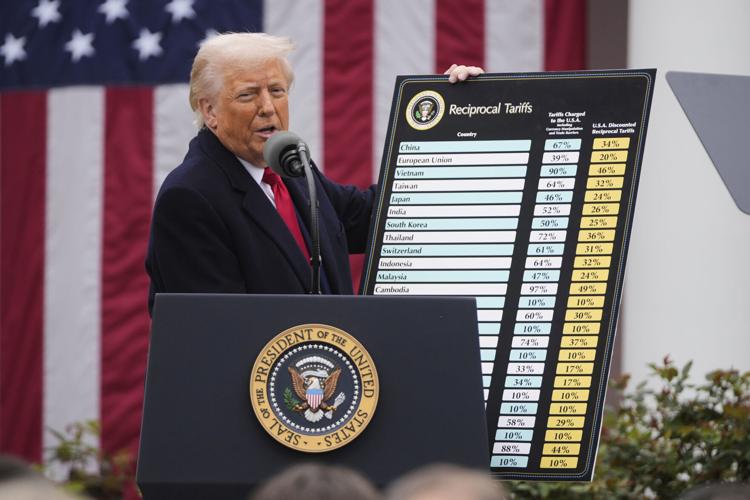
Trump has used executive actions to remold the global economy. He’s imposed hundreds of billions of dollars a year in new import taxes — albeit partially suspending some of them — launching a full-scale trade war against China and pledging to wrap up deals with dozen of other countries that are temporarily facing tariffs of 10%. Financial markets are swinging with every twist and turn from Trump’s tariff pronouncements.
Many Americans are not convinced this is the right approach. About 6 in 10 say Trump has “gone too far” when it comes to imposing new tariffs, according to the poll.
Stocks are down this year, while interest charges on U.S. government bonds have climbed in ways that could make it more costly to repay mortgages, auto loans and student debt. CEOs are scrapping their earnings guidance for investors and seeking exemptions from Trump’s tariffs, which hit allies such as Canada and even penguin-inhabited islands.
Trump seemed to recognize the drag from tariffs as he highlighted this week the possibility of a deal with China. Treasury Secretary Scott Bessent also said in a closed-door speech that the situation with China is not “sustainable.”
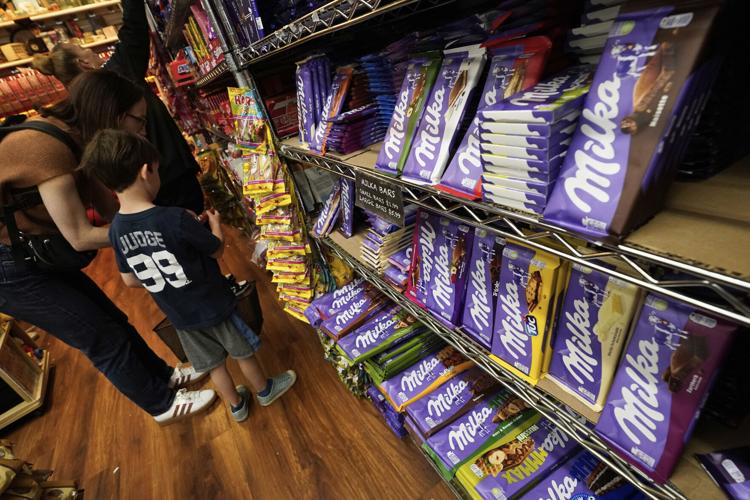
About 6 in 10 U.S. adults are “extremely” or “very” concerned about the cost of groceries in the next few months, while about half are highly concerned about the cost of big purchases, such as a car, cellphone or appliance. Less than half are highly concerned about their ability to purchase the goods they want — a sign of the economy’s resilience so far.
Retirement savings are a source of anxiety — about 4 in 10 Americans say their retirement savings are a “major source” of stress in their lives. But fewer — only about 2 in 10 — identify the stock market as a major source of anxiety.
“This whole tariff war is just a losing situation not only for the American people but everybody worldwide,” said Nicole Jones, 32. “It’s revenge — and everybody’s losing on it.”
The Englewood, Florida, resident voted last year for then-Vice President Kamala Harris, who replaced the incumbent president, Joe Biden, as the Democratic nominee. Jones hadn’t given much thought to tariffs until recently, and now, as an occupational therapy student, she also worries about losing her financial aid and facing high amounts of educational debt.
“Things are more expensive for us,” she said.
And most Americans still think the national economy is in a weak state.
The difference is that Republicans — who largely thought the economy was in bad shape when Biden was president — now feel more optimistic. But Democrats have become much more bleak about the country’s financial future.
“It wasn’t all sunshine and rainbows, but we were doing fine,” Jones, a Democratic voter, said about the economy before Trump’s policies went into effect.

