

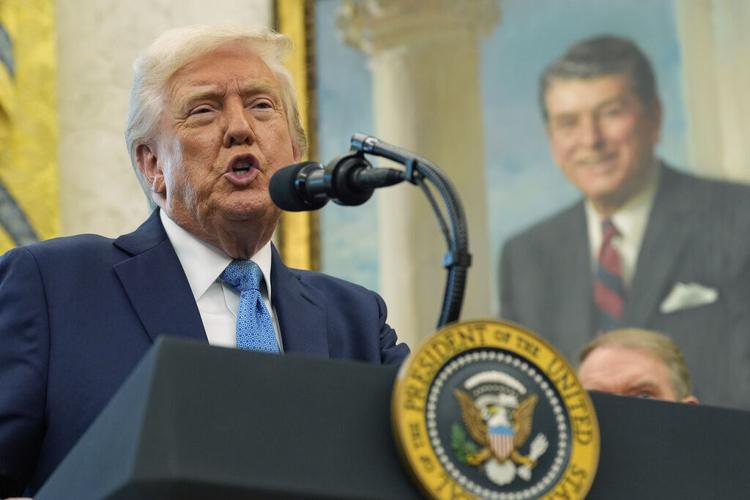
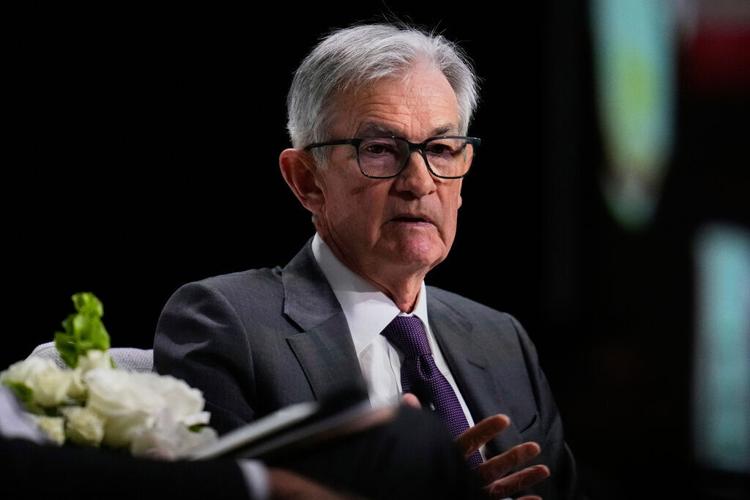
WASHINGTON — President Donald Trump said Tuesday he has no plans to fire Federal Reserve Chair Jerome Powell, just days after his statement that he would like to terminate the head of the U.S. central bank caused a stock market selloff.
“I have no intention of firing him,” Trump told reporters.
The U.S. president previously insinuated otherwise as he said he could fire Powell if he wanted to, having been frustrated by the Fed putting a pause on cuts to short-term interest rates.
Powell said Trump’s tariffs are creating uncertainty about slower growth and higher inflationary pressures, while the president maintains that inflationary worries are essentially non-existent.
The president maintains that energy and grocery prices are falling, so the Fed should cut its benchmark rates because inflation is no longer a threat to the U.S. economy. His remarks indicated that he still plans to use the bully pulpit to pressure a U.S. central bank that is committed to resisting political pressure as part of its mandate to stabilize prices and maximize employment.
Trump's frustration led him to post on social media last Thursday: “Powell’s termination cannot come fast enough!”
The Fed chair’s term ends in May 2026.
On Tuesday, Trump continued to air his grievances about Powell, even though he said the Fed chair would stay on the job despite the president's belief that inflation is no longer a problem.
“It’s all coming down,” Trump said. “The only thing that hasn’t come down, but hasn’t gone up much, are interest rates. And we think the Fed should lower the rate. We think that it’s a perfect time to lower the rate. And we’d like to see our chairman be early or on time, as opposed to late. Late’s not good.”
Trump again attacked Powell on Monday on his Truth Social account, saying, “there is virtually No Inflation.”
The comment built on a statement by Trump last week that said he believed he could fire Powell, a move that shook financial markets and frightened investors that interest rates might be subject to politics instead of economic fundamentals.
“If I want him out, he’ll be out of there real fast, believe me,” Trump said in the Oval Office last Thursday. “I’m not happy with him.”
The Fed held off on further reductions to its federal funds rate, which influences the money supply by setting the interest rate that banks can charge each other for overnight loans. That rate is effectively 4.33%, down a fully percentage point since last August as inflationary pressures appeared to ease.
The Fed initially raised that rate because of inflation spiking during Joe Biden’s presidency, a byproduct of the global economy recovering from the COVID-19 pandemic and higher energy and food prices after Russia invaded Ukraine in 2022.
But Powell also has been willing to challenge the president's trade policies. He said last week in a Chicago speech that Trump’s tariff policies would hurt the U.S. economy, a direct warning to a White House trying to sell the import taxes as a long-term positive for the country.
“The level of tariff increases announced so far is significantly larger than anticipated, and the same is likely to be true of the economic effects which will include higher inflation and slower growth,” Powell said last week at the Economic Club of Chicago.
U.S. stocks jumped in a widespread rally Tuesday, and other U.S. investments steadied a day after falling sharply on worries about President Donald Trump’s trade war and his attacks on the head of the Federal Reserve.
The S&P 500 climbed 2.5%. The Dow Jones Industrial Average rose 1,016 points, or 2.7%, and the Nasdaq composite gained 2.7%. All three indexes more than made up their big losses from the start of the week.
The value of the U.S. dollar also stabilized after sliding against the euro and other competitors, while longer-term Treasury yields held steadier as more calm returned to financial markets. Sharp, unusual moves for the dollar and for Treasurys recently raised worries that Trump’s policies are making investors more skeptical about U.S. investments’ reputation as the world’s safest.
The only prediction many Wall Street strategists are willing to make is that financial markets will likely continue to veer up and down as hopes rise and fall that Trump may negotiate deals with other countries to lower his tariffs. If no such deals come quickly enough, many investors expect the economy to fall into a recession.

