


NEW YORK — Most Americans aren't making end-of-year charitable giving plans, according to the results of a new AP-NORC poll, despite the fundraising appeals made by nonprofits that rely on donation surges in the calendar's final month to reach budget targets.
The survey, conducted in early December by The Associated Press-NORC Center for Public Affairs Research, found that about half of U.S. adults say they've already made their charitable contributions for 2025. Just 18% say they've donated and will donate again before the year is over. Only 6% report they haven't given yet but will do so by December's end. The rest, 30%, haven't donated and don't plan to.
Donors faced competing priorities this year. President Donald Trump's social services grant cuts, severe foreign aid rollbacks and November SNAP benefits freeze — plus natural disasters like Los Angeles' historically destructive wildfires — left no shortage of urgent causes in need of heightened support. Trump's tax and spending legislation offered an extra incentive to give, too; most tax filers will see a new charitable deduction of up to $1,000 for individuals and $2,000 for married couples.
But weaker income gains and steep price inflation meant that lower-income households had less money to redistribute. Other surveys have also found a yearslong decline in the number of individuals who give.

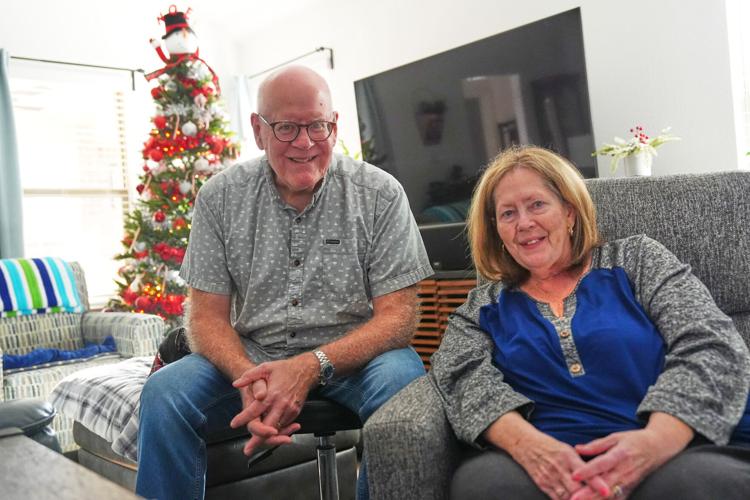
Chuck Dietrick, left, and his wife, Lori Dietrick, sit for a portrait at their home in Anna, Texas.
Few donate on GivingTuesday
Perhaps no day is more consequential for fundraisers than GivingTuesday, a celebration of generosity on the Tuesday after Thanksgiving. Americans donated an estimated $4 billion to nonprofits this most recent GivingTuesday.
But Americans were much more likely to make a Black Friday purchase than a GivingTuesday gift this year. Just under half say they bought something for Black Friday, according to the poll, compared to about 1 in 10 who say they donated to a charity for GivingTuesday.
Oakley Graham, a 32-year-old from Missouri, said his family has "definitely tightened the financial belt" in recent years. He and his wife are dealing with student loan debts now that the Trump administration suspended their repayment plan. Their two young children are always growing out of their clothes. It's good if there's anything left for savings.
"Not that I'm not willing to give here and there," he said. "But it seems like it's pretty tough to find the extra funds."

Checkout charity proves more popular
Another avenue for nudging Americans to give is more widely used, even if individual donations are small. The AP-NORC poll found that about 4 in 10 U.S. adults say they donated to a charity when checking out at a store this year.
Graham is among those who reported giving at the cash register. As an outdoorsy person, he said he is "always susceptible to giving for conservation," and that he likely rounded up once or twice at Bass Pro Shops this year.
"With the finances, I don't do a lot of buying these days. But a couple cents here or there is like — I can do that," he said. "It doesn't sound like much. But I know if everybody did it would make a difference."

Chuck Dietrick walks to the front door at his home in Anna, Texas, on Thursday.
One man's process for year-end donations
Chuck Dietrick, a 69-year-old architect from the Dallas-Forth Worth area, applies what he calls a "shotgun approach" as the year comes to a close.
He and his wife give monthly to Valley Hope, a nonprofit addiction services provider where their son did inpatient rehab. And then there are eight or so organizations that they support with end-of-the-year gifts.

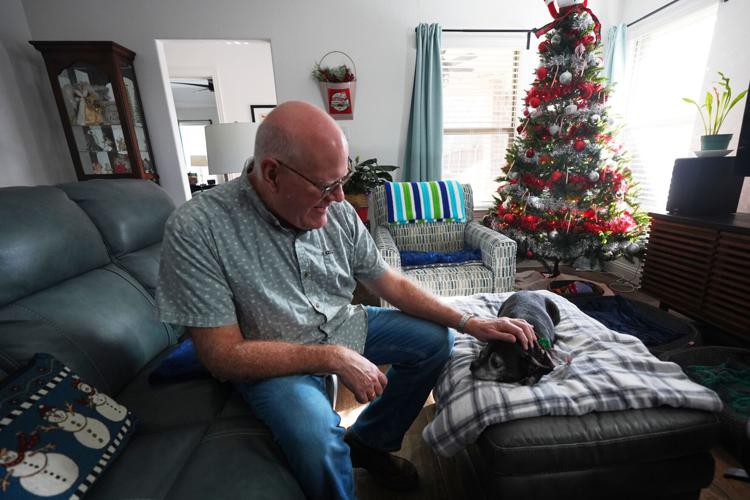
Chuck Dietrick sits with his dog at his home in Anna, Texas.
Dietrick estimates their household donated somewhere between $501 and $2,500, mostly to organizations that have touched their lives or those of their friends.
There's the hospice that cared for Dietrick's mother. He has relatives and friends who served in the military, so he also gives to the Disabled American Veterans and the Wounded Warrior Project.
"I would rather give a smaller amount of money to a variety of institutions that I care about rather than giving a big chunk of money to one," he explained.

Giving amid federal funding cuts, shutdown
Most 2025 donors say the amount they gave wasn't affected much by this year's federal funding cuts or the government shutdown, according to the AP-NORC poll, although about 3 in 10 say those situations did impact the charities they chose to support.
Jeannine Disviscour, a 63-year-old Baltimore teacher, is among donors who say the cuts prompted them to give more.
She estimates her household gave between $501 and $2,500, including support for National Public Radio. Congress eliminated $1.1 billion allocated to public broadcasting this summer, leaving hundreds of NPR stations with some sort of budget hole. She said she wanted to ensure journalism reached news deserts where residents have few media options.
Living in an area that is home to many refugees, Disviscour also donated her time and money to a local nonprofit that helps asylum-seekers and other forced migrants find food, shelter, clothing, transportation and language classes.
____
The AP-NORC poll of 1,146 adults was conducted Dec. 4-8 using a sample drawn from NORC's probability-based AmeriSpeak Panel, which is designed to be representative of the U.S. population. The margin of sampling error for adults overall is plus or minus 4 percentage points.


