


DEDHAM, Mass. — A jury found Karen Read not guilty of second-degree murder and manslaughter charges Wednesday in the 2022 death of her Boston police officer boyfriend, a case that attracted legions of true crime followers who erupted in cheers when word of the acquittal spread outside court.
The same jury found her guilty of a lesser charge of drunken driving. The jury handed down its decision after deliberating for at least 22 hours since June 13.
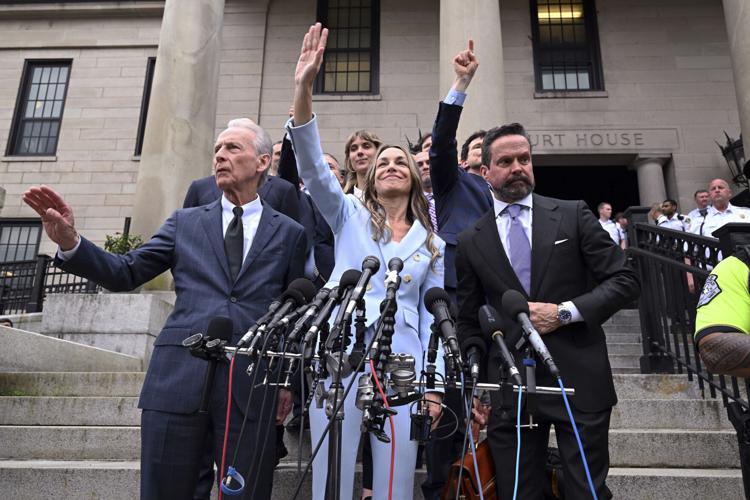
Cheers from the crowd outside could be heard in the courtroom as the verdict was read. With cheering supporters, Read departed the courthouse with her attorneys and family.
“No one has fought harder for justice for John O’Keefe than I have," Read said.

Supporters of Karen Read react Wednesday after she was found not guilty of second-degree murder in Dedham, Mass.
The verdict came nearly a year after a separate jury deadlocked over Read’s involvement in the January 2022 death of John O’Keefe and resulted in a judge declaring a mistrial.
It’s a huge victory for Read’s lawyers, who long asserted she was framed by police after dropping O’Keefe off at a party at the home of a fellow officer. Prosecutors argued the 45-year-old Read hit O’Keefe, 46, with her SUV before driving away, but the defense maintained O’Keefe was killed inside the home and later dragged outside.
Read faced charges of second-degree murder, manslaughter and leaving the scene outside Boston. A second-degree murder conviction would have carried a life sentence.
Read’s father, Bill Read, told reporters outside the courthouse that he felt relief and gave “tremendous thanks” to God when the verdict was read. “We need to get our life back together, and we will,” he said.
Asked why he thought the second trial’s outcome was different, he said “another year of information circulating in the public, and people are aware of what’s happened.”

Karen Read, center, waves to supporters Wednesday after she was found not guilty of second-degree murder in Dedham, Mass.
T.D. Floras of Nashua, New Hampshire, stood next to the barrier facing the court house after the jury’s verdict was read. She held her chorkie, Lucy, in her arms, and the dog wore a sign around her neck reading “Free Karen.” Floras said she is “beyond thrilled and excited” about the outcome.
“I would do that OUI probation for her myself,” she said. “It’s been a long-time coming, so let’s put this behind her now so she can have some peace in her life.”
Several witnesses in the case said Wednesday that their “hearts are with John and the entire O’Keefe family.” The witnesses who signed the statement included Jennifer McCabe, who was with Read and O’Keefe the night of his death, and Brian Albert, who owned the home where the party took place.
“While we may have more to say in the future, today we mourn with John’s family and lament the cruel reality that this prosecution was infected by lies and conspiracy theories spread by Karen Read, her defense team, and some in the media. The result is a devastating miscarriage of justice,” the statement said.
Much like during the first trial, attorneys spent months presenting their case, featuring hundreds of pieces of evidence and dozens of witnesses.
Read’s defense said O’Keefe was beaten, bitten by a dog, then left outside a home in the Boston suburb of Canton in a conspiracy orchestrated by the police that included planting evidence.
Prosecutors described Read as a scorned lover who chose to leave O’Keefe dying in the snow after striking him with her SUV outside the house party.

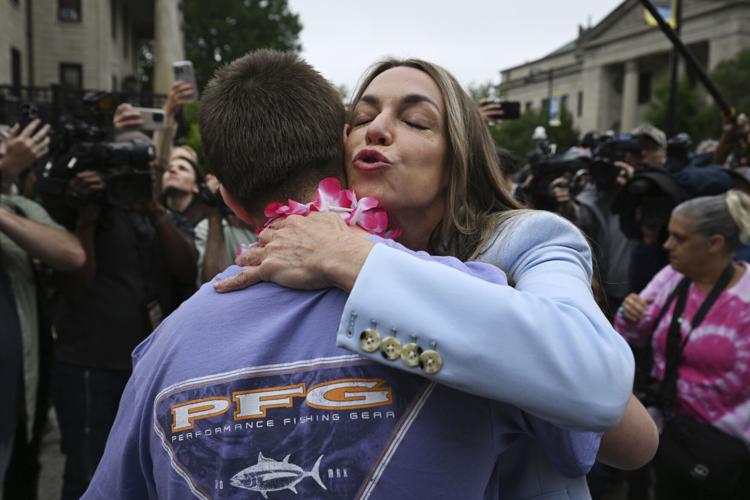
Karen Read embraces a supporter Wednesday as she leaves the courthouse at the start of the third day of jury deliberations in her trial at Norfolk Superior Court in Dedham, Mass.
It was state’s second attempt to convict Read. The first Read trial ended July 1 in a mistrial due to a hung jury.
A blogger who championed Read’s innocence and was charged with witness intimidation in connection with her case, said he was “overcome with emotion” after hearing the verdict.
“Two and a half years of this. It’s finally over. Karen Read’s free,” Aidan Kearney said. “Everything I did was worth it, and we finally have justice. We finally put this nightmare behind us.”
The state’s case was led by special prosecutor Hank Brennan, who called fewer witnesses than prosecutor Adam Lally, who ran the first trial against Read.
Describing O’Keefe as a “good man” who “helped people,” Brennan told jurors during closing arguments that O’Keefe needed help that night and the only person who could provide it was Read. Instead, she drove away in her SUV.
“She was drunk," he said. "She hit him and she left him to die."
Defense attorney Alan Jackson rejected the idea that there was a collision at all. He and the defense called forward expert witnesses who agreed.
“There is no evidence that John was hit by a car. None," Jackson said during closing arguments. "This case should be over right now, done, because there was no collision.”
Trump vs. the courts: Presidential attacks open new front in long battle
Trump vs. the courts: Presidential attacks open new front in long battle
Updated
On March 15, three planes carrying approximately 200 Venezuelan migrants left the U.S., bound for a mega-prison in El Salvador. The Trump administration justified the deportation by saying most of the men on the planes were members of the Tren de Aragua (TdA) criminal gang.
Lawyers for some of the men say their clients were misidentified as gang members, in many cases, because of tattoos unrelated to TdA. In one case, a lawyer says the tattoo may have been a reference to the logo for the popular Real Madrid soccer team.
None of the men had the opportunity to argue against the administration's assertion in court because they were deported under the Alien Enemies Act, which President Donald Trump had invoked on March 14. The act gives the government the power to expel foreigners from hostile nations during wartime or an invasion, without due process.
The U.S. is not at war with Venezuela or TdA, nor is the gang a country—one of several reasons federal judge James Boasberg ordered the planes to turn around on March 15. Boasberg concluded that the administration likely did not have the legal authority to make the deportations.
Despite the order, the planes landed, and the men were taken into the custody of the Salvadoran prison, complete with online taunting by Trump administration figures. The episode set off a legal and political firestorm over whether the administration had openly defied a federal court order, and what would come next if so.
"If anyone is being detained or removed based on the administration's assertion that it can do so without judicial review or due process," Jamal Greene, a law professor at Columbia, told The New York Times, "the president is asserting dictatorial power and 'constitutional crisis' doesn't capture the gravity of the situation."
There are about 1,700 federal judges in the U.S., and all are appointed by presidents and confirmed by the U.S. Senate—not elected, The Marshall Project explains. Trump and his allies have argued that it is, in effect, antidemocratic that any single judge, from any district, can overrule the will of the president on a national level.
Skepticism of the federal courts on these grounds is not a distinctly Republican or conservative preoccupation: In the aftermath of Dobbs v. Jackson Women's Health Organization, the 2022 Supreme Court decision that struck down Roe v. Wade, prominent Democrats also complained about the undemocratic nature of rulings by unelected judges. A few even made the case for defying judicial rulings they disagreed with.
More broadly, presidents have long jockeyed with the courts over power. Franklin D. Roosevelt's unrealized plan to expand the Supreme Court to up to 15 justices to add members sympathetic to his New Deal programs is just one memorable example.
However, Trump's attacks on the judiciary are unprecedented in some ways, especially the extent to which they've been directed at individual judges.
Trump has called Boasberg—who was first appointed to the Washington, D.C., bench by President George W. Bush—"a radical left lunatic" and called for his impeachment. Almost immediately, some Republican House members introduced articles of impeachment against Boasberg. The effort is unlikely to go far, as it would require support from Senate Democrats to convict. Still, some experts see it as an escalation in Trump's longstanding conflict with the judiciary. To date, no federal judge has ever been removed from office "because of dissatisfaction with his or her rulings," a former judge told NPR.
The personalized and agitated tenor around judges has some of them fearing for their personal safety and that of their families. That was true even before the recent controversy over the deportation flights.
Congressional Republicans are pursuing legislation that would prevent district courts from issuing sweeping national injunctions altogether. On Thursday, Trump also called for the Supreme Court to curtail the power of district court judges to issue national injunctions.
If either came to fruition, it would massively untether the administration from judicial checks. According to The Washington Post, there are 13 active cases where a federal judge paused or reversed a Trump administration policy. That means about once every four days since Trump's inauguration, a judge has concluded that the administration likely broke the law.
Trump officials have denied that they are defying the courts, and on March 19 "border czar" Tom Homan said that he will let the legal battle over the Alien Enemies Act play out before using it for more deportation flights. But at the same time, Boasberg has ruled that administration lawyers evaded some of his questions about the deportations or gave "woefully insufficient" answers.
If the Trump administration were to simply begin ignoring the courts, it's unclear what could be done to stop it. Federal court orders are generally enforced by the U.S. Marshals Service—an agency under the Department of Justice. As Vox's Ian Millhiser wrote this week: Trump could simply tell the U.S. attorney general to instruct marshals not to enforce court orders against his administration.
While Congress could impeach Trump if he blatantly ignores the law, that outcome is unlikely for the same partisan reasons that will probably save Boasberg from removal.
Still, some argue that the point isn't necessarily defiance—it may be just as much about the spectacle of defiance and punishment. In a post this week, historian Timothy Snyder opined that elements of the standoff seem designed more for public consumption than to achieve any discrete immigration enforcement goal.
"They are deliberately associating the law itself with people, the deportees, who they expect to be unpopular," Snyder wrote. "In this way they hope to get popular opinion on their side as they ignore a court order. But if they succeed in making an exception once, it becomes the rule."

This story was produced by The Marshall Project, a nonpartisan, nonprofit news organization that seeks to create and sustain a sense of national urgency about the U.S. criminal justice system, and reviewed and distributed by Stacker.

