

Over the past 18 years, officers at Maryland's Frederick County jail have asked thousands of inmates two standard questions: What country are you a citizen of? And where were you born?
If the answer was anything other than the United States, local officers deputized with special federal authority launched an investigation into whether the person was in the country illegally. Since 2008, Frederick County has turned over 1,884 people to U.S. Immigration and Customs Enforcement, Sheriff Charles Jenkins said.
But that is coming to an immediate halt under a law signed this past week by Democratic Gov. Wes Moore that prohibits immigration enforcement agreements with the federal government.

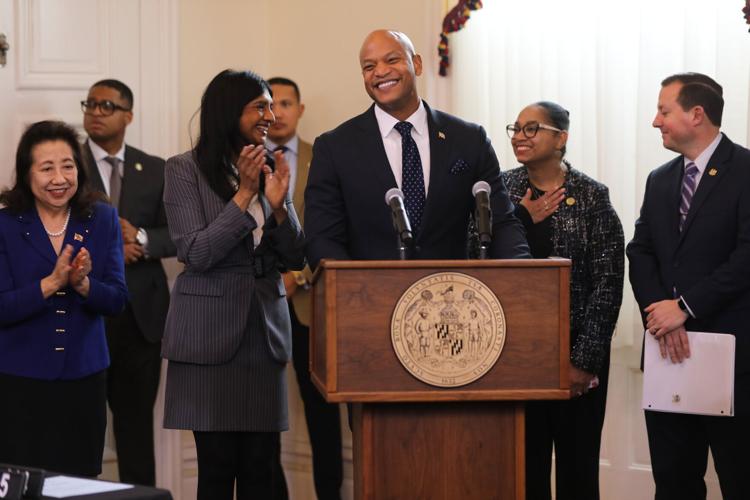
Maryland Gov. Wes Moore, center, smiles before signing legislation that prohibits immigration enforcement agreements with the federal government during a bill-signing ceremony on Tuesday in Annapolis, Md. He is joined, from left, by Maryland Secretary of State Susan Lee, Lt. Gov. Aruna Miller, House Speaker Peña-Melnyk and Senate President Bill Ferguson.
The new Maryland law highlights the extent to which Democratic-led states are pushing back against President Donald Trump's immigration crackdown. Ten states — all led by Democrats — now have statewide policies prohibiting law enforcement officers from cooperating in one of the primary programs Trump is using to carry out mass deportations.
Laws banning cooperative agreements with ICE were signed earlier this month in New Mexico and took effect last month in Maine. New York Gov. Kathy Hochul also is backing legislation that would ban local law officers from being deputized by ICE. And Virginia Gov. Abigail Spanberger recently terminated state ICE agreements signed under her Republican predecessor, though her order didn't cancel existing arrangements with local sheriffs.
"There needs to be accountability for this organization, because right now the Trump-Vance ICE operation is not moving with proper accountability measures," Moore told reporters after signing the new restrictions.
The longtime Republican sheriff of Frederick County contends the termination of a cooperative agreement with ICE will force him to let some people out of jail who may later commit more crimes.

ICE agreements rise under Trump
Upon taking office last year, Trump revived a decades-old program that trains local law officers to interrogate and detain people suspected of being in the U.S. illegally.
The 287(g) program — named for a section of the 1996 law that created it — had been used during President Joe Biden's administration only for immigrants already jailed or imprisoned on charges. But Trump expanded it to include local task forces that can make arrests on the streets, resurrecting a model that former President Barack Obama had discontinued amid concerns about racial profiling.
Participation in the program has exploded, from 135 agreements in 20 states before Trump took office to more than 1,400 current agreements in a total of 41 states and territories.
About 800 entities have task force pacts, granting the most expansive authority. As an incentive, ICE offers local agencies that sign task force agreements $100,000 for new vehicles. And for each trained task force officer, ICE covers the salary, benefits and equipment.
Arkansas, Florida, Georgia and Texas — all led by Republicans — require local jails to participate in the program. Those states account for half of all 287(g) agreements.
The growth in ICE agreements has come alongside a surge in federal immigration enforcement funding. A big tax-cut law Trump signed last year allots $150 billion for immigration enforcement, including more than $46 billion to hire 10,000 ICE agents and $45 billion to expand immigrant detention centers.

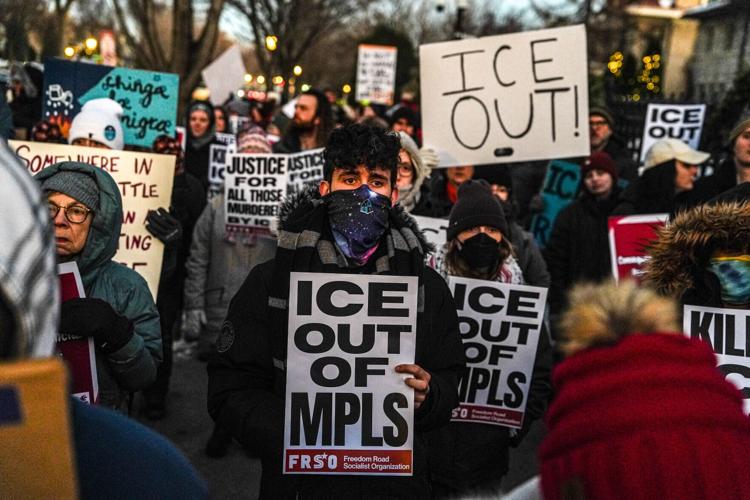
People participate in an anti-ICE protest outside of the Governors Residence, on Feb. 6 in St. Paul, Minn.
Nine Maryland counties with Republican sheriffs have cooperative agreements with ICE. Those pacts must end under the new law, which passed overwhelmingly in the Democratic-led General Assembly.
But banning cooperative agreements could lead ICE to send more of its own officers to the state, some Republican sheriffs and lawmakers said.
The Department of Homeland Security said the new law "will make Maryland less safe" and increase its workload there.
"When politicians bar local law enforcement from working with DHS, our law enforcement officers have to have a more visible presence so that we can find and apprehend the criminals let out of jails and back into communities," the department said in a statement.

New ICE limits mirror public pushback
About 6 in 10 U.S. adults say Trump has "gone too far" in sending federal immigration agents into U.S. cities, according to an AP-NORC poll.
"The growing public pushback against Trump's immigration enforcement — especially in more Democratic-leaning states — has created political pressure and a political opening to pass laws like the one in Maryland," said Nayna Gupta, policy director at the nonprofit American Immigration Council.

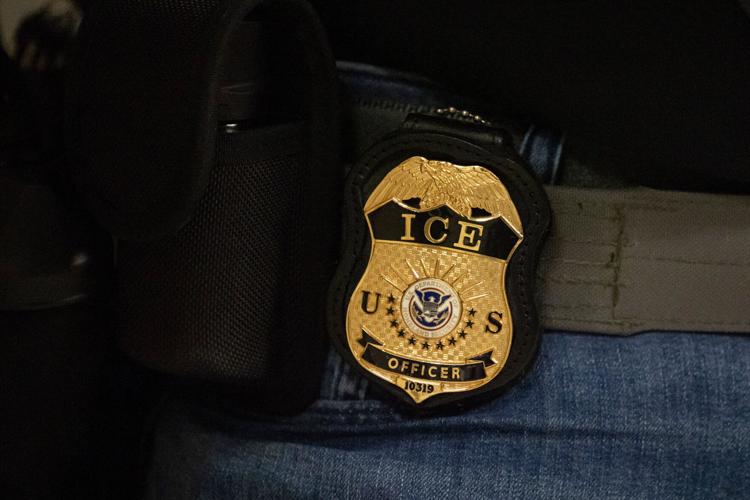
A federal agent wears a U.S. Immigration and Customs Enforcement badge in New York on June 10.
Lawmakers in New Mexico cited the intense immigration enforcement efforts in Minnesota as a reason to limit cooperation with ICE. The New Mexico measure prohibits state and local government contracts for ICE detention facilities and bars agreements that allow local law officers to carry out federal immigration functions.
Curry County, a rural area about 100 miles southwest of Amarillo, Texas, is the only New Mexico jurisdiction with a 287(g) agreement. Sheriff Michael Brockett said the arrangement has provided a secure way to transfer people to ICE custody, "rather than federal agents searching for released prisoners on the streets and in neighborhoods of our community."

Photos: ICE killings spur protests in Minnesota and beyond

People gather for a protest against ICE outside the Bishop Henry Whipple Federal Building, Friday, Jan. 30, 2026, in Minneapolis. (AP Photo/Adam Gray)

A sign at a cannabis shop indicates it is closed for the general strike to support the state's immigrant community Friday, Jan. 30, 2026, in Portland, Maine. (AP Photo/Robert F. Bukaty)

Los Angeles police fire less lethal rounds at protesters in downtown Los Angeles on Friday, Jan. 30, 2026. (AP Photo/Jae C. Hong)

EDS NOTE: OBSCENITY - Demonstrators join hands to block off Congress Street near Granada as the speeches continue through to sunset for the ICE OUT demonstration, Jan. 30, 2026, Tucson, Ariz. (Kelly Presnell/Arizona Daily Star via AP)

EDS NOTE: OBSCENITY - People gather during a protest Friday, Jan. 30, 2026, in Minneapolis. (AP Photo/Alex Brandon)

People protest against U.S. Immigrations and Customs enforcement in Portland, Maine, Friday, Jan. 30, 2026. (AP Photo/Robert F. Bukaty)

Photos of Vice President JD Vance, left, and other members of the Trump administration dressed as clowns are seen during a protest Friday, Jan. 30, 2026, in Minneapolis. (AP Photo/Alex Brandon)

People gather near Los Angels City Hall, during a protest on Friday, Jan. 30, 2026. (AP Photo/Jae C. Hong)

People gather during a protest on Friday, Jan. 30, 2026, in Los Angeles. (AP Photo/Jae C. Hong)

People gather during a protest Friday, Jan. 30, 2026, in Minneapolis. (AP Photo/Adam Gray)

People fill the streets during a protest in Los Angeles on Friday, Jan. 30, 2026. (AP Photo/Jae C. Hong)

A protester's eyes are washed out after getting tear gassed during a scuffle between federal police at the Metropolitan Detention Center in downtown Los Angeles on Friday, Jan. 30, 2026. (AP Photo/Jae C. Hong)

Protesters throw trash at federal police blocking a loading dock at the Metropolitan Detention Center in downtown Los Angeles on Friday, Jan. 30,2026. (AP Photo/Jae C. Hong)

Protesters take cover from tear gas fired by federal police during clashes at the Metropolitan Detention Center in downtown Los Angeles on Friday, Jan. 30,2026. (AP Photo/Jae C. Hong)

Crockett High School student Alexandra Fulbright, 15, walks out of school in Austin, Texas, on Friday, Jan. 30, 2026, as part of a nationwide protest of the actions of U.S.(Jay Janner /Austin American-Statesman via AP)

People gather during a protest Friday, Jan. 30, 2026, in Minneapolis. (AP Photo/Alex Brandon)

EDS NOTE: OBSCENITY - People gather during a protest Friday, Jan. 30, 2026, in Minneapolis. (AP Photo/Alex Brandon)

EDS NOTE: OBSCENITY - People gather during a protest Friday, Jan. 30, 2026, in Minneapolis. (AP Photo/Alex Brandon)

A person yells at federal immigration officers, Saturday, Jan. 24, 2026, in Minneapolis. (AP Photo/Abbie Parr)

Law enforcement officers detain a demonstrator during a protest outside SpringHill Suites and Residence Inn by Marriott hotels on Monday, Jan. 26, 2026, in Maple Grove, Minn. (AP Photo/Adam Gray)

People inside a SpringHill Suites by Marriott hotel watch as law enforcement clash with protesters outside the hotel on Monday, Jan. 26, 2026, in Maple Grove, Minn. (AP Photo/Adam Gray)

Demonstrators hold signs during a rally against federal immigration enforcement at Federal Courthouse Plaza on Tuesday, Jan. 27, 2026, in Minneapolis. (AP Photo/Adam Gray)

People attend a vigil where Alex Pretti was shot and killed by federal immigration enforcement in Minneapolis, on Wednesday, Jan. 28, 2026. (AP Photo/Adam Gray)

People gather during a vigil where Alex Pretti was shot and killed by federal immigration enforcement in Minneapolis, on Wednesday, Jan. 28, 2026. (AP Photo/Adam Gray)

A person holds a picture during a vigil for Alex Pretti, who was shot and killed by federal immigration enforcement in Minneapolis, Wednesday, Jan. 28, 2026, in Henderson, Nev. (AP Photo/John Locher)

People participate in an anti-ICE rally Sunday, Jan. 25, 2026, in Minneapolis. (AP Photo/Jack Brook)

EDS NOTE: OBSCENITY - People protest against ICE (Immigration and Customs Enforcement) in downtown Minneapolis, Sunday, Jan. 25, 2026. (AP Photo/Adam Gray)

People protest against ICE (Immigration and Customs Enforcement) in downtown Minneapolis, Sunday, Jan. 25, 2026. (AP Photo/Adam Gray)

A federal agent points a weapon at a person outside a hotel during a noise demonstration protest in response to federal immigration enforcement operations in the city Sunday, Jan. 25, 2026, in Minneapolis. (AP Photo/Adam Gray)

Flares are seen as federal agents try to clear the demonstrators near a hotel, using tear gas during a noise demonstration protest in response to federal immigration enforcement operations in the city Sunday, Jan. 25, 2026, in Minneapolis. (AP Photo/Adam Gray)

Demonstrators make noise during a protest outside a SpringHill Suites and Residence Inn by Marriott hotels on Monday, Jan. 26, 2026, in Maple Grove, Minn. (AP Photo/Adam Gray)

A person holds a Minnesota state flag as federal immigration officers deploy tear gas Saturday, Jan. 24, 2026, in Minneapolis. (AP Photo/Abbie Parr)

People glance out of their window as federal immigration agents work on the scene in Minneapolis, Sunday, Jan. 25, 2026. (AP Photo/Adam Gray)

A person is pushed back by a federal agent working on the scene in Minneapolis, Sunday, Jan. 25, 2026. (AP Photo/Adam Gray)

A makeshift memorial is placed where Alex Pretti was fatally shot by a U.S. Border Patrol officer yesterday, in Minneapolis, Sunday, Jan. 25, 2026. (AP Photo/Adam Gray)

People participate in an anti-ICE rally Sunday, Jan. 25, 2026, in Minneapolis. (AP Photo/Jack Brook)

Federal immigration officers deploy tear gas at protesters after a shooting Saturday, Jan. 24, 2026, in Minneapolis. (AP Photo/Abbie Parr)

