

The biggest day of this year's primary campaign is approaching as 16 states vote in contests known as Super Tuesday.

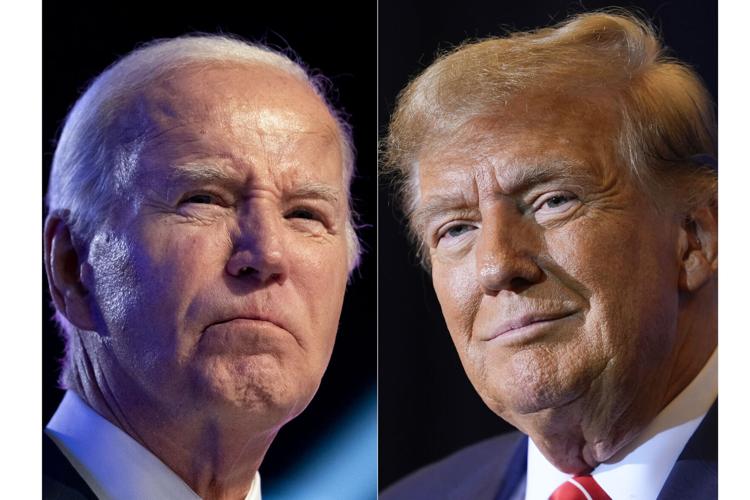
President Joe Biden, left, and former President Donald Trump go head to head on Super Tuesday.
The elections are a crucial moment for President Joe Biden and Donald Trump, who are the overwhelming front-runners for the Democratic and Republican presidential nominations, respectively. As the day with the most delegates up for stake, strong performances by Biden and Trump would move them much closer to becoming their party's nominee.
The contest will unfold from Alaska and California to Virginia and Vermont. And while most of the attention will be on the presidential contest, there are other important elections on Tuesday.
Some things to watch:
Does Trump keep rolling?
So far, the Republican presidential primary has been a snoozer.
The former president has dominated the race and his last major rival in the race, his onetime U.N. Ambassador Nikki Haley, is struggling to keep up. She lost the Feb. 27 primary in Michigan by more than 40 percentage points. She even lost her home state of South Carolina, where she was twice elected governor, by more than 20 percentage points.
As the race pivots to Super Tuesday, the vast map seems tailor-made for Trump to roll up an insurmountable lead on Haley.

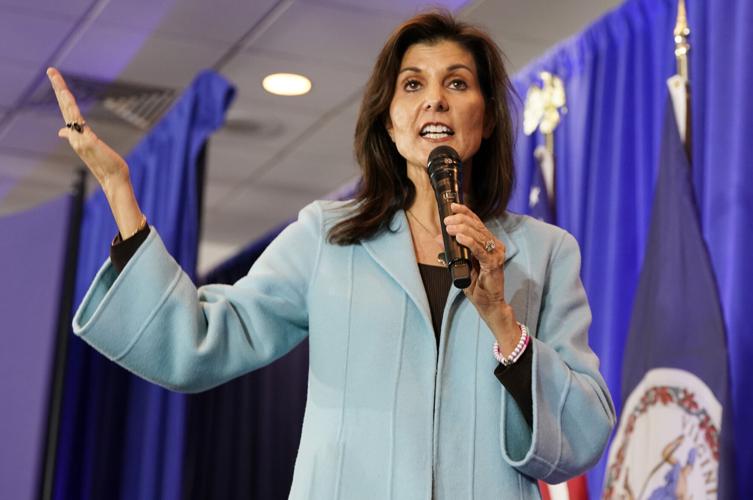
Republican presidential candidate and former UN Ambassador Nikki Haley speaks Feb. 29 at a campaign event in Richmond, Va.
His team has been turning up the pressure on Haley to drop out, and another big win could be a major point in their favor.
Haley's banked a considerable amount of campaign money and says she wants to stay in the race until the Republican National Convention in July in case delegates there have second thoughts about formally nominating Trump amidst his legal woes. But she's seen some of her financial support waver recently — the organization Americans For Prosperity, backed by the Koch brothers, announced it'd stop spending on her behalf after South Carolina.
She may not be able to afford another sweeping loss.
Do college grads keep turning against Trump?
Amid Trump's commanding wins this primary season have been a notable warning sign for November: He's performed poorly with college-educated primary voters.
In the New Hampshire and South Carolina primaries, APVoteCast found that college graduates picked Haley over Trump.

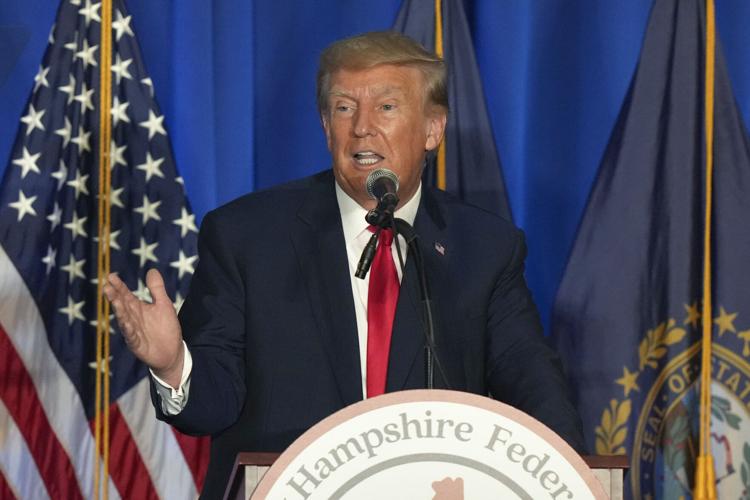
Former President Donald Trump speaks June 27 at the New Hampshire Federation of Republican Women Lilac Luncheon in Concord, N.H.
Roughly two-thirds of voters in both states who went to graduate school after college voted for the former South Carolina governor.
In South Carolina, Trump won the suburbs but not by the same magnitude as his dominance in small towns and rural areas, essentially splitting the vote with Haley.
One of the biggest questions on Tuesday is whether Trump can start repairing that rupture. Weakness with college graduates and in the suburbs where they cluster is what doomed Trump in his 2020 loss to Biden.
Does Biden end doubts?
As sleepy as the Republican presidential primary has been, the Democratic one has been even quieter.

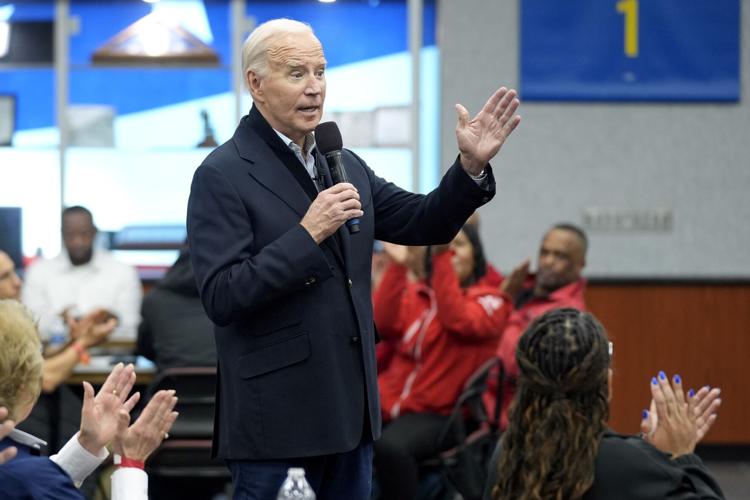
President Joe Biden meets with UAW members Feb. 1 during a campaign stop in Warren, Mich.
Biden has many political problems dragging him down in public opinion polls, but not, so far, at primary polling stations. The one speed bump came in Michigan, where an organized attempt to vote “uncommitted” in the primary there to protest Biden's support of Israel during the war in Gaza garnered 13% of the vote, a slightly higher share than that option got in the last primary under a Democratic president.
The only similar organized anti-Biden effort on the Super Tuesday calendar is one put together at the last minute by a handful of leftist groups in Colorado on Thursday to vote “non-committed” like in Michigan.
Some 700,000 people had already cast ballots in the all-mail state's primary.
The other obstacles are the president's two longshot primary opponents who've yet to crack low single digits against him, U.S. Rep. Dean Phillips of Minnesota and self-help author Marianne Williamson, who revived her campaign after receiving a surprise 3% of the Michigan primary vote.
What happens in California’s Senate race?
There's far more than the presidential primaries on the ballot Tuesday. One of the most consequential contests is the California primary for the U.S. Senate seat left open by the death of Democratic Sen. Dianne Feinstein.
The seat's temporary occupant, Laphonza Butler, isn't running for a full term. Rather than having the winners of party primaries face off in November, California throws every candidate into a single primary and has the top two vote-getters make it to the general election.
Democrats have a lock on statewide races in the overwhelmingly blue state, and for months the speculation was that two prominent U.S. House members from that party, Reps. Katie Porter and Adam Schiff, would battle it out until Election Day. But that's changed since former Dodgers great Steve Garvey threw his hat in the ring.
Garvey, 75, is both a Republican and a novice at politics. Schiff has been airing ads slamming him — or, more accurately, promoting him — as most likely to carry out Trump's wishes. The idea is to unite the state's outnumbered conservatives behind Garvey so he and Schiff finish in the top two, denying Porter a spot in November. Schiff would then be the overwhelming favorite for the seat.
The current primary setup was passed by voters in 2010, partly to stop partisans from engaging in primary shenanigans. Among other things, the Senate primary will be a test of whether, in the end, motivated politicians can game any system.

Which way on criminal justice?
Voters in San Francisco and Los Angeles will once more grapple with questions of criminal justice and public order.
In Los Angeles County, District Attorney George Gascon faces 11 challengers in a primary amid criticism of his progressive approach that includes not seeking cash bail for misdemeanors and nonviolent felonies and not prosecuting juveniles as adults. His opponents have blamed him for a rise in property crimes in some parts of the county, including a brazen smash-and-grab spree at luxury stores.
Gascon has weathered criticism before, including two failed recall efforts, one of which was in his first 100 days of taking office. The primary will determine who he faces in November and whether there are signs that Los Angeles' liberal voters are changing their minds.
In San Francisco, Mayor London Breed is pushing one ballot measure to expand police powers to use tactics like drones and surveillance cameras, and another testing single adults on welfare for drugs. The two initiatives come as the city has been wracked by homelessness and drug use, and Breed faces a cranky electorate in her own reelection in November.
Another GOP test in Texas
Texas Attorney General Ken Paxton last year survived an impeachment led by his own party. Now he wants payback, and Trump is helping him. The primary will be a test of how Republican voters are willing to regulate their own leaders.
The impeachment stemmed from Paxton's legal woes. He faces an April trial on felony security fraud charges, and an additional federal corruption probe over the allegations that he used his office to favor a campaign donor that was the foundation of the impeachment charges.
Paxton is targeting more than 30 Republican state lawmakers in the primary, including House Speaker Dale Phelan. Paxton is also trying to remove three Republican judges on the state's conservative appeals court who voted to limit the attorney general's powers.
Paxton has been a staunch supporter of Trump, including the former president's attempts to overturn his own 2020 election loss, and Trump is helping Paxton in his primary campaign. The Texas purge will be a test of what Republican voters value the most in their elected officials.
Can North Carolina candidates unite the parties?
Most of the country picked its governors in the 2022 off-year elections, but North Carolina is gearing up for an intense race this fall. The major-party front-runners for the seat being vacated by term-limited Democratic Gov. Roy Cooper both will need to demonstrate an ability to unite their parties in the primary.
Attorney General Josh Stein has Cooper’s endorsement. Stein's main competitor is a former state Supreme Court associate justice, Mike Morgan, who is Black. Watch whether Stein’s able to hold onto a significant share of the primary’s Black voters, which is essential for any Democrat who wants to be competitive in November.
The Republican front-runner is Lt. Gov. Mark Robinson, who is Black, has been a divisive figure for some for criticizing vocally the teaching of LGBTQ+ issues during sex education and for comments at a church that Christians are “called to be led by men.” His opponents, state Treasurer Dale Folwell and trial attorney Bill Graham, say Robinson is too polarizing to win in November.
Robinson received Trump’s support last year, but it’s worth watching whether he shows the same weaknesses as the former president among college-educated, suburban voters. Biden’s reelection campaign is targeting North Carolina because it thinks those voters can help him beat Trump there.
Who’s running for president? See the latest rundown of major 2024 candidates
Donald Trump

The former president announced his third campaign for the White House on Nov. 15, 2022, at his Mar-a-Lago resort, forcing the party to decide whether to embrace a candidate whose refusal to accept defeat in 2020 sparked the U.S. Capitol attack and still dominates his speeches.
The GOP front-runner remains hugely popular in the Republican Party, despite making history as the first president to be impeached twice and inciting the Capitol insurrection on Jan. 6, 2021. Referring to himself as America's “most pro-life president," Trump nominated three conservative judges to the Supreme Court, paving the way for the reversal of Roe v. Wade, which had legalized abortion nationwide for nearly 50 years. Sweeping criminal justice reforms he signed into law in 2019 eased mandatory minimum sentences and gave judges more discretion in sentencing.
In March, Trump became the first former U.S. president to be criminally charged, facing 34 felony counts of falsifying business records as part of a hush-money scheme. Since then, he has been charged with 57 more felonies in three other criminal cases, accused of mishandling and unlawfully retaining classified documents and trying to illegally overturn the results of the 2020 election.
His overwhelming win in the lead-off Iowa caucuses signaled his dominant position in the race for the GOP nomination.
Joe Biden
Updated
President Joe Biden formally announced his reelection campaign on April 25 in a video, asking voters for time to “finish this job."
Biden, the oldest president in American history, would be 86 at the end of a second term, and his age has prompted some of his critics to question whether he can serve effectively. A notable number of Democratic voters indicated they would prefer he not run, though he is expected to easily win the Democratic nomination.
Biden, who has vowed to “restore the soul of America,” plans to run on his record. He spent his first two years as president combating the coronavirus pandemic and pushing through major bills such as the bipartisan infrastructure package and legislation to promote high-tech manufacturing and climate measures.
Robert F. Kennedy Jr.
Updated
The bestselling author and environmental lawyer announced on Oct. 9 that he was ending his Democratic presidential bid and instead launching an independent run.
A nephew of President John F. Kennedy and son of Attorney General Robert F. Kennedy, he initially launched a long-shot bid to challenge Biden for the Democratic nomination on April 19 in Boston. He said in announcing his party switch that he intended to be a spoiler candidate for both Biden and Trump.
Kennedy has emerged as one of the leading voices of the anti-vaccine movement, with public health experts and even members of his own family describing his work as misleading and dangerous. He has also been linked to far-right figures in recent years.
Jill Stein
Updated
The environmental activist, whose 2016 third-party presidential bid was blamed by Democrats for helping Trump win the White House, says she is making another run for the nation's highest office.
Jill Stein announced Nov. 9 that she will again run under the Green Party banner. "I'm running for president to offer that choice for the people outside of the failed two-party system,” she said.
She ran against Trump and Democrat Hillary Clinton in 2016 as a Green Party candidate and received about 1% of the vote. Some Democrats said her candidacy siphoned votes away from Clinton, particularly in swing states like Wisconsin.
Cornel West
Updated
The progressive activist and scholar announced Oct. 5 that he was ending his bid for the presidency under the Green Party banner and was instead running as an independent.
West wrote on X that he was running as an independent to “end the iron grip of the ruling class and ensure true democracy!” He added, "We need to break the grip of the duopoly and give power to the people.”
He initially announced in June that he would be running as a member of The People’s Party before soon switching to the Green Party.
Who’s dropped out?
Updated
Republicans:
- Former South Carolina Gov. Nikki Haley
- Florida Gov. Ron DeSantis
- Former Vice President Mike Pence
- Sen. Tim Scott of South Carolina
- Former New Jersey Gov. Chris Christie
- Entrepreneur Vivek Ramaswamy
- Former Arkansas Gov. Asa Hutchinson
- North Dakota Gov. Doug Burgum
- Radio show host Larry Elder
- Businessman Perry Johnson
- Former U.S. Rep. Will Hurd of Texas
- Miami Mayor Francis Suarez
Democrats:
- U.S. Rep. Dean Phillips of Minnesota
- Self-help author and spiritual guru Marianne Williamson

