

Every week hundreds of millions of people around the world gather to worship in peace. But for some, deadly violence invades their sacred spaces and shatters that sense of sanctuary and safety.
It happened recently at a synagogue in England and two churches in the United States. Those followed other high-profile attacks — violence that can intensify anxiety and outright fear among clergy and worshippers worldwide.
Security measures were bolstered, congregants were placed on alert, yet a key question lingers: Can believers feel safe — and at peace — continuing to worship together?
The Oct. 2 attack on a synagogue in Manchester, England, left two congregants dead and, according to police, was carried out by a man who pledged allegiance to the Islamic State group. Two days later, a mosque in an English coastal town was targeted with a suspected arson attack.
How to instill that feeling is a constant challenge. In the U.S., most synagogues — and many non-Jewish houses of worship — employ layered security strategies. These can involve guards, cameras and various systems for controlling access to events through ticketing, registration or other forms of vetting.

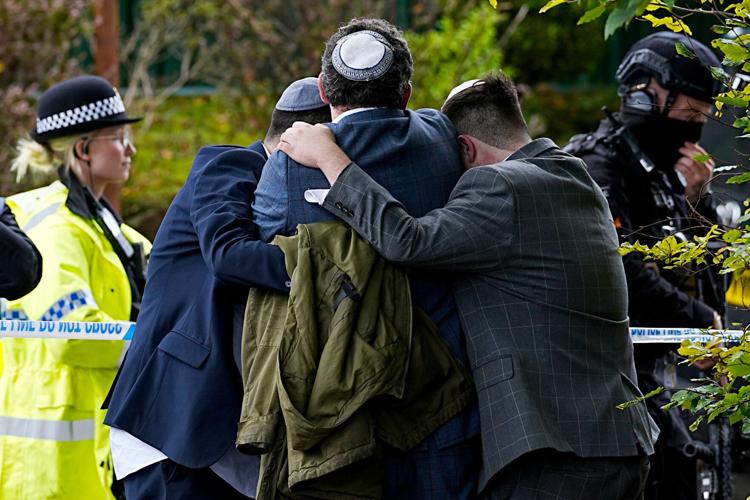
Members of the Jewish community comfort one another Oct. 2 near the Heaton Park Hebrew Congregation synagogue in Crumpsall, Manchester, England, after police reported that two people were killed and three others were seriously injured in a synagogue attack in northern England.
Seeking security without heightening anxiety
The deadliest attack on Jews in the U.S. occurred in October 2018, when a gunman killed 11 worshippers from three congregations at Pittsburgh's Tree of Life synagogue.
Eric Kroll, deputy director of community security at the Jewish Federation of Greater Pittsburgh, said synagogues there began systemic security trainings before the attack.
Some of the training recommendations — such as keeping a phone on hand for emergencies even on the Sabbath, when observant Jews normally wouldn't use a phone — helped save lives, he said. The federation continues to evaluate attacks such as the one in Manchester to prepare for assailants' evolving tactics.

"Many of us feel grief, fear, and deep unease," Bishop Bonnie Perry, leader of the Episcopal Diocese of Michigan, wrote in a letter to her congregations two days after a gunman killed four people inside The Church of Jesus Christ of Latter-day Saints in Michigan's Grand Blanc Township on Sept. 29. "It is natural to wonder whether the places where we pray and gather are safe."
She detailed a balanced approach to security, rejecting suggestions to lock church doors during worship but encouraging greater vigilance and preparedness, including formation of emergency response teams at the diocese's churches.

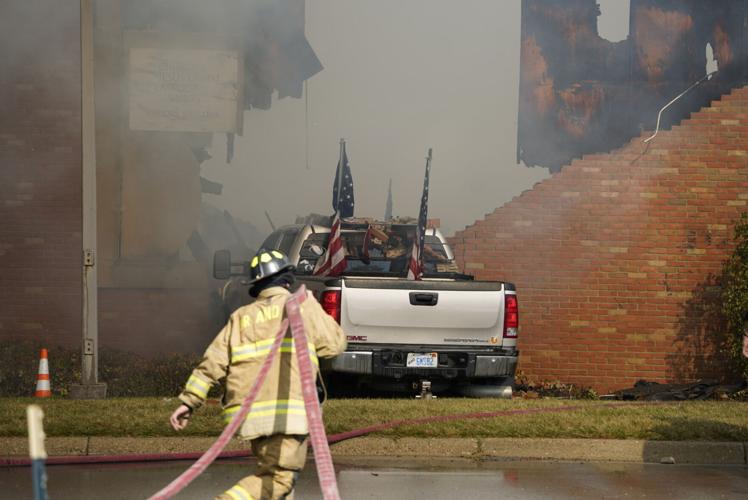
Firefighters work on the scene of a Sept. 28 fire and shooting at the Church of Jesus Christ of Latter-day Saints in Grand Blanc, Mich.
Differences over guns in church
While some Christian pastors in the U.S. encourage congregants to bring firearms to church as a security measure, many denominations and individual houses of worship forbid this. After the Grand Blanc attack, The Church of Jesus Christ of Latter-day Saints affirmed that it prohibits carrying firearms and other lethal weapons inside its meetinghouses and temples, except for current law enforcement officers.
Black churches in the U.S. withstood a long history of violent attacks, from decades of church burnings and bombings to the murder of nine Bible study participants in 2015 at Mother Emanuel AME in Charleston, South Carolina. The perpetrator of that attack, now on death row, posted selfies with a Confederate flag to flaunt his racist rationale for shooting Black churchgoers.

A member of Metropolitan AME in Washington, D.C., Khaleelah Harris, 29, said the threat of violence is often on her mind.
"It can be difficult to be a part of a worship service, and you look around and five police officers are in the service because somebody just walked in, and they look a little suspicious. It shifts the atmosphere," said Harris, who is in the AME ordination process.
Her church won a lawsuit earlier this year against the Proud Boys, after the far-right group vandalized the church's property in 2020. The congregation increased security, at one point paying $20,000 per month.
It's a struggle to balance being a welcoming congregation with tightened security protocols, Harris said.

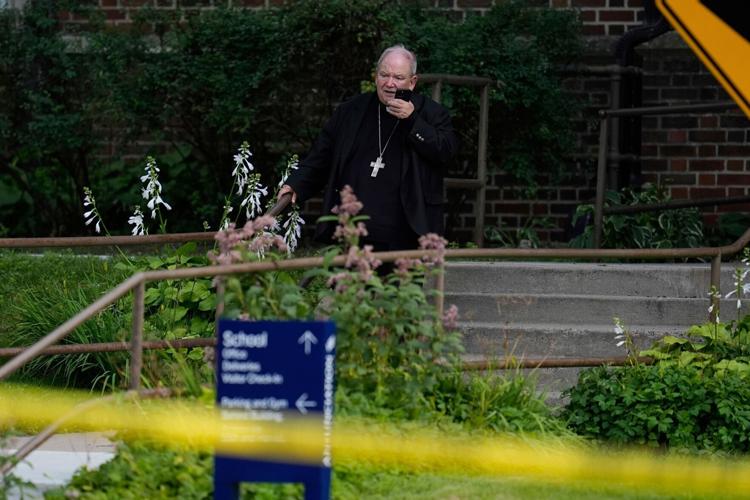
The archbishop of Saint Paul and Minneapolis, Bernard Hebda, talks on the phone Aug. 27 outside the Annunciation Church's school in Minneapolis after a shooting there.
A worldwide problem
Attacks on individual houses of worship in places like the U.S. and Western Europe tend to draw the international spotlight more than attacks that are part of broader ongoing conflicts — such as Christian churches burned by Islamic militants in parts of Africa or the destruction of many mosques in Gaza through Israeli strikes mounted in its war against Hamas.
Attacks on mosques — usually blamed on Islamic militants with rival ideologies — took place in other Middle Eastern countries.
Egypt reeled in 2017 from the killing of more than 300 people in a militant attack on a mosque in Sinai frequented by Sufis, followers of a mystic movement within Islam. On March 4, 2022, an Afghan suicide bomber struck inside a Shiite mosque in Pakistan's northwestern city of Peshawar, killing at more than 60 worshippers. The Islamic State group claimed responsibility.

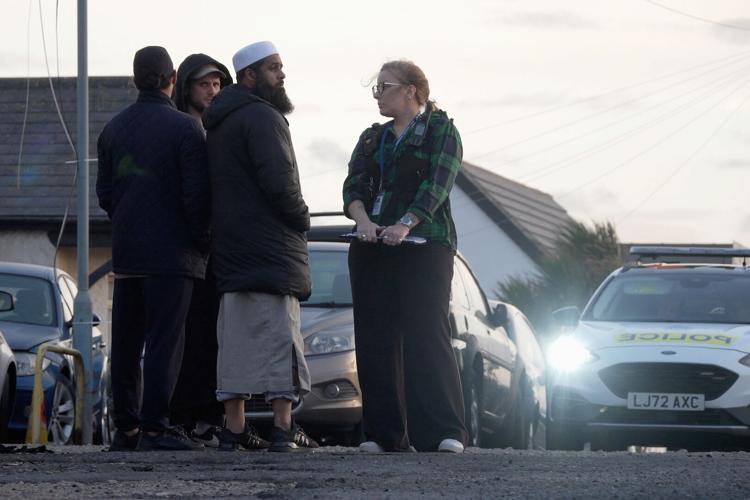
Local residents view the damage outside the front entrance of the mosque in Peacehaven following a suspected arson attack Oct. 5 in East Sussex, England.
In Christchurch, New Zealand, a white supremacist gunman killed 51 worshippers at two mosques during Friday prayers in 2019. It prompted new laws banning an array of semiautomatic firearms and high-capacity magazines. They also prompted global changes to social media protocols after the gunman livestreamed his attack on Facebook.
During a wave of antisemitic incidents in Australia, a synagogue in Melbourne was firebombed in December 2024. Australian authorities accused Iran of directing that attack.
Australia is among several countries, including South Africa and Britain, that engaged with the U.S.-based Secure Community Network to share information regarding possible antisemitic threats, according to SCN's national director, Michael Masters. The network provides security advice and training to Jewish institutions across North America.
In the U.S., religious leaders urge Congress to expand the Nonprofit Security Grant Program, which helps nonprofits and houses of worship pay for security system upgrades and emergency planning.
More states are filling a federal gap by helping police track stolen guns
More states are filling a federal gap by helping police track stolen guns
Updated
On Dec. 6, 2024, Connecticut State Police arrested a 35-year-old man who had allegedly failed to report several of his guns as stolen.
It wasn't a mundane arrest: His case appeared to be a classic example of gun trafficking fueled by straw purchasing, a term for when a person buys a gun with the intent of giving or selling it to someone prohibited from possessing it, like a person convicted of a felony. In all, the man had allegedly purchased more than 30 guns, including 16 in 2020 alone. Some resurfaced in criminal investigations in Connecticut and neighboring New York.
A Connecticut law that requires gun owners to report lost or stolen firearms aided the investigation.
In 2017, The Trace found that just 11 states had requirements for reporting lost and stolen guns on the books. Six more states have adopted them since then, bringing the total to 17. This year, as legislative sessions heat up, at least four states may vote on bills to enact new requirements, and two more are considering bills that could strengthen existing requirements.
These mandates fill a gap in federal law: While firearms dealers are required to report lost or stolen guns within 48 hours, there's no similar federal requirement for individual gun owners.

What happens after a gun is stolen?
Updated
Proponents say reporting requirements, at their most basic, enable law enforcement to track down stolen guns faster—hopefully, before they're used in a crime. But the laws do more than that. As in the Connecticut case, they can also help to identify trends of suspicious purchases and "thefts" to suss out cases of straw purchasing and gun trafficking.
"That helps a lot in firearms trafficking cases and dealing with straw purchasers, who routinely use a gun being 'stolen' as their excuse," said Michael Bouchard, a former Bureau of Alcohol, Tobacco, Firearms and Explosives assistant director and president of the ATF Association.
Firearms stolen from private citizens account for nearly 95 percent of all guns stolen in thefts, according to a 2025 ATF report. From 2019 to 2023, nearly 1.1 million firearms were reported stolen, and more than 1 million of those were stolen from private citizens, or roughly 200,000 annually.
Once out of the hands of their original owners, those guns are much more likely to be used in crimes, according to research published last year in the journal Injury Epidemiology. For the study, the Violence Prevention Research Program at the University of California, Davis, analyzed over 8 million gun sales records and tens of thousands of reports of crime guns being recovered by law enforcement. They found that guns reported lost were three times more likely to be used in crimes. Stolen guns had nearly nine times the likelihood.
The researchers noted that guarding firearms against theft and loss should be a "primary focus" of efforts to prevent gun violence.
"If someone steals your gun, it's likely a gun thief is going to use it in a crime, probably against somebody," Bouchard said. "If an officer confronts someone with a firearm, and it's been reported stolen, now that's one crime gun that's taken off the street before there are any more victims."
In Minnesota, state Representative Kaohly Vang Her, a Democrat, has been trying to get a mandatory reporting requirement passed for several years.
"I own a gun. I've hunted probably for about 25 years," Her said. "It makes me feel more strongly that we need better gun violence prevention and about what it means to be a responsible gun owner. When I think about lost or stolen firearms, it's just common sense that this is what we should be doing."
Her's bill passed the Minnesota House during the state's 2023-2024 legislative session, but it ultimately failed in the upper chamber. She plans to file a new version in the coming weeks. Lawmakers in at least three other states—Texas, Missouri, and Kansas—have proposed similar bills, while legislators in Illinois and Ohio have proposed measures to strengthen existing requirements. The proposals come after the Biden administration released model legislation that states could follow.
In Congress, U.S. Representative Sean Casten, an Illinois Democrat, introduced a bill on Feb. 21 that would require lost or stolen firearms to be reported to law enforcement within 48 hours. But it faces an uphill battle with Republicans in control.
Two sides to the coin
Updated
Republican lawmakers and gun rights groups frequently oppose reporting requirements as a burden on law-abiding gun owners.
"This bill creates criminal penalties for the victims of crime," Minnesota state Representative Walter Hudson, a Republican who opposed Her's bill, said during a committee hearing on the legislation. "What this seems to be targeting is lawful gun owners who do not make reports for reasons that are their own."
But proponents of the laws say the burden is minimal. The amount of time gun owners have to report a theft ranges from 24 hours to a week, and there are typically exceptions if a gun owner didn't immediately realize their gun was stolen—like if, say, it went missing from a vacation home.
"This is not that hard. It doesn't burden anybody to report a gun as stolen," Bouchard said. "It's not just like I lost my wallet, or I lost a ring. A gun, if it's stolen, it's in a criminal's hands."
The effect of mandatory reporting laws on rates of gun violence has not been researched extensively, but at least four studies have found them to be associated with reduced gun trafficking. One of those studies, published in 2020, found that the laws may reduce trafficking to other states by as much as 28 percent.
"Failing to report a firearm stolen—that's an offense that takes away your opportunity to continue to be a straw purchaser, because you now have a criminal offense on your record, assuming you're caught," said Jim Burch, the president of the National Policing Institute and a former ATF acting assistant director.
Other policies could improve or build on reporting requirements.
Under Oregon's law, gun owners who fail to report the theft of their firearm can be sued if their gun is used in a crime. The risk of facing an expensive lawsuit could be a bigger incentive to report than the comparably smaller fines associated with most mandatory reporting laws.
Not all strategies need to be punitive. In Ohio and Florida, law enforcement maintains databases that allow gun purchasers to check if the gun they're looking to buy has been reported stolen. And in some states, "Save-a-Casing" programs provide gun owners with a way to give law enforcement spent shell casings that can connect stolen guns with crimes.
"It gives them much, much stronger potential for recovering firearms quickly," said Burch, who authored a 2024 report on reporting laws and how they could be improved.
Mandatory reporting requirements are far from a fix-all solution for gun violence. One major issue: The laws often go unenforced.
"The penalties for violating these laws are, in some cases, as low as $25 fines, so the effort that it takes to prosecute someone for that kind of a penalty kind of serves as a disincentive," Burch said. "I don't know that we see good evidence of how they're working, because I don't know that we've seen good evidence that they're actually being implemented and enforced."
Still, for Her, the Minnesota representative, the argument that reporting laws won't fix everything isn't a reason not to try.
"There is no piece of legislation that anybody writes in any state that is perfect," she said. "What I do know is that gun violence is an epidemic in this country. And if this helps prevent people from getting hurt, why wouldn't we?"
This story was produced by The Trace and reviewed and distributed by Stacker.

