

As if on cue, while President Donald Trump told a Rose Garden audience about his efforts to quell violence in the nation's capital, his words were drowned out by the wail of sirens from passing vehicles.
"Listen to the beauty of that sound," he said, grinning. "They're not politically correct sirens."
That moment encapsulated how Trump's law-and-order-at-all-costs push became a centerpiece of his second term.

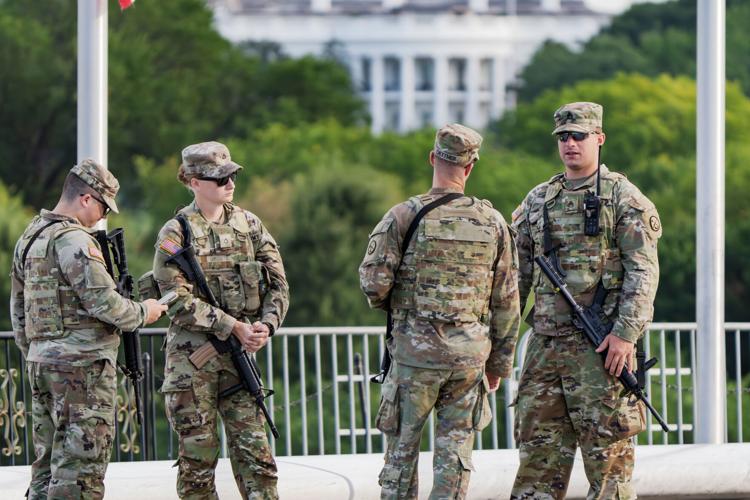
With the White House in the distance, National Guard troops patrol the Mall on Aug. 28 in Washington, part of the president's order to impose federal law enforcement in the nation's capital.
"Now it's like a passion for me," he said this month in the Oval Office, touting the results of a crackdown named Operation Summer Heat, during which he said the FBI made more than 8,000 arrests. He said his actions were "many, many steps above" what he'd pledged on the campaign trail last year.
He deployed troops to Democratic-majority cities and directed federal officials, often with their faces obscured by masks, to round up people illegally living in the United States. He suggested urban areas could become military "training grounds" and toyed with invoking the Insurrection Act so political opponents can't use the courts to foil his plans.
In his second term, the Republican president embraced the kind of tough-on-crime approach he was unable to achieve as naysayers checked his most extreme instincts during his first four years in office.
Trump's efforts drew resistance from state and other leaders. His plans to send soldiers to Chicago and Portland, Oregon, were thwarted by legal challenges. He said he's confident he'll win on appeal but hasn't ruled out using the Insurrection Act as a workaround.

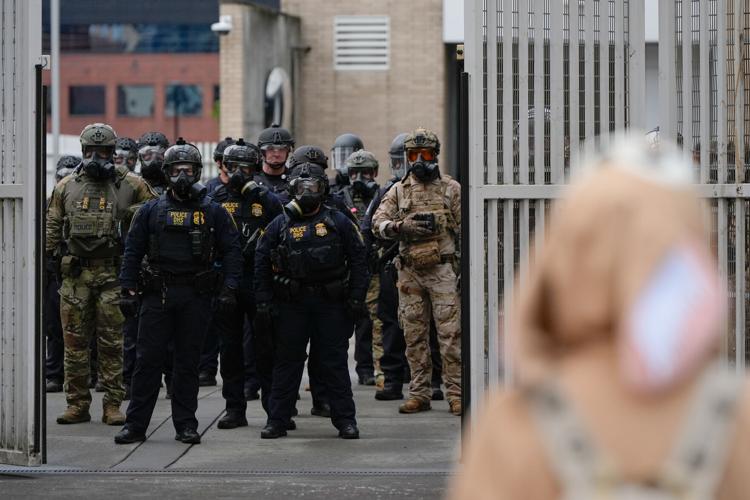
Law enforcement officers watch as the gates close Oct. 11 at a U.S. Immigration and Customs Enforcement facility in Portland, Ore., as people protest outside.
Elsewhere, his moves dramatically altered day-to-day lives. He took control of the California National Guard in response to protests against immigration raids in Los Angeles and sent the National Guard into Washington, D.C., and Memphis, Tennessee. He mused about taking similar action in Baltimore, New Orleans, New York and Boston.
'Bring Back Our Police'
Trump's embrace of the hardest possible line against crime suspects dates back to his time as a real estate mogul in the gritty days of 1970s and '80s New York, when crime was rampant.
His mindset burst into public view when he stirred racial tensions by calling for the execution of the Central Park Five, a group of Black and Hispanic teenagers wrongly convicted of rape in 1989. Trump took out full-page newspaper ads under the headlines: "Bring Back The Death Penalty. Bring Back Our Police!"
The Central Park Five convictions were vacated in 2002, after evidence linked a serial rapist to the crime. Today, activists see the case as evidence of a criminal justice system prejudiced against defendants of color.
"That's the very same spirit that's at work now," said the Rev. J. Lawrence Turner of the Mississippi Boulevard Christian Church in Memphis. Turner said Trump "demonized" and "targeted" Memphis, which is 62% African American and has a Black mayor and county leader.
"We have this president unleashed in this second term," he said.

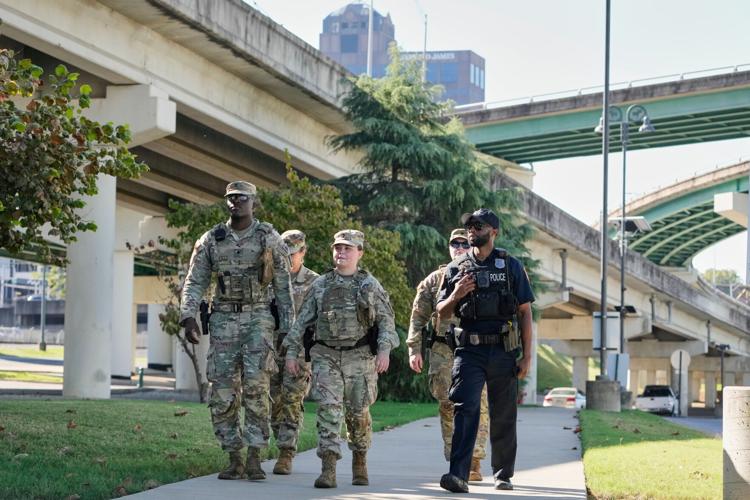
A city police officer, right, patrols Oct. 10 with members of the National Guard in Memphis, Tenn.
First-term flirtations
Trump covered some of the same political ground in his first term during the protests over racism and police brutality sparked by officers' 2020 killing of George Floyd, an unarmed Black man. The president sent troops to the streets of Washington and Portland, but his advisers at the time staunchly opposed many of his calls to more broadly deploy the military to beat back unrest.
Mark Esper, Trump's former defense secretary, later told CBS' "60 Minutes" that Trump asked during the protests whether the National Guard could be tougher on demonstrators. "'Can't you just shoot them? Just shoot them in the legs, or something,'" Esper said he recalled Trump saying.
However, a Trump signature bipartisan achievement in his first term was a 2018 criminal justice reform measure meant to reduce federal prison populations and address disparities in sentencing, after lobbying from advocates including Kim Kardashian.
Trump was attacked from the right for that policy during the 2024 Republican primary and rarely spoke about his criminal justice reform bill while campaigning. He instead drew cheers with calls for the death penalty for drug dealers and those who kill police officers.

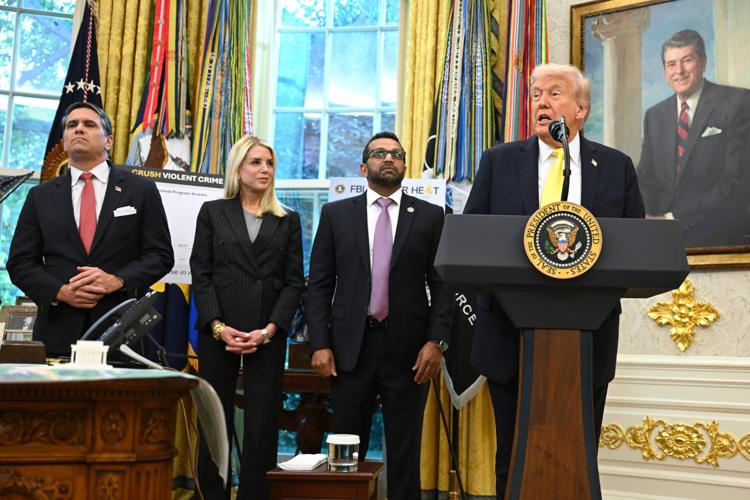
President Donald Trump speaks as FBI Director Kash Patel, Attorney General Pam Bondi and Deputy Attorney General Todd Blanche listen during an Oct. 15 event in the Oval Office at the White House in Washington.
'We're going to save all our cities'
Trump now sees getting tough on crime as a winning political issue.
"We're going to save all of our cities, and we're going to make them essentially crime-free," he said this month.
Recent polling from The Associated Press-NORC Center for Public Affairs Research found his administration's tough-on-crime approach emerged as one of his best issues, amid frustrations over his handling of the economy and immigration.
The vast majority of Americans, 81%, see crime as a "major problem" in large cities, even as statistics show violent crime is down across the U.S. following a spike during the COVID-19 pandemic.
The shift reflects a Trump no longer encumbered by chiefs of staff, generals and others who saw reining in his most extreme impulses as their duty; those officials were replaced by loyalists.
"This time around, he has people around him that are not simply supporting what he's doing, they're encouraging him," said Patrick G. Eddington, a senior fellow at the libertarian Cato Institute.

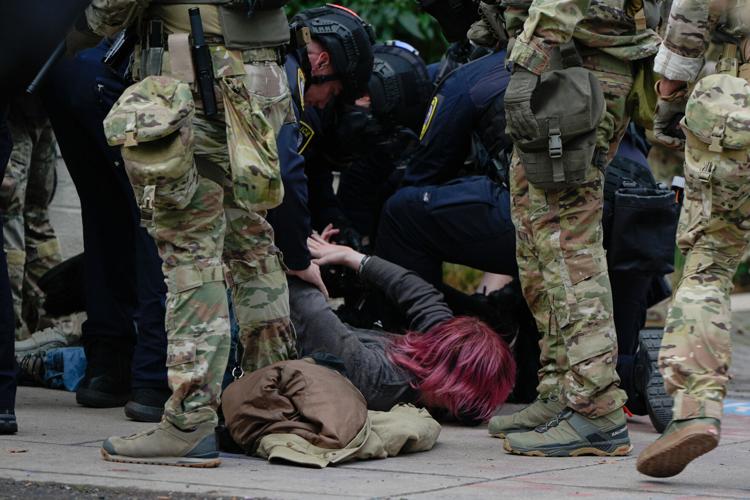
A demonstrator is detained Oct. 11 outside a U.S. Immigration and Customs Enforcement facility in Portland, Ore.
'Making all Americans safer'
The White House rejects suggestions that Trump's crackdown on crime has to do with race. It says the National Guard was utilized in different cities for different reasons.
Washington is a crime-fighting push that Republican state leaders in Tennessee asked be replicated in Memphis, it argues. In Portland and Chicago, as in Los Angeles previously, the goal is protection of federal authorities working on priorities like immigration enforcement.
"The president's bold actions in cities across the country are making all Americans safer," White House spokesperson Abigail Jackson said, describing Trump's actions as the fulfillment of a campaign promise.
Still, deploying troops to cities gives Trump the opportunity to paint Democratic opponents as soft on crime while overstating — often in apocalyptic terms — how bad the problem really is. He then exaggerates the results.
He spent weeks suggesting Portland is "on fire" and declared Washington "a raging hellhole." He now suggests Washington crime has fallen to zero, which also isn't true.
Maya Wiley, president and CEO of the Leadership Conference on Civil and Human Rights, said the administration's efforts are an extension of Trump's brand, which she described as "using race overtly to drive division, to consolidate a base and to use that to usurp power a president does not have, or should not be deemed to have."
Trump now routinely speaks of criminals as people without redemption.
"They're sick," he said recently, "and we're taking them out."


'No Kings' protesters take to the streets

Crowds gather Saturday, Oct. 18, 2025, to listen to Sen. Bernie Sanders, I-Vt., during a No Kings protest in Washington.

Crowds gather Saturday, Oct. 18, 2025, to listen to Sen. Bernie Sanders, I-Vt., during a No Kings protest in Washington.

Attendees sign a banner representing the U.S. Constitution on Saturday, Oct. 18, 2025, during a No Kings protest in Washington.

Demonstrators carry a signed banner representing the U.S. Constitution as they rally Saturday, Oct. 18, 2025, before marching to the National Mall during a No Kings protest in Washington.

Sen. Bernie Sanders, I-Vt., speaks Saturday, Oct. 18, 2025, during a No Kings protest in Washington.

Demonstrators carry signs Saturday, Oct. 18, 2025, as they march to the National Mall during a No Kings protest in Washington.

Demonstrators carry signs during a No Kings protest Saturday, Oct. 18, 2025, in Washington.

Demonstrators carry signs during a No Kings protest Saturday, Oct. 18, 2025, in Washington.

Demonstrators carry signs during a No Kings protest Saturday, Oct. 18, 2025, in Washington.

Demonstrators carry signs during a No Kings protest Saturday, Oct. 18, 2025, in Washington.

People participate in a "No Kings" rally Saturday, Oct. 18, 2025, in Birmingham, Ala.

Matt Ezell participates in a "No Kings" rally Saturday, Oct. 18, 2025, in Birmingham, Ala.

A demonstrator participates in a "No Kings" rally Saturday, Oct. 18, 2025, in Birmingham, Ala.

A demonstrator holds a sign Saturday, Oct. 18, 2025, during an anti-Trump protest in Madrid, Spain.

People take part in a pro-democracy 'No Kings' protest Saturday, Oct. 18, 2025, in Malmö, Sweden.

A woman shows a poster as she participates in a pro-democracy, anti-Trump protest Saturday, Oct. 18, 2025, outside the U.S. Embassy at the Pariser Platz square in Berlin.

People display U.S. flag and a "No Kings" sign as they participate in a pro-democracy, anti-Trump protest Saturday, Oct. 18, 2025, outside the U.S. Embassy at the Pariser Platz square in Berlin.

Illinois Gov. JB Pritzker arrives Saturday, Oct. 18, 2025, during a "No Kings" protest in Chicago.

A demonstrators carries a sign stating "RULE of LAW" on Saturday, Oct. 18, 2025, during a No Kings protest in Washington.

People walk along the street Saturday, Oct. 18, 2025, during the "No Kings" protest in Houston.

A rallygoer plays guitar Saturday, Oct. 18, 2025, during a rally and march through the streets in Denver.

A U.S. Park Police officer oversees a No Kings protest Saturday, Oct. 18, 2025, in Washington.

A protester wears a blow-up mushroom costume Saturday, Oct. 18, 2025, during a "No Kings" protest in New York.

Protesters holding an upside-down U.S. flag shout slogans from scaffolding Saturday, Oct. 18, 2025, during a "No Kings" protest in New York.

People gather Saturday, Oct. 18, 2025, during a "No Kings" protest in Chicago.

A demonstrator carries a sign saying "DEMocracy not TRUMPocracy" on Saturday, Oct. 18, 2025, a No Kings protest in Washington.

People march Saturday, Oct. 18, 2025, during a "No Kings" protest in Portland, Ore.

Protesters march Saturday, Oct. 18, 2025, in the streets near City Hall during a "No Kings" protest in Los Angeles.

People take part in a "No Kings" protest Saturday, Oct. 18, 2025, in Seattle.

A protester carrying an effigy of Donald Trump during a "No Kings" protest Saturday, Oct. 18, 2025, in Los Angeles.

Demonstrators wearing inflatable bald eagle costumes gather Saturday, Oct. 18, 2025, in Kiener Plaza during the "No Kings" protest in St. Louis, with the Gateway Arch in the background.

Demonstrators in costumes hold placards Saturday, Oct. 18, 2025, during a protest outside the U.S. Embassy in London.

