

CARACAS, Venezuela — Nicolás Maduro, who oversaw his country's democratic undoing and economic collapse, was captured Saturday during a U.S. attack on his capital.
His fall was the culmination of months of stepped-up U.S. pressure on various fronts.
He spent the last months of his presidency fueling speculation over the intentions of the U.S. government to attack Venezuela with the goal of ending the self-proclaimed socialist revolution that his late mentor and predecessor, Hugo Chávez, ushered in. Maduro, like Chávez, cast the United States as Venezuela's biggest threat, railing against Democratic and Republic administrations for efforts to restore democratic norms.
Maduro's political career began 40 years ago. In 1986, he traveled to Cuba to receive a year of ideological instruction, his only formal education after high school. Upon his return, he worked as a bus driver for the Caracas subway system, where he quickly became a union leader. Venezuela's intelligence agencies in the 1990s identified him as a leftist radical with close ties to the Cuban government.
Maduro eventually joined the political movement that Chávez organized after receiving a presidential pardon in 1994 for leading a failed and bloody military coup years earlier. After Chávez took office, the former youth baseball player rose through the ranks of the ruling party, spending his first six years as a lawmaker before becoming president of the National Assembly. He then served six years as foreign minister and a couple months as vice president.

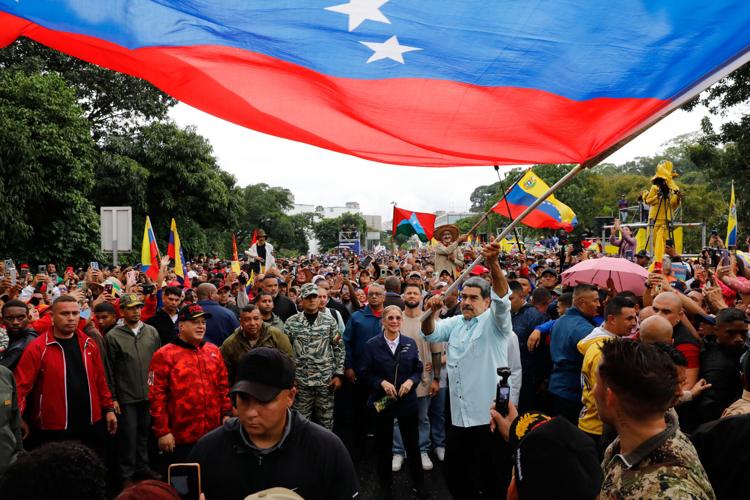
President Nicolas Maduro waves a flag Dec. 10 in Caracas, Venezuela, during a rally marking the anniversary of the Battle of Santa Ines, which took place during Venezuela's 19th-century Federal War.
Heir to Chávez
Chávez used his last address to the nation before his death in 2013 to anoint Maduro as his successor, asking his supporters to vote for the then-foreign affairs minister should he die. The choice stunned supporters and detractors alike. But Chávez's enormous electoral capital delivered Maduro a razor-thin victory that year, giving him his first six-year term, though he would never enjoy the devotion voters professed for Chávez.
Maduro married Flores, his partner of nearly two decades, in July 2013, shortly after he became president. He called her the "first combatant," instead of first lady, and considered her a crucial adviser.
Maduro's presidency was marked by a complex social, political and economic crisis that pushed millions into poverty and put thousands of real or perceived government opponents in prison, where many were tortured, some at his direction. Maduro also purged institutions of anyone who dared dissent.
Venezuela's crisis took hold during Maduro's first year in office. The political opposition, including the now-Nobel Peace Prize winner María Corina Machado, called for street protests. Maduro's security forces pushed back on protests, which ended with 43 deaths and dozens of arrests.
Maduro's United Socialist Party of Venezuela lost control of the National Assembly for the first time in 16 years in the 2015 election. He moved to neutralize the opposition-controlled legislature by establishing a pro-government Constituent Assembly in 2017, leading to months of protests that were violently suppressed.
More than 100 people were killed and thousands were injured in the demonstrations. Hundreds were arrested, causing the International Criminal Court to open an investigation against Maduro and members of his government for crimes against humanity.
In 2018, Maduro survived an assassination attempt when drones rigged with explosives detonated near him as he delivered a speech during a nationally televised military parade.

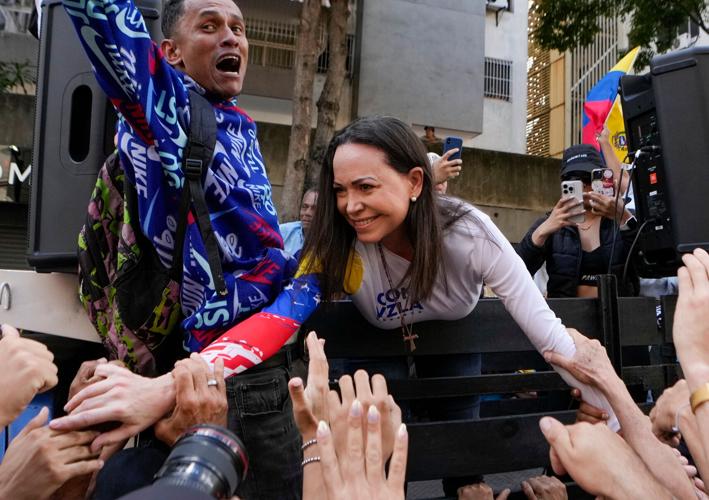
Opposition leader Maria Corina Machado greets supporters Jan. 9, 2025, in Caracas, Venezuela, during a protest against Venezuelan President Nicolas Maduro the day before his inauguration for a third term.
Economic problems
Inflation and severe shortages of food and medicines affected Venezuelans nationwide. Families starved and more than 7.7 million people fled the country. Those who remained lined up for hours to buy rice, beans and other basics; some fought on the streets over flour.
Ruling party loyalists moved the December 2018 presidential election to May and blocked opposition parties from the ballot. Some opposition politicians were imprisoned; others fled into exile. Maduro was declared winner, but dozens of countries did not recognize him.
Months after the election, he drew fury after social media videos showed him feasting on a steak a celebrity chef prepared at a restaurant in Turkey while millions in his country went hungry.
Under Maduro's watch, Venezuela's economy shrank 71% between 2012 and 2020, while inflation topped 130,000%. Its oil production dropped to less than 400,000 barrels a day.

The first Trump administration imposed economic sanctions against Maduro, his allies and state-owned companies to try to force a government change.
Maduro began implementing economic measures in 2021 that eventually ended Venezuela's hyperinflation cycle. He made concessions to the U.S.-backed political opposition, with which it restarted negotiations for what many hoped would be a free and democratic presidential election in 2024.
Maduro used negotiations to gain concessions from the U.S. government, including the pardon and prison release of one of his closest allies and the sanctions license that allowed oil giant Chevron to restart pumping and exporting Venezuelan oil. The license became his government's financial lifeline.
The government in 2023 banned Machado from running for office and, in early 2024, it intensified repressive efforts, detaining opposition leaders and human rights defenders.
US captures Venezuela's leader in military operation

Men watch smoke rising from a dock Saturday, Jan. 3, 2026, at La Guaira port, Venezuela, after explosions were heard.

Pedestrians walk past destroyed containers Saturday, Jan. 3, 2026, at La Guaira port, Venezuela, after explosions were heard.

Venezuela's President Nicolas Maduro, then Constituent National Assembly President Delcy Rodriguez, left, and first lady Cilia Flores, wave May 24, 2018, as they arrive at the National Assembly in Caracas, Venezuela.

Residents evacuate a building Saturday, Jan. 3, 2026, near the Miraflores presidential palace in Caracas, Venezuela, after explosions and low-flying aircraft were heard.

Soldiers guard the area around the Miraflores presidential palace Saturday, Jan. 3, 2026, in Caracas, Venezuela, after explosions and low-flying aircraft were heard.

Pedestrians walk past the Miraflores presidential palace Saturday, Jan. 3, 2026, in Caracas, Venezuela, after explosions and low-flying aircraft were heard.

Supporters of Venezuelan President Nicolás Maduro embrace Saturday, Jan. 3, 2026, in downtown Caracas, Venezuela, after U.S. President Donald Trump announced Maduro was captured.

Venezuelans celebrate Saturday, Jan. 3, 2026, in Lima, Peru, after U.S. President Donald Trump announced Venezuelan President Nicolas Maduro was captured.

Pro-government armed civilians patrol Saturday, Jan. 3, 2026, in La Guaira, Venezuela, after U.S. President Donald Trump said President Nicolás Maduro was captured.

Smoke rises Saturday, Jan. 3, 2026, from Fort Tiuna, the main military garrison in Caracas, Venezuela, after aircraft swept through the area and multiple explosions were heard.

A destroyed armored vehicle sits Saturday, Jan. 3, 2026, at La Carlota airport in Caracas, Venezuela, after explosions were reported at the site.

Pro-government armed civilians deploy Saturday, Jan. 3, 2026, in Caracas, Venezuela, after U.S. President Donald Trump announced that President Nicolás Maduro was captured.

Police and pro-government armed civilians block streets Saturday, Jan. 3, 2026, in Caracas, Venezuela.

National Guard armored vehicles block an avenue Saturday, Jan. 3, 2026, leading to Miraflores presidential palace in Caracas, Venezuela.

