

Activists and politicians are marking the one-year anniversary of the U.S. Supreme Court ruling that overturned a nationwide right to abortion with a range of reactions that vary from praise and protests.
Advocates on both sides marched at rallies Saturday in Washington and across the country to call attention to the Dobbs v. Jackson Women's Health Organization ruling on June 24, 2022, which upended the 1973 Roe v. Wade decision.
"I'm absolutely livid that people think that they can interfere with medical decisions between a woman and her doctor," Lynn Rust of Silver Springs, Maryland, said at a Women's March rally in Washington.
In Chicago, dueling rallies gathered on opposite sides of a street outside a downtown federal building. There was shouting but no reports of clashes.
“The elected officials in Illinois are trying to turn us into the abortion capital of the middle of the country,” Peter Breen, vice president of the conservative Thomas More Society, told the Chicago Tribune.
Andy Thayer of the Gay Liberation Network said people in Illinois who are pro-abortion rights can't be complacent because conservative judges have been appointed to key court positions. “That’s why we have to be in the streets,” he said.

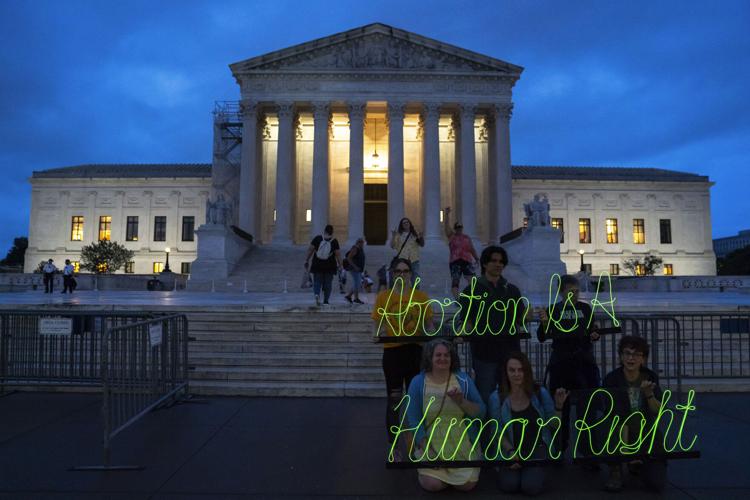
Demonstrators mark the first anniversary of the Supreme Court's Dobbs v. Jackson Women's Health Organization decision, the case widely considered to have overturned Roe v. Wade, by displaying neon signs in support of abortion access Friday in front of the Supreme Court in Washington.
The Dobbs decision made abortion an unavoidable campaign issue and deepened policy differences between the states.
Most Republican-controlled states imposed bans, including 14 where laws now block most abortions in every stage of pregnancy, with varying exceptions for the life and health of the women and for pregnancies resulting from rape or incest. Most Democrat-led states took steps to protect abortion access, particularly by seeking to protect doctors and others from prosecution for violating other states' abortion bans.
The issue is far from settled, as demonstrated by Saturday's rallies as well as the past year's battles that have played out in courtrooms, on ballots and in state legislatures.
Judges are still weighing whether the bans and restrictions in several states comply with state constitutions. As soon as this fall, more voters could decide directly on abortion-related policies; last year, they sided with abortion rights in all six states with measures on the ballot. The issue will be on the ballot in elections this year and next.

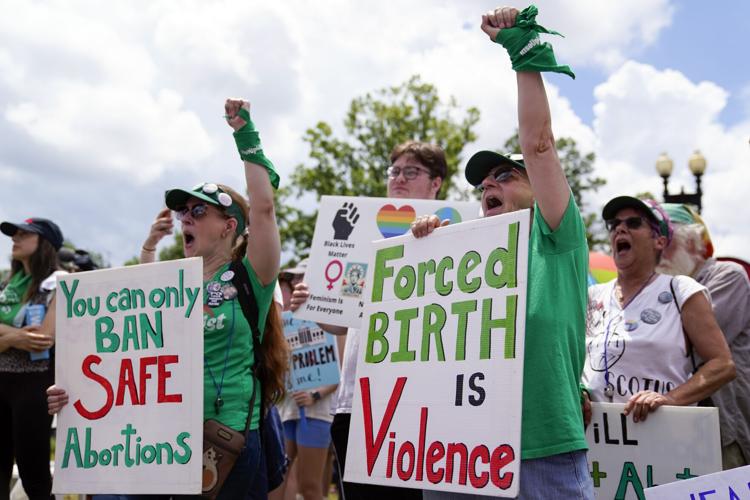
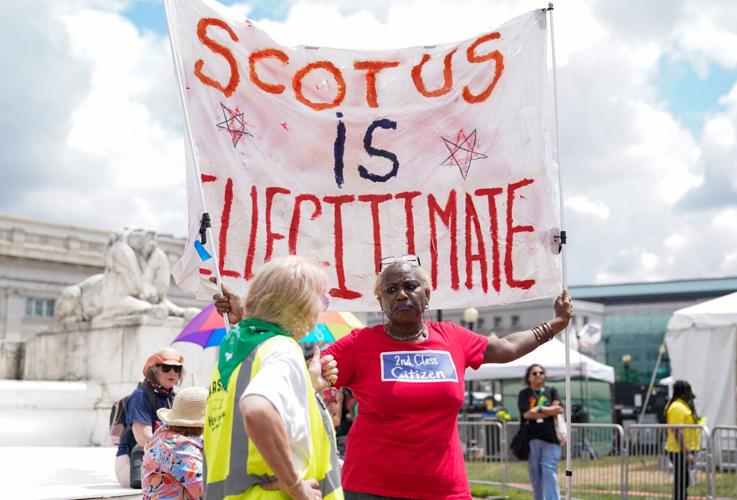
Demonstrators hold signs Saturday as they gather for the Women's March in Washington.
Vice President Kamala Harris spoke about the impact of the Dobbs ruling in Charlotte, North Carolina.
"We knew this decision would create a health care crisis in America," Harris said, pointing to women who were initially denied abortion access even during miscarriages because hospitals were concerned about the legal fallout.
The laws restricting abortion "in design and effect have created chaos, confusion and fear," she said.
While there's far from a universal consensus among voters, public opinion polls have consistently found that the majority oppose the most restrictive bans but also oppose unchecked abortion access at all stages of pregnancy.
While Biden pushed for a national law to reinstate abortion access, Republicans called for a national ban.
Saturday evening, former President Donald Trump was the keynote speaker at the Faith and Freedom Coalition conference in Washington. He praised his three Supreme Corurt nominees.
“Exactly one year ago today, those justices were the pivotal votes in the Supreme Court’s landmark decision ending the constitutional atrocity known as Roe v. Wade," Trump said.
He also declared: “I am proud to be the most pro-life president in American history.”
On Friday, former Vice President Mike Pence, who is seeking the 2024 GOP presidential nomination, called for his party's presidential candidates to join him in backing a national ban after 15 weeks of pregnancy.
With Democrats controlling the presidency and U.S. Senate and Republicans holding the House, no federal change is imminent.

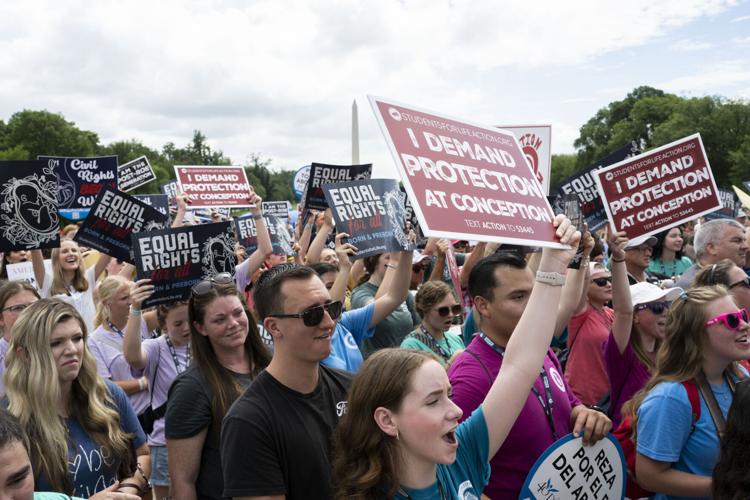
Anti-abortion activists cheer before Republican presidential candidate former Vice President Mike Pence speaks Saturday at the National Celebrate Life Rally at the Lincoln Memorial in Washington.
Nikki Haley, another GOP presidential candidate and former ambassador to the United Nations, said she backs a federal ban but it doesn't have enough support to advance. Speaking at the Faith and Freedom Conference in Washington, Haley said both parities should instead look to goals such as limiting abortion later in pregnancy. Only a half-dozen states allow abortion at any point in pregnancy, and abortions after 21 weeks or so are very rare.
"We need to make sure that our country stops demonizing this issue and we humanize this issue," Haley said. "This is personal for everyone."
Policies have vast practical implications.
In states with the deepest bans, the number of abortions has plummeted to nearly zero. There have been more abortions in states where access has been maintained — especially those closest to those with bans, as women travel for care they used to be able to get closer to home.
"I can't tell you how many people arrive at the clinic utterly exhausted after driving all night from Georgia, Tennessee, Louisiana," said Amy Bryant, a doctor who provides abortions at a clinic in Chapel Hill, North Carolina.

A demonstrator holds a sign Saturday as people gather for the Women's March in Washington.
There's also been a rise in use of networks that distribute abortion pills.
Because of lags and gaps in official reporting, and because some of the pill use goes unreported, the impact on the total number of abortions in the U.S. is not clear.
While abortions have continued, advocates say there's an equity problem: Black women and lower-income women especially, they say, are those who were expected to lose access.
"Seeing how it impacts every one in the country, but especially the people who are already at a disadvantage and don't have that access is really scary," Larkin O'Gorman, a Washington resident, said at the Women's March event.
Today in history: June 24
1946: Fred M. Vinson
Updated
In 1946, Fred M. Vinson was sworn in as the 13th chief justice of the United States, succeeding the late Harlan F. Stone.
1973: Richard Nixon
Updated
In 1973, President Richard Nixon concluded his summit with the visiting leader of the Soviet Union, Leonid Brezhnev, who hailed the talks in an address on American television.
1983: Sally K. Ride
Updated
In 1983, the space shuttle Challenger — carrying America’s first woman in space, Sally K. Ride — coasted to a safe landing at Edwards Air Force Base in California.
2012: Eric Schneiderman
Updated
New York Attorney General Eric Schneiderman announced a settlement that would bring $405 million to victims of Bernard Madoff’s historic investment scam.
2012: Mohammed Morsi
Updated
Ten years ago: The Muslim Brotherhood’s Mohammed Morsi was declared the winner of Egypt’s first free presidential election.
2013: George Zimmerman
Updated
In 2013, opening statements took place in the Sanford, Florida, trial of George Zimmerman, accused of murdering 17-year-old Trayvon Martin. (Zimmerman was acquitted.)
2015: Dzhokhar Tsarnaev
Updated
In 2015, a federal judge in Boston formally sentenced Boston Marathon bomber Dzhokhar Tsarnaev (joh-HAHR’ sahr-NEYE’-ehv) to death for the 2013 terror attacks. (A federal appeals court later threw out the sentence; the Supreme Court reinstated it.)
2017: Steven Mnuchin
Updated
Five years ago: President Donald Trump and first lady Melania Trump were among the guests as Treasury Secretary Steven Mnuchin (mih-NOO’-shin) married Scottish actor Louise Linton in Washington.
2020: Ahmaud Arbery
Updated
In 2020, three white men were indicted on murder charges in the killing of Ahmaud Arbery, a Black man who was shot while running in a neighborhood near Georgia’s coast. (All three were convicted.)
2021: Nancy Pelosi
Updated
House Speaker Nancy Pelosi said she would create a special committee to investigate the Jan. 6 attack on the Capitol; Senate Republicans had blocked legislation that would form a bipartisan commission to investigate the attack.
2021: Rudy Giuliani
Updated
An appeals court suspended Rudy Giuliani from practicing law in New York because he made false statements while trying to get courts to overturn Donald Trump’s loss in the presidential race.
2022: Roe v. Wade overturned
Updated
In 2022, the Supreme Court ended constitutional protections for abortion that had been in place nearly 50 years — a decision by its conservative majority to overturn the court’s landmark abortion cases. The outcome overturning Roe v. Wade was expected to lead to abortion bans in roughly half the states.

