

WASHINGTON — Get ready for several years of even more record-breaking heat that pushes Earth to more deadly, fiery and uncomfortable extremes, two of the world's top weather agencies forecast.
There's an 80% chance the world will break another annual temperature record in the next five years, and it's even more probable that the world will again exceed the international temperature threshold set 10 years ago, according to a five-year forecast released Wednesday by the World Meteorological Organization and the U.K. Meteorological Office.
"Higher global mean temperatures may sound abstract, but it translates in real life to a higher chance of extreme weather: stronger hurricanes, stronger precipitation, droughts," said Cornell University climate scientist Natalie Mahowald, who wasn't part of the calculations but said they made sense. "So higher global mean temperatures translates to more lives lost."

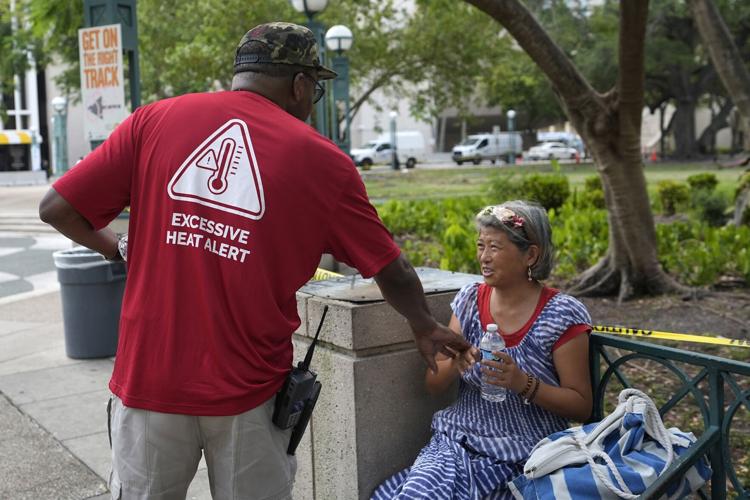
Ricky Leath, an outreach specialist with the City of Miami, talks with Bei Zhao, right, May 15, 2024, as he works with the Miami-Dade County Homeless Trust to distribute bottles of water and other supplies to the homeless population in Miami.
With every tenth of a degree the world warms from human-caused climate change "we will experience higher frequency and more extreme events (particularly heat waves but also droughts, floods, fires and human-reinforced hurricanes/typhoons)," emailed Johan Rockstrom, director of the Potsdam Institute for Climate Impact Research in Germany. He was not part of the research.
For the first time there's a chance — albeit slight — that before the end of the decade, the world's annual temperature will shoot past the Paris climate accord goal of limiting warming to 1.5 degrees Celsius and hit a more alarming 2 degrees Celsius of heating since the mid-1800s, the two agencies said.
There's an 86% chance that one of the next five years will pass 1.5 degrees and a 70% chance that the five years as a whole will average more than that global milestone, they figured.
The projections come from more than 200 forecasts using computer simulations run by 10 global centers of scientists.

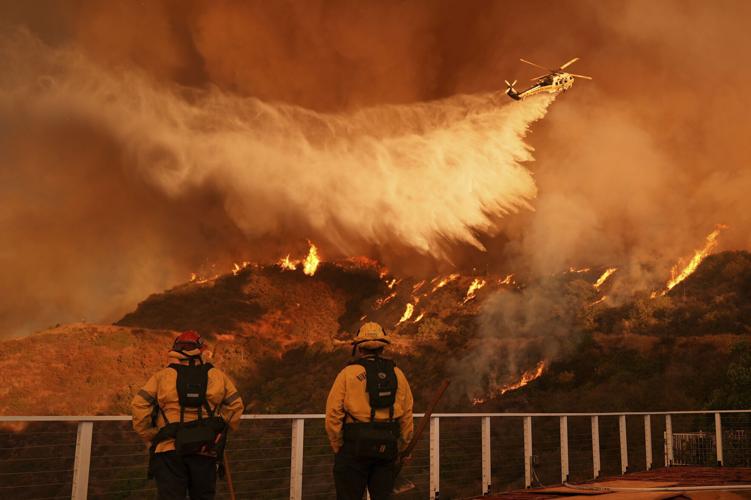
Firefighters watch a helicopter drop water Jan. 11 on the Palisades Fire in Mandeville Canyon in Los Angeles.
Ten years ago, the same teams figured there was a similar remote chance — about 1% — that one of the upcoming years would exceed that critical 1.5 degree threshold and then it happened last year. This year, a 2-degree Celsius above pre-industrial year enters the equation in a similar manner, something UK Met Office longer term predictions chief Adam Scaife and science scientist Leon Hermanson called "shocking."
"It's not something anyone wants to see, but that's what the science is telling us," Hermanson said. Two degrees of warming is the secondary threshold, the one considered less likely to break, set by the 2015 Paris agreement.
Technically, even though 2024 was 1.5 degrees Celsius warmer than pre-industrial times, the Paris climate agreement's threshold is for a 20-year time period, so it has not been exceeded. Factoring in the past 10 years and forecasting the next 10 years, the world is now probably about 1.4 degrees Celsius hotter since the mid 1800s, World Meteorological Organization climate services director Chris Hewitt estimated.
"With the next five years forecast to be more than 1.5C warmer than pre-industrial levels on average, this will put more people than ever at risk of severe heat waves, bringing more deaths and severe health impacts unless people can be better protected from the effects of heat. Also we can expect more severe wildfires as the hotter atmosphere dries out the landscape," said Richard Betts, head of climate impacts research at the UK Met Office and a professor at the University of Exeter.
Ice in the Arctic — which will continue to warm 3.5 times faster than the rest of the world — will melt and seas will rise faster, Hewitt said.
What tends to happen is that global temperatures rise like riding on an escalator, with temporary and natural El Nino weather cycles acting like jumps up or down on that escalator, scientists said. But lately, after each jump from an El Nino, which adds warming to the globe, the planet doesn't go back down much, if at all.
"Record temperatures immediately become the new normal," said Stanford University climate scientist Rob Jackson.
Is the US becoming uninsurable? How climate change affects insurance costs
Is the US becoming uninsurable? How climate change affects insurance costs
Updated
As Southern California still reels from January's catastrophic wildfires, the economic damage has surged to $250 billion, far exceeding initial estimates. But that figure doesn't account for damage incurred by residents whose homes and businesses were reduced to rubble and ash.
The Palisades and Eaton fires alone will result in up to $45 billion in insurance payouts to homeowners and businesses, according to data analytics firm CoreLogic. Of course, that only applies to residents who had insurance in the first place.
In the wake of an extreme weather event, residents typically can rely on insurance claims to repair damaged property —but the increasing frequency and severity of fires, storms, floods, and other occurrences complicate coverage.
The National Oceanic and Atmospheric Administration in 2023 documented 28 separate billion-dollar climate and weather disasters across the U.S., a number that outpaced any prior year on record. Climate change is the main culprit fueling these disasters' increasing frequency and intensity. By September 2023, NOAA reported that the U.S. had already racked up a staggering $57.6 billion in damages for that year.
Insurance companies have responded with higher rates to cover costs, culminating in overall higher insurance fees for customers. In June, the Bipartisan Policy Center reported that property insurance rates have increased every quarter since the end of 2017. And car insurance isn't faring any better, either: According to the Washington Post, blizzards, tornadoes, and hailstorms led to a 52% increase in auto insurance premiums in Colorado from 2013 to 2023, and hurricanes are responsible for an 88% jump in Florida over the same period.
CheapInsurance.com used data from NOAA to analyze the rising number of billion-dollar disasters and their implications for the insurance marketplace in the U.S.
Some insurers have begun leaving states altogether to ensure profit margins, particularly in coastal areas. Notably, Allstate and State Farm halted new policy sales in 2023 for property and casualty coverage in California due to wildfire costs. Many insurers have abandoned Louisiana and Florida residents as hurricane risk intensifies.
Annual home insurance rates average $2,258 as of February 2025—a slight dip from last year. Costs vary widely based on a home's size, age, and location. Nebraska, Florida, and Oklahoma have the highest rates in the nation.

Severe storms cause the most damage nationally each year
Updated
Droughts, storms, and floods were nearly unrelenting throughout 2023. In August, Hurricane Idalia brought storm surge, heavy rains, and flooding to Florida, Georgia, and the Carolinas, causing $3.5 billion in damages. 2024 didn't offer much of a break, either. The year began with tornadoes and high winds across the entire East Coast, racking up $1.8 billion in damages, and ended with back-to-back catastrophic hurricanes, Helene and Milton. Together, they caused an estimated $300 billion in damages and killed 250 people in Florida and other southeastern states.
With severe weather disasters becoming more common, the market for insurance has become more limited—especially in disaster-prone states. In Florida and California, for instance, some big-name insurers have stopped providing services altogether. To counter this, Florida implemented the Hurricane Catastrophe Fund and Citizens Property Insurance Corporation, both of which subsidize home insurance.
California, on the other hand, regulates insurer rates by only allowing them to evaluate based on the past 20 years, not just the current conditions. Both methods are imperfect: Florida's subsidy funds are draining quickly, and many insurers refuse to operate in California.
It's important to note that insurance alone is just treating the symptom of a larger issue: In addition to reevaluating home and auto insurance policies, states need to examine how they brace for—and recover from—natural disasters overall. As storms grow and insurance vanishes, they can't afford not to.
A mutually beneficial option might be for insurers and clients to engage in more transparent negotiations. In wildfire-riddled Oregon, for example, new legislation is attempting to encourage insurers to work with citizens to identify and increase coverage for mitigation measures.
Story editing by Nicole Caldwell and Alizah Salario. Additional editing by Kelly Glass and Elisa Huang. Copy editing by Tim Bruns and Kristen Wegrzyn.
This story originally appeared on CheapInsurance.com and was produced and distributed in partnership with Stacker Studio.

