

SHAMROCK, Texas — As severe storms once again soak, twist and pelt the nation's midsection, a team of dozens of scientists is driving into them to study one of the nation's costliest but least-appreciated weather dangers: Hail.
Hail rarely kills, but it hammers roofs, cars and crops to the tune of $10 billion a year in damage in the U.S. So in one of the few federally funded science studies remaining after Trump administration cuts, teams from several universities are observing storms from the inside and seeing how the hail forms. Project ICECHIP has already collected and dissected hail the size of small cantaloupes, along with ice balls of all sizes and shapes.

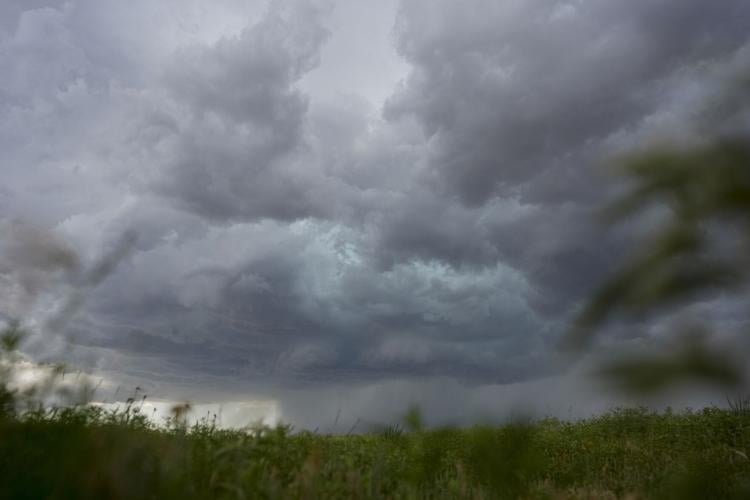
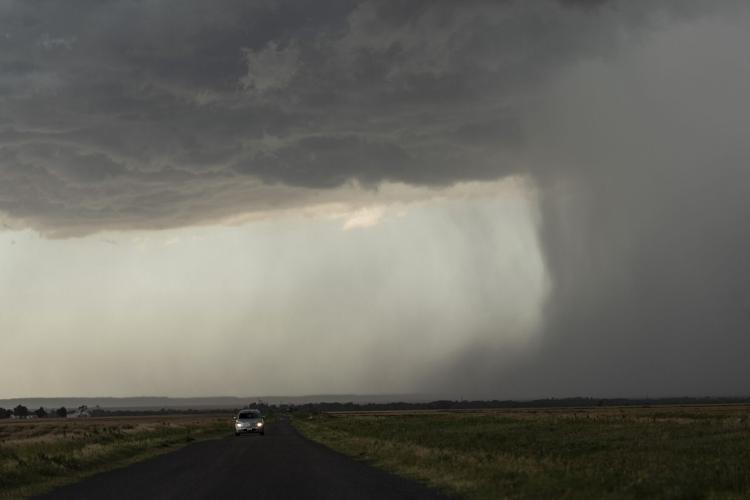
An approaching storm and rain shaft is visible during a Project ICECHIP operation June 3 near Tipton, Okla.
Scientists in two hail-dimpled vehicles with special mesh protecting the windshields are driving straight into the heart of the storms, an area known as the "shaft" where the hail pelting is the most intense. It's a first-of-its-kind icy twist on tornado chasing.
"It's an interesting experience. It sounds like somebody on the outside of your vehicle is hitting you with a hammer," said Northern Illinois University meteorology professor Victor Gensini, one of the lead researchers.
A team of journalists from The Associated Press joined them this week in a several-day trek across the Great Plains, starting Tuesday morning in northern Texas with a weather briefing before joining a caravan of scientists and students looking for ice.

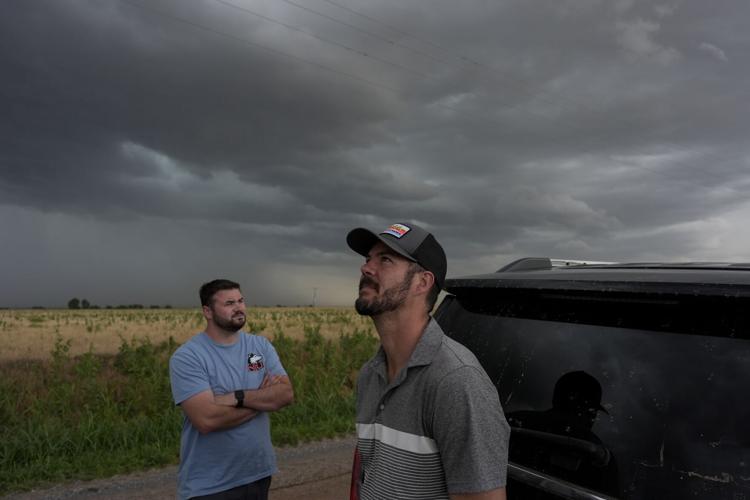
Victor Gensini, Northern Illinois University meteorology professor and a lead scientist of Project ICECHIP, right, and Logan Bundy, a doctoral candidate at NIU and ICECHIP IOP assistant, look at cloud formations during a Project ICECHIP operation June 3 south of Tipton, Okla.
Driving toward the most extreme forecasts
The caravan features more than a dozen radar trucks and weather balloon launching vehicles. At each site, the scientists load and unload drones, lasers and cameras and other specialized equipment. There are foam pads to measure hail impact and experimental roofing material. There are even special person-sized funnels to collect pristine hail before it hits the ground and becomes tainted with dirt.
Already in treks across Kansas, Oklahoma and Texas, the team has found hail measuring more than 5 inches in diameter — bigger than a softball, but not quite a soccer ball. The team's equipment and vehicles already sport dings, dimples and dents that scientists show off like battle scars.
"We got a few good whacks," said forensic engineer Tim Marshall, who was carrying roofing samples to see if there were ways shingles could better handle hail. "I look at broken, busted stuff all the time."

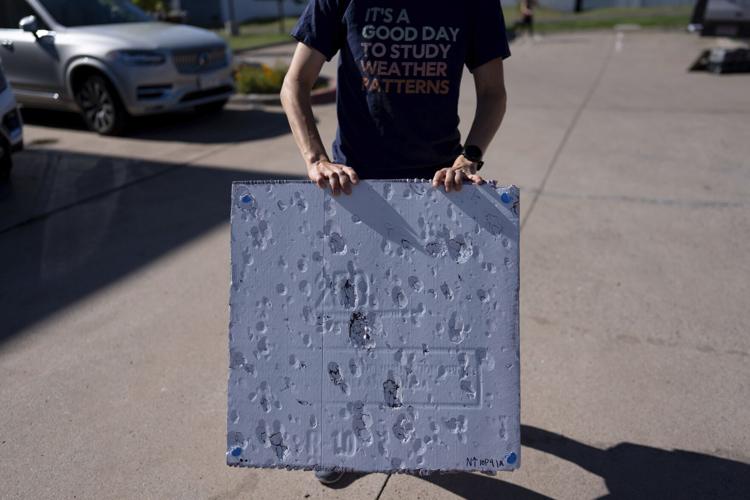
Hannah Vagasky holds a foam board hail pad covered with impact dents in a parking lot June 3 in Shamrock, Texas, as the team prepares for a day of hailstorm chasing. The hail pad is used to measure the size, angle of impact and intensity of hail.
At Tuesday's weather briefing, retired National Weather Service forecaster David Imy pointed to potential hot spots this week in Texas, Oklahoma and New Mexico. Computer models show the potential for a "monster storm down here near the Red River" later in the week, he said. Acting on the latest forecasts, Gensini and other leaders told the team to head to Altus, Oklahoma, but be ready to cross the Red River back into Texas at a moment's notice.
A few hours after his briefing, Imy had the opportunity to chase one of the bigger storms, packing what radar showed was large hail at 8,000 feet in the air. Because of the warm air closer to the surface, the hail was only pea sized by the time it hit the ground. But the outing still provided good data and beautiful views for Imy, who was with a group that stationed themselves about a half-mile from the center of the storm.
"Beautiful colors: turquoise, bluish green, teal," Imy said, pointing to the mushroom shaped cloud dominating the sky. "This is beauty to me and also seeing the power of nature."

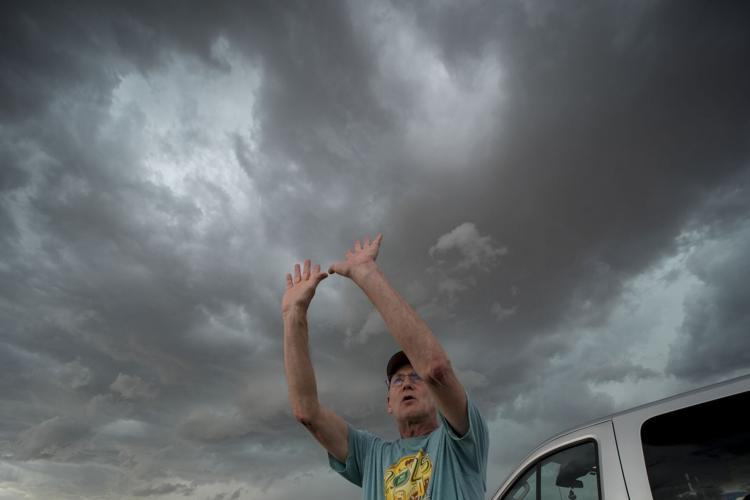
Retired National Weather Service forecaster David Imy gestures to an approaching storm during a Project ICECHIP operation June 3 near Tipton, Okla. He's part of a team of scientists driving into severe storms to study hail.
A costly but overlooked severe weather problem
This is not just a bunch of scientists looking for an adrenaline rush or another sequel to the movie "Twister." It's serious science research into weather that damages a lot of crops in the Midwest, Gensini said. Hail damage is so costly that the insurance industry is helping to pay for the mission, which is primarily funded by the National Science Foundation.
"These are the stones that do the most damage to lives and property," Gensini said. "We want the biggest hail possible."

A car moves away from an approaching storm with a rain shaft during a Project ICECHIP operation June 3 near Tipton, Okla.
A 2024 study by Gensini found that as the world warms from human-caused climate change, small hailstones will become less likely while the larger ones become more common.
The bigger, more damaging ones that the ICECHIP team is studying are projected to increase 15% to 75% this century depending on how much the world warms. That's because the stronger updrafts in storms would keep stones aloft longer to get bigger, but the heat would melt the tinier ones.
The experiment is unique because of the combination of driving into the hail and deploying numerous radars and weather balloons to get an overall picture of how the storms work, Gensini said, adding that hail is often overlooked because researchers have considered it a lower priority than other extreme weather events.

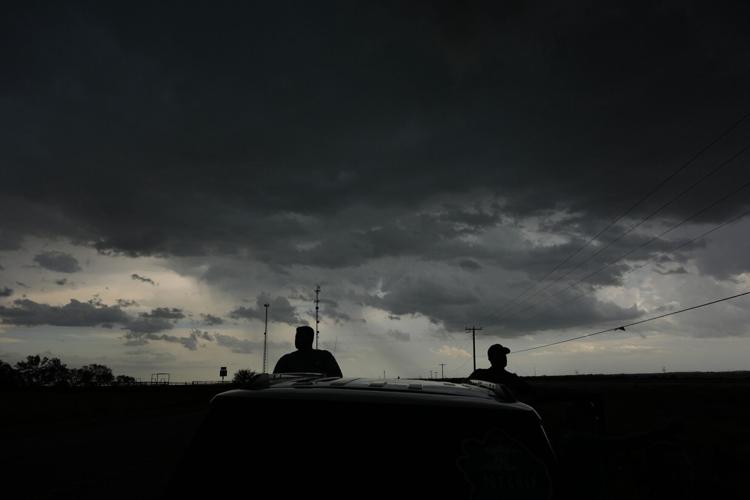
Victor Gensini, Northern Illinois University meteorology professor and a lead scientist of Project ICECHIP, right, and Logan Bundy, a doctoral candidate at NIU and ICECHIP IOP assistant, left, stand at the command vehicle watching an approaching storm June 3 in Scotland, Texas.
Outside scientists said the research mission looks promising because there are a lot of unanswered questions about hail. Hail is the No. 1 reason for soaring costs in billion-dollar weather disasters in the United States, said meteorologist Jeff Masters, who cofounded Weather Underground and is now at Yale Climate Connections.
"Now a large part of that reason is because we simply have more people with more stuff in harm's way," said Masters, who wasn't part of the research. "Insurance has become unaffordable in a lot of places and hail has become a big reason."
In Colorado, hail is "actually our most costly natural disaster," said Lori Peek, director of the Natural Hazards Center at the University of Colorado, adding that "hail does such incredible damage to property."


Oh, great: Rat populations are surging as cities heat up
Oh, great: Rat populations are surging as cities heat up
Updated
Rats are, in many ways, better adapted to cities than the humans that built them. While urbanites struggle with crowds, sparse parking spaces, and their upstairs neighbors stomping around at 4 a.m., rats are living their best lives. Huddled safely underground, they pop up at night to chew through heaps of food waste in dumpsters and hot dogs left on stoops.
Now, scientists have found yet another gnawing advantage for rats, Grist reports. A study published in January in the journal Science Advances found that as temperatures climb in cities, rat populations are growing, even as city dwellers suffer. "In cities that have experienced the fastest warming temperatures, they tended to have faster increases in their rat numbers as well," said Jonathan Richardson, an urban ecologist at the University of Richmond and lead author of the paper. "Females will reach sexual maturity faster. They're able to breed more, and typically, their litters are larger at warmer temperatures in the lab."
The analysis used public complaints about rats and inspection records from 16 cities between 2007 and 2024, which collectively served as a proxy for rat populations. In 11 of those cities, rat numbers surged during that period. The winner of the Most Rats Gained award goes to Washington, D.C., with a 390% increase according to the city's last decade of data, followed by San Francisco (300%), Toronto (186%), and New York City (162 percent). Meanwhile, a few cities actually saw their rat populations decrease, including New Orleans, Tokyo, and Louisville, Kentucky, due in part to more diligent pest control.
"It's a first step at answering this question, that if you get a bunch of rat scientists into a room, we're bound to ask each other: How might climate change play into rat populations?" said Kaylee Byers, a health researcher at Simon Fraser University in Canada, who wasn't involved in the study.
Beyond the physiological factors that influence breeding, rat behavior changes with temperature, too. If it's too cold out, the rodents tend to huddle underground—in basements, sewers, and really anywhere else in the subterranean built environment. Once it warms up, rats emerge and gorge, but also bring food back to their nests to store in caches. Climate change is also altering the timing of seasons: If the weather stays warmer a week or two longer into the early winter, and if spring comes a week or two earlier, that's more time to forage. "Rats are really well-adapted to take advantage of a food resource and convert that to new baby rats that you'll see in your neighborhood," Richardson said.
While temperatures are rising globally, they're getting particularly extreme in cities thanks to the urban heat island effect. Buildings and concrete absorb the sun's energy, raising temperatures up to 27 degrees Fahrenheit higher than in surrounding rural areas and releasing that heat at night. That's especially dangerous in the summer for urbanites during prolonged heat waves. But in the winter, that bit of extra heat could be helping rats.
Rising temperatures were the dominant force helping rat populations grow, but they weren't the only factor, the study found. Urban human populations are exploding around the world, and they're wasting a lot of food for rats to find. As cities expand around their edges, they have to add new infrastructure, which rats colonize. And when cities build new sewer systems to handle more people, they often leave the old ones in place, providing a welcoming environment for rats. "The vestigial urban infrastructure that's down there, it doesn't really matter for us," Richardson said. "But for a rat, that's like a free highway."
The researchers also found that cities with fewer green spaces had higher growth of rat populations. It's not clear yet why that might be, they said. No two green spaces are the same: A small urban park might teem with rats because office workers flock there to eat lunch, then drop their leftovers in trash bins, whereas the interior of a larger space like Central Park might provide less food and fewer places for rodents to hide from predators like hawks and coyotes.
So how can a city control its rat population as temperatures rise? For one, by getting more data like the numbers found in this study. "You can't manage what you can't measure," said Niamh M. Quinn, who studies human-wildlife interactions at the University of California Division of Agriculture and Natural Resources but wasn't involved in the research. "We live in an infinite sea of rats, so you can't just manage small pockets. You have to have municipal rat management."
New Orleans has succeeded by being proactive, Richardson said, such as with education campaigns teaching building owners how to rat-proof their structures, and insisting that if they do see rats to call the city for eradication. Cities can't just poison their way out of this problem without hurting other animals, he said, because that poison makes its way into the stomachs of rat-eating predators.
"Right now, our approach to rat management is very reactive," Byers said. "We're not thinking about the future at all. We need to do that if we're actually concerned about rats, and if we want to manage the risks associated with them."

This story was produced by Grist and reviewed and distributed by Stacker.

