

KODIAK, Alaska — Gabriel Prout worked four seasons on his father's crab boat, the Silver Spray, before joining his two brothers in 2020 to buy a half-interest plus access rights for a snow crab fishery that's typically the largest and richest in the Bering Sea. Then in 2021, disaster: an annual survey found crabs crashing to an all-time low. The red king crab fishery was closed; the snow crab fishery cut to a tenth of the previous year's take.
After another bad survey last year, the red king crab fishery closed again and the snow crab fishery closed for the first time ever. Suddenly, Prout's optimism about being his family's third generation in crab fishing seemed misplaced.

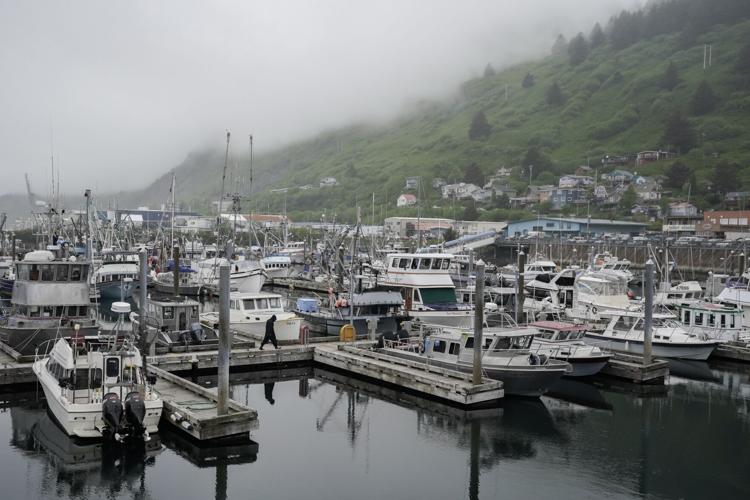
A person walks across the dock June 22 at St. Paul Harbor in Kodiak, Alaska, where crab fishers have been scrambling to stay afloat after two years of the Bering Sea fishery being closed or severely curtailed.
“It’s very hard to find a way to keep going forward,” said Prout, 33. With almost all his expected income gone, he's scrambled ever since to scratch out a living by working as a salmon tender — using his boat to supply other boats and offload their catch.
Researchers are scrambling to understand crabs' collapse, with seas warmed by climate change as one theory. Preliminary data from this year's survey suggest another year of closed or severely limited fisheries, with decisions on crab catch limits expected in early October shortly before the season traditionally opens.
Kevin Abena, who runs a fishing business with his father, also relies on tendering to stay afloat in the wake of the crab fishery closure. His vessel Big Blue, which his father built in the late 1970s, stopped fishing for most crab in Bristol Bay in 2010, but they still own access rights and take a percentage from other boats that fish their quota. Abena also fishes for halibut and black cod.
His income has dropped by about 20%, he said. He sympathizes with the larger hit taken by owners of boats with rights only for crab.
“That’s rent, that’s mortgages, that’s everything in life,” he said.

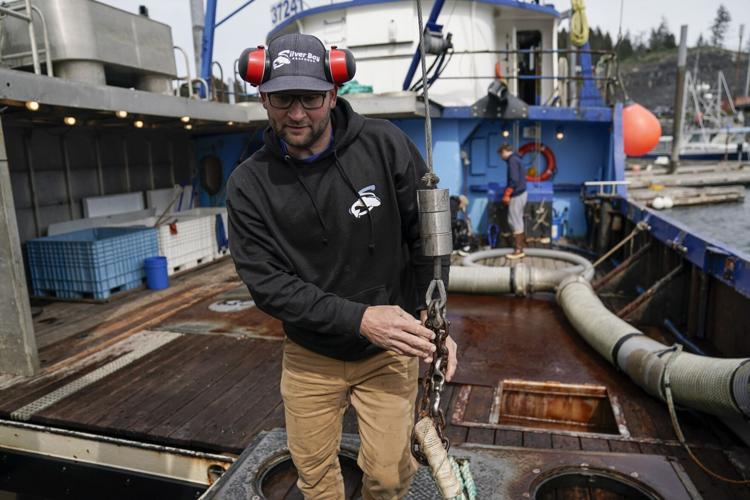
Kevin Abena, who runs a fishing business with his father, walks across the deck June 25 as he docks at Saint Herman Harbor in Kodiak, Alaska. They rely on tendering to stay afloat in the wake of the crab fishery closure. His vessel Big Blue, stopped fishing for most crab in Bristol Bay in 2010, but they still own access rights and take a percentage from other boats that fish their quota.
Abena, a board member of the Kodiak Crab Alliance Cooperative, said he's seen the competition increase for tendering and for access to other fisheries. He noticed more boats going after tanner crab last season — a much smaller fishery, but one that was open.
When fisheries get closed “you displace a lot of boats and a lot of crew,” he said. “It makes people start hunting for more opportunity.”
But not all boats can adapt quickly to work in another fishery. Different equipment is often needed and access rights are necessary, both costly investments.

Scientists say two years of low sea ice cover and abnormally warm ocean temperatures due to climate change in 2018 and 2019 may have altered the ecosystem in a way that snow crab couldn’t survive, said Mike Litzow, lab director at the Kodiak Fisheries Science Center. Their annual survey, which was skipped in 2020 due to COVID, found total crab populations in the Bering Sea plummeted from an all-time high of 11.7 billion in 2018 to 940 million in 2021, the lowest ever recorded.

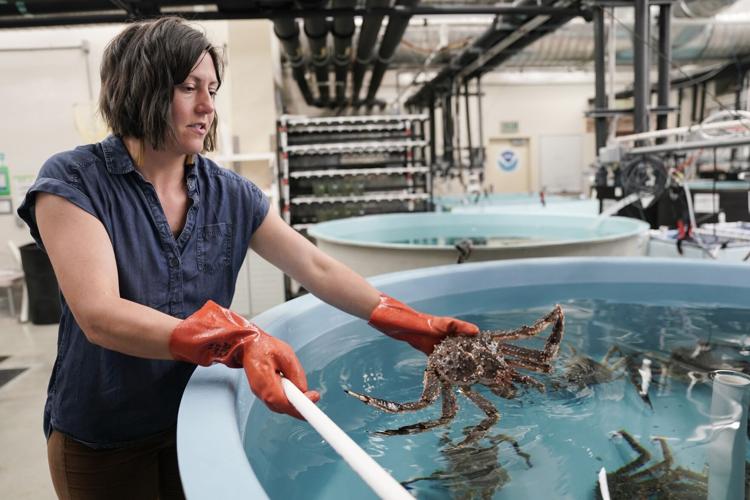
Erin Fedewa, a research fisheries biologist, places a red king crab back in a tank June 22 at the Alaska Fisheries Science Center in Kodiak, Alaska. Researchers are scrambling to understand crabs' collapse, with seas warmed by climate change as one theory.
Researchers this year brought samples of crab back to Kodiak for further analysis, exploring how snow crab respond to stress in their environment, including rising heat.
Snow crab are typically found in a cold pool — water in the Bering Sea that stays below 35.6 degrees Fahrenheit throughout the year. Researchers have found these crab can survive in water warmer than this, leading them to speculate that rising ocean temperatures alone aren't to blame for the collapse. Instead, researchers think the warmer water may have allowed more predators into the habitat, facilitated disease spread or made it harder for the crabs to catch enough prey to fuel an increased metabolism.
“They’re an Arctic animal,” Litzow said. “Longer term, what we expect is that the fish will be moving farther north as those Arctic characteristics recede in the Bering Sea.”
Researchers and managers have started examining data from this year’s survey. It will help determine what crab fisheries might open this winter and decisions on each kind of crab are expected some time in early October.

“We were making a prediction last year about outcomes for this year and I think we are more right than wrong,” said Mark Stichert, the groundfish and shellfish fisheries coordinator for the Alaska Department of Fish and Game. “We think things are going to get worse before they get better.”

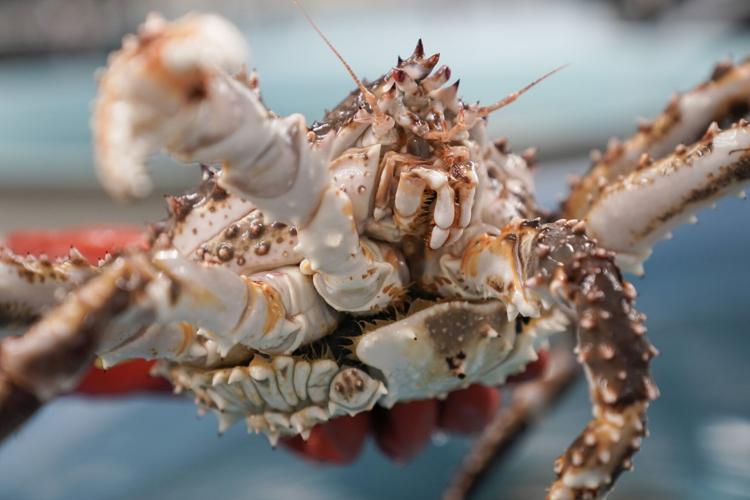
Erin Fedewa, a research fisheries biologist, holds an adult red king crab June 22 at the Alaska Fisheries Science Center in Kodiak, Alaska. “We were making a prediction last year about outcomes for this year and I think we are more right than wrong,” said Mark Stichert, the groundfish and shellfish fisheries coordinator for the Alaska Department of Fish and Game. “We think things are going to get worse before they get better.”
Some fishers have questioned why trawl boats, which use large nets to catch a variety of fish, are still being allowed to operate. They also say the trawl nets can damage crab habitat by dragging across the bottom of the ocean.
In May, the U.S. Department of Commerce allocated almost $192 million to help Alaska fishers affected by the closures of the king and snow crab fisheries for the past two years, but Prout thinks many boats will go out of business before that money arrives.
Prout hopes his family can weather a potential closure, but he's already mulling ways to earn money this year outside of fishing.
“It's kind of sad because you go down to the boat harbor and the boats are all just tied up sitting there and they should be working,” Prout said. “It'd be great if they came back and said ‘Hey, we found a ton of snow crab,’ but I don't think that'll happen.”
Crabs are disappearing from the Bering Sea. Scientists are trying to learn why

Crab pots sit on a dock, Sunday, June 25, 2023, in Kodiak, Alaska. Crab fishermen in Alaska have been scrambling to stay afloat after two years of the Bering Sea fishery being closed or severely curtailed due to plummeting crab numbers.

Kevin Abena, right, who runs a fishing business with his father, looks out as he prepares to dock in Saint Herman Harbor after unloading salmon at a processor, Sunday, June 25, 2023, in Kodiak, Alaska. They rely on tendering to stay afloat in the wake of the crab fishery closure. His vessel Big Blue, stopped fishing for most crab in Bristol Bay in 2010, but they still own access rights and take a percentage from other boats that fish their quota.

A person walks across the dock at St. Paul Harbor, Thursday, June 22, 2023, in Kodiak, Alaska. Crab fishermen in Alaska have been scrambling to stay afloat after two years of the Bering Sea fishery being closed or severely curtailed due to plummeting crab numbers. Researchers and managers have started examining data from this year’s survey. It will help determine what crab fisheries might open this winter and decisions on each kind of crab are expected some time in early October.

Kevin Abena, who runs a fishing business with his father, walks across the deck as he docks at Saint Herman Harbor, Sunday, June 25, 2023, in Kodiak, Alaska. They rely on tendering to stay afloat in the wake of the crab fishery closure. His vessel Big Blue, stopped fishing for most crab in Bristol Bay in 2010, but they still own access rights and take a percentage from other boats that fish their quota.

Cannery crew use a hose to unload salmon from a tender boat, Sunday, June 25, 2023, in Kodiak, Alaska. Salmon tendering, using a boat to supply other boats and offload their catch, is a way some fisherman supplement their income. In May, the U.S. Department of Commerce allocated almost $192 million to help Alaska fishers affected by the closures of the king and snow crab fisheries for the last two years, but some fear many boats will go out of business before that money arrives.

Switgard Duesterloh takes a tissue sample from a snow crab while working, Thursday, June 22, 2023, at the Alaska Fisheries Science Center in Kodiak, Alaska. Researchers are scrambling to understand crabs' collapse, with seas warmed by climate change as one theory.

Shelby Bacus, a graduate student at the University of Alaska-Fairbanks, checks equipment while conducting an experiment on snow crabs, Thursday, June 22, 2023, at the Alaska Fisheries Science Center in Kodiak, Alaska. Researchers are scrambling to understand crabs' collapse, with seas warmed by climate change as one theory.

Shelby Bacus, a graduate student at the University of Alaska-Fairbanks, pulls a jar with a live snow crab inside out of a water tank as she conducts an experiment, Thursday, June 22, 2023, at the Kodiak Fisheries Science Center in Kodiak, Alaska. Researchers are scrambling to understand crabs' collapse, with seas warmed by climate change as one theory.

Molts and shells from snow crab sit on a table, Thursday, June 22, 2023, at the Alaska Fisheries Science Center in Kodiak, Alaska. Researchers are scrambling to understand crabs' collapse, with seas warmed by climate change as one theory.

Erin Fedewa, a research fisheries biologist, places a red king crab back in a tank, Thursday, June 22, 2023, at the Alaska Fisheries Science Center in Kodiak, Alaska. Researchers are scrambling to understand crabs' collapse, with seas warmed by climate change as one theory.

Erin Fedewa, a research fisheries biologist, holds an adult red king crab, Thursday, June 22, 2023, at the Alaska Fisheries Science Center in Kodiak, Alaska. Researchers are scrambling to understand crabs' collapse, with seas warmed by climate change as one theory.

Fog hangs over Saint Herman Harbor on Sunday, June 25, 2023, in Kodiak, Alaska. Crab fishermen in Alaska have been scrambling to stay afloat after two years of the Bering Sea fishery being closed or severely curtailed due to plummeting crab numbers.

Salmon are visible in the bottom of a tender boat as crew unload at a cannery, Sunday, June 25, 2023, in Kodiak, Alaska. Salmon tendering, using a boat to supply other boats and offload their catch, is a way some fisherman supplement their income.

Salmon are visible at the bottom of a tender boat as crew unload at a cannery, Sunday, June 25, 2023, in Kodiak, Alaska. Salmon tendering, using a boat to supply other boats and offload their catch, is a way some fisherman supplement their income.

Sam Stern, right, a deckhand on the Big Blue, watches as cannery crewmen unload salmon from the ship's storage area, Sunday, June 25, 2023, in Kodiak, Alaska. Salmon tendering, using a boat to supply other boats and offload their catch, is a way some fisherman supplement their income.

Kevin Abena, who runs a fishing business with his father, looks back as he steers his boat away from a processor's dock, Sunday, June 25, 2023, in Kodiak, Alaska. They rely on tendering to stay afloat in the wake of the crab fishery closure. His vessel Big Blue, stopped fishing for most crab in Bristol Bay in 2010, but they still own access rights and take a percentage from other boats that fish their quota.

A deckhand removes a buoy as the fishing vessel Big Blue prepares to leave a processor's dock after unloading salmon, Sunday, June 25, 2023, in Kodiak, Alaska. Crab fishermen in Alaska have been scrambling to stay afloat after two years of the Bering Sea fishery being closed or severely curtailed due to plummeting crab numbers.

A boat, that can be used for trawling, heads out to sea, Friday, June 23, 2023, near Kodiak, Alaska. Crab fishermen in Alaska have been scrambling to stay afloat after two years of the Bering Sea fishery being closed or severely curtailed due to plummeting crab numbers.

