

Scientists are pretty good at recognizing marine heat waves: A global network of thousands of oceanic buoys and orbiting satellites allow them to see, in real time, ocean surface temperatures, changing currents and storm systems as they develop, move or stall from the Antarctic to the North Pole.
What’s harder to see is what’s happening to the marine ecosystems below — to the fish, invertebrates, plants and mammals.

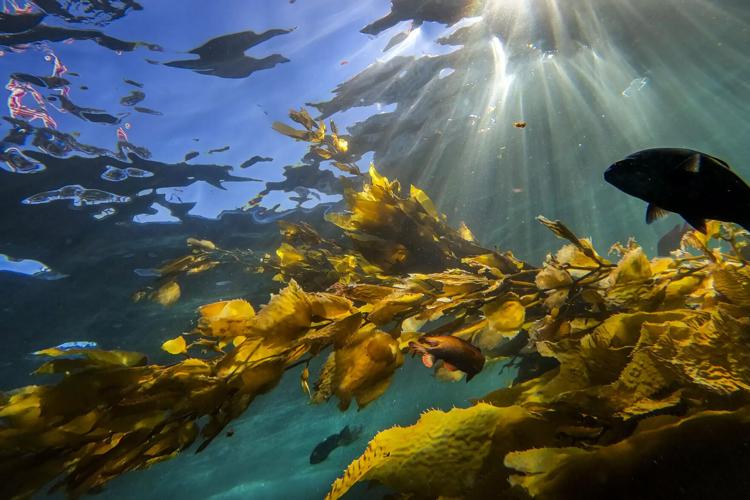
Fish swim along a kelp forest in 2016 near Catalina Island off the coast of California.
“There’s sort of a disconnect between temperature and how something like temperature impacts species distribution patterns or how fisheries are operating or how protected species might be responding,” said Jarrod Santora, a fisheries biologist with the National Oceanic and Atmospheric Administration. “There’s a big jump between what we identify as a temperature anomaly and process in the ocean.”
Some animals may move down the water column to darker, colder waters. Others may move north — or south — depending upon where the cooler waters are. Many may flourish; others will perish.
And some may not be affected at all, said Santora.
“We’re just looking at temperature anomalies that focus on the skin of the ocean; we don’t know what’s happening inside,” he said.
That’s why Heather Welch, a marine spatial ecologist at UC Santa Cruz, and other researchers have created statistical models designed to predict where animals will go when things heat up.
“So one of the tricky things with heat wave impacts is you have to be lucky and actually have direct observations during the events,” she said. Such direct observations are often made via GPS tags on animals, or observations made from a research vessel that happens to be in the right place at the right time.

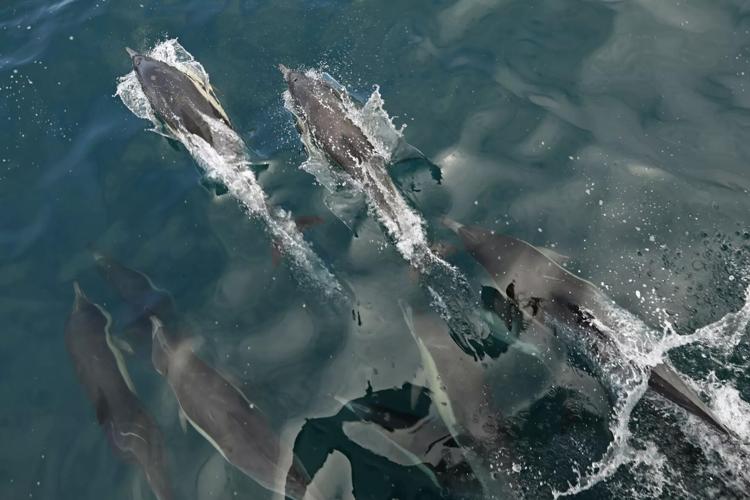
Dolphins swim off Newport Beach, California.
But with a model, you can use data collected not just during a heat wave, but at other times, too, and “extrapolate to see what would have happened during heat waves, or what did happen,” she said.
Earlier this month, she and a team of researchers published the results of a model that they used to predict the movements of 14 marine predators — a selection of mammals, birds and fish — in the North Pacific during the heat waves of 2014, 2015, 2019 and 2020.
What they found was a “wide diversity of responses across heat waves,” she said.
For instance, during the heat waves of 2014 and 2015, bluefin and albacore tuna moved northwest. In 2019 and 2020, however, they moved southeast.
The researchers also found that different species responded differently.

“So if you look at a blue whale versus an albatross, they’re going to do different things,” she said, noting that such an observation hadn’t really been seen before — because most studies of marine heat waves focused on one animal in one heat wave.
It’s a point that Alexa Fredstone, an assistant professor of ocean sciences at UC Santa Cruz, echoed.
“We have a number of stories that individually make sense about how particular communities were affected,” she said. “But every story is unique and the most common thing that we see actually is when there has been a marine heat wave, we don’t really see any coherent response in the ecosystem.”
She said heat waves have had clearly detrimental impacts on shallow water ecosystems, such as kelp forests and coral reefs. But once you get farther down the water column, things get a little murkier.
She and a team of ocean and data scientists from across North America and Europe looked at the effects of marine heat waves on fish between 1993 and 2019. They found no clear effect — nothing beyond what you’d expect with natural variability.

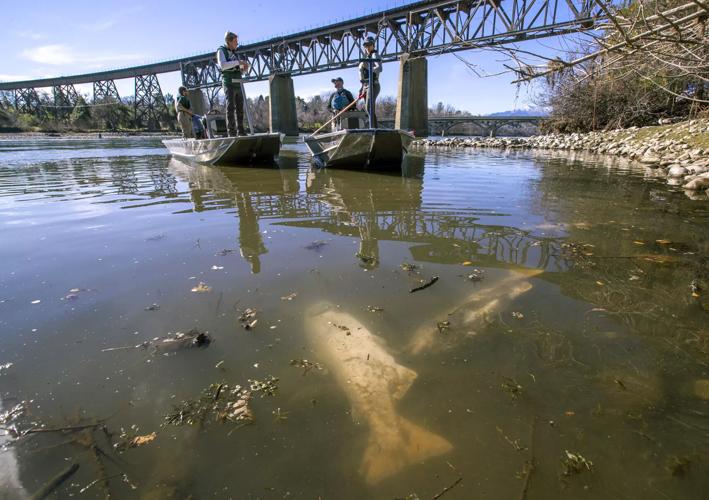
A survey team approaches dead fall-run Chinook salmon in 2022 in Northern California's Sacramento River. Marine heat waves in the Pacific are having very different effects on different salmon species.
“What’s surprising about this is that studies have shown that, over decades, fish are shifting towards the poles on average” as ocean temperatures climb from global warming, she said. “So we know that there’s a long-term climate signal. Maybe that’s just easier to detect statistically than the short term effect of a heat wave?”
For fish like salmon, which require both marine and freshwater environments, the situation is slightly different — and the combination of heat waves in the North Pacific on top of a warming planet, is a boon to some species, and a disaster to others, said Nate Mantua, a fish biologist with NOAA.
If “you get far enough north,” warming may actually be benefiting salmon like the Bering Sea and Bristol Bay sockeye salmon, he said. In the past 10 years, these fish had “the biggest run … the biggest harvest ever. Fifty-million fish harvested.”

He said that Russia’s Pacific salmon fishery this year also “has never been higher. It’s off the charts, but it’s almost entirely due to pink salmon from Russia and the stock populations in Bristol Bay. Everywhere else things are not good.”
Farther north than that? “That’s an interesting wrinkle,” Mantua said. “The salmon there have been doing extremely poorly the last 20 years.”

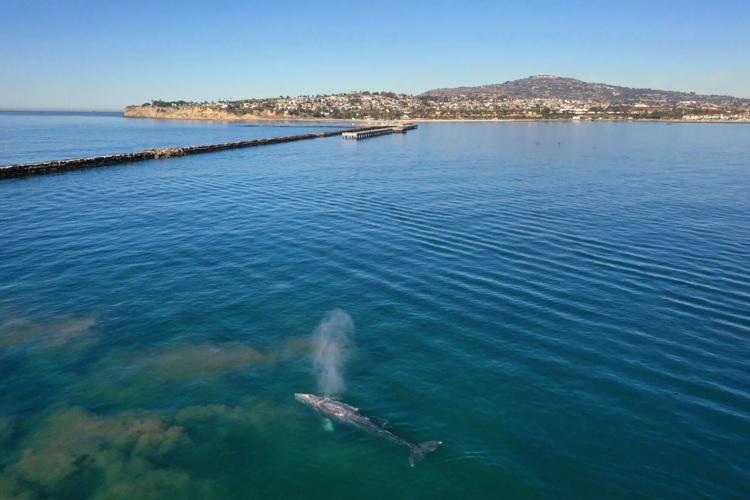
A gray whale swims in April off Dana Point, California. Researchers in September published the results of a model they used to predict the movements of 14 marine predators in the North Pacific during the heatwaves of 2014, 2015, 2019 and 2020. What they found was a “wide diversity of responses across heat waves,” one said.
It’s for species such as this — the ones that need protecting — that Welch hopes her and others’ ecological forecasting models will help.
“I think it’s exciting to be sharing some potentially optimistic news about the oceans,” Fredstone said of the researchers’ findings. “We’re all very concerned about these places that seem to be really vulnerable, like coral reefs. It was exciting to potentially have a discovery that some other ecosystems that we also care about, that are also really important to human culture and economy and well-being, may be a little more resilient.”
Crabs are disappearing from the Bering Sea. Scientists are trying to learn why

Crab pots sit on a dock, Sunday, June 25, 2023, in Kodiak, Alaska. Crab fishermen in Alaska have been scrambling to stay afloat after two years of the Bering Sea fishery being closed or severely curtailed due to plummeting crab numbers.

Kevin Abena, right, who runs a fishing business with his father, looks out as he prepares to dock in Saint Herman Harbor after unloading salmon at a processor, Sunday, June 25, 2023, in Kodiak, Alaska. They rely on tendering to stay afloat in the wake of the crab fishery closure. His vessel Big Blue, stopped fishing for most crab in Bristol Bay in 2010, but they still own access rights and take a percentage from other boats that fish their quota.

A person walks across the dock at St. Paul Harbor, Thursday, June 22, 2023, in Kodiak, Alaska. Crab fishermen in Alaska have been scrambling to stay afloat after two years of the Bering Sea fishery being closed or severely curtailed due to plummeting crab numbers. Researchers and managers have started examining data from this year’s survey. It will help determine what crab fisheries might open this winter and decisions on each kind of crab are expected some time in early October.

Kevin Abena, who runs a fishing business with his father, walks across the deck as he docks at Saint Herman Harbor, Sunday, June 25, 2023, in Kodiak, Alaska. They rely on tendering to stay afloat in the wake of the crab fishery closure. His vessel Big Blue, stopped fishing for most crab in Bristol Bay in 2010, but they still own access rights and take a percentage from other boats that fish their quota.

Cannery crew use a hose to unload salmon from a tender boat, Sunday, June 25, 2023, in Kodiak, Alaska. Salmon tendering, using a boat to supply other boats and offload their catch, is a way some fisherman supplement their income. In May, the U.S. Department of Commerce allocated almost $192 million to help Alaska fishers affected by the closures of the king and snow crab fisheries for the last two years, but some fear many boats will go out of business before that money arrives.

Switgard Duesterloh takes a tissue sample from a snow crab while working, Thursday, June 22, 2023, at the Alaska Fisheries Science Center in Kodiak, Alaska. Researchers are scrambling to understand crabs' collapse, with seas warmed by climate change as one theory.

Shelby Bacus, a graduate student at the University of Alaska-Fairbanks, checks equipment while conducting an experiment on snow crabs, Thursday, June 22, 2023, at the Alaska Fisheries Science Center in Kodiak, Alaska. Researchers are scrambling to understand crabs' collapse, with seas warmed by climate change as one theory.

Shelby Bacus, a graduate student at the University of Alaska-Fairbanks, pulls a jar with a live snow crab inside out of a water tank as she conducts an experiment, Thursday, June 22, 2023, at the Kodiak Fisheries Science Center in Kodiak, Alaska. Researchers are scrambling to understand crabs' collapse, with seas warmed by climate change as one theory.

Molts and shells from snow crab sit on a table, Thursday, June 22, 2023, at the Alaska Fisheries Science Center in Kodiak, Alaska. Researchers are scrambling to understand crabs' collapse, with seas warmed by climate change as one theory.

Erin Fedewa, a research fisheries biologist, places a red king crab back in a tank, Thursday, June 22, 2023, at the Alaska Fisheries Science Center in Kodiak, Alaska. Researchers are scrambling to understand crabs' collapse, with seas warmed by climate change as one theory.

Erin Fedewa, a research fisheries biologist, holds an adult red king crab, Thursday, June 22, 2023, at the Alaska Fisheries Science Center in Kodiak, Alaska. Researchers are scrambling to understand crabs' collapse, with seas warmed by climate change as one theory.

Fog hangs over Saint Herman Harbor on Sunday, June 25, 2023, in Kodiak, Alaska. Crab fishermen in Alaska have been scrambling to stay afloat after two years of the Bering Sea fishery being closed or severely curtailed due to plummeting crab numbers.

Salmon are visible in the bottom of a tender boat as crew unload at a cannery, Sunday, June 25, 2023, in Kodiak, Alaska. Salmon tendering, using a boat to supply other boats and offload their catch, is a way some fisherman supplement their income.

Salmon are visible at the bottom of a tender boat as crew unload at a cannery, Sunday, June 25, 2023, in Kodiak, Alaska. Salmon tendering, using a boat to supply other boats and offload their catch, is a way some fisherman supplement their income.

Sam Stern, right, a deckhand on the Big Blue, watches as cannery crewmen unload salmon from the ship's storage area, Sunday, June 25, 2023, in Kodiak, Alaska. Salmon tendering, using a boat to supply other boats and offload their catch, is a way some fisherman supplement their income.

Kevin Abena, who runs a fishing business with his father, looks back as he steers his boat away from a processor's dock, Sunday, June 25, 2023, in Kodiak, Alaska. They rely on tendering to stay afloat in the wake of the crab fishery closure. His vessel Big Blue, stopped fishing for most crab in Bristol Bay in 2010, but they still own access rights and take a percentage from other boats that fish their quota.

A deckhand removes a buoy as the fishing vessel Big Blue prepares to leave a processor's dock after unloading salmon, Sunday, June 25, 2023, in Kodiak, Alaska. Crab fishermen in Alaska have been scrambling to stay afloat after two years of the Bering Sea fishery being closed or severely curtailed due to plummeting crab numbers.

A boat, that can be used for trawling, heads out to sea, Friday, June 23, 2023, near Kodiak, Alaska. Crab fishermen in Alaska have been scrambling to stay afloat after two years of the Bering Sea fishery being closed or severely curtailed due to plummeting crab numbers.

