


NEW YORK — The U.S. government is going in the other direction. Temperatures keep rising. More extreme weather is sweeping across the world. Yet hundreds of leaders from government and business are in New York this week to keep the fight against climate change alive. Amid fracture and despair, they are emphasizing progress and hope.
More than 110 world leaders will speak at a special U.N. climate summit Wednesday designed to get nations to strengthen their required — but already late — plans to wean themselves from the coal, oil and natural gas that causes climate change. Dozens of business leaders are in the city networking in various conferences aimed at greener and cleaner energy.
“We’re here to power on. In the end, we either will have a livable planet or we won’t,” said Helen Clarkson, CEO of The Climate Group, kicking off New York City Climate Week and its more than 1,000 events. “It’s an uphill struggle, but we know we don’t have a choice. It’s up to us to protect what we love.”

People attend a “Fridays for Future” demonstration at the fish market as part of an international day of action on Saturday in Hamburg, Germany.
But on Monday, as leaders talked about stronger national plans and reduction in fossil fuel emissions, Climate Action Tracker, an independent group of scientists who track pledges to fight climate announced that the host nation — the United States — had the biggest backslide in history.
“This is the most aggressive, comprehensive and consequential climate policy rollback the CAT has ever analyzed,” said Niklas Höhne, a New Climate Institute scientist who helps run the tracker.
But non-U.S. leaders in politics and business highlighted how much of the world has switched to cleaner renewable energy, such as solar and wind, mostly because of price.
“The economic case is clear,” European Commission President Ursula von der Leyen told the Global Renewables Summit. She said 90% of new renewable projects generate power more cheaply than fossil fuels, and solar energy is now 41% cheaper than the lowest-cost fossil alternative. “So yes, the momentum is real.”

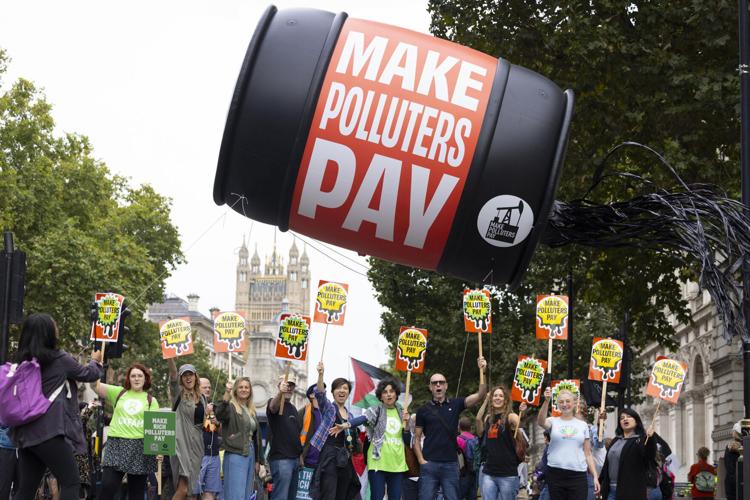
Protesters with “Make Polluters Pay” campaign, calling on billionaires and fossil fuel companies to contribute financially to climate action, demonstrate as part of a national demonstration demanding economic and climate justice, ahead of the 2025 United Nations Climate Change Conference and UK Autumn Budget, on Saturday in London.
Last year the world invested $2 trillion in renewable energy, twice as much as the fossil fuels that spew heat-trapping gases, several leaders said.
Just 10 years ago when the world’s leaders adopted the Paris climate agreement, the planet was headed to nine degrees Fahrenheit of warming above pre-industrial times. Now it’s on track for 5.4 degrees, said United Nations climate chief Simon Stiell. But it’s not near the Paris goal of 2.7, Stiell said.
“We will have inched forward so progress is being made,” Stiell said. He said the unanimous consensus process of international negotiations is “difficult, but it is delivering.”
But it’s not enough and too slow, said Ralph Regenvanu, Vanuatu’s climate change minister. His country and other small island nations and vulnerable states plan to ask the U.N. General Assembly — which goes by majority rule, not unanimity — to follow up on the International Court of Justice’s ruling earlier this year that all countries must act on climate change. Vanuatu’s resolution won’t be proposed until after November’s climate negotiations in Brazil, he said.

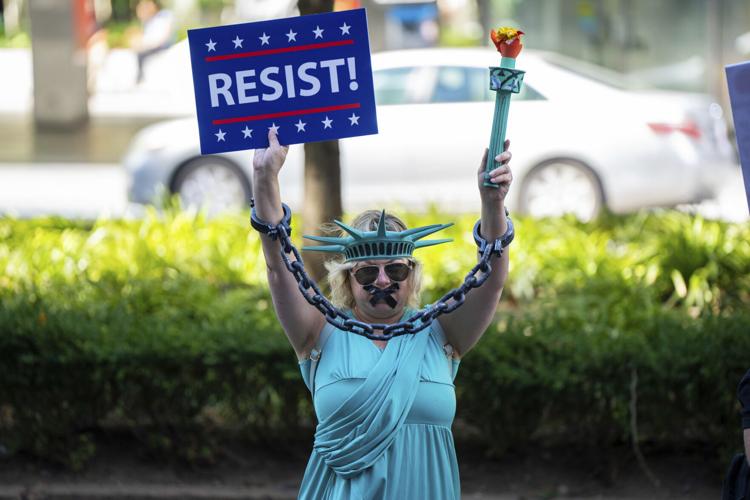
A woman dressed as the Statue of Liberty in chains protests at the “Make Billionaires Pay” climate march on Saturday in New York.
Places such as Antigua and Barbuda are “under siege for a climate crisis we did not create,” Prime Minister Gaston Browne said of his nation, which has been hit by four Category Four and Five hurricanes in a decade. “Every degree of warming is an invoice, literally a demand sent to small islands that we cannot afford to pay.”
The nations of the world all were supposed to come up with new five-year plans for curbing carbon emissions by February, leading into the Brazil negotiations. But only 47 of the 195 nations — those responsible for less than a quarter of global emissions — have done so. U.N. officials said they should be submitted by the end of this month so experts can calculate how the world is doing in its emission-reduction efforts.
The world’s biggest emitter, China, and another top polluter, the European Union, are expected to announce their plans or rough sketches of their plans this week. The United Nations session Wednesday is designed to cajole countries to do more.
Australian billionaire Andrew Forrest tried to cheer business and world leaders on Monday. “Despair is not leadership,” Forrest said. “Fear has never built anything. We’re here today to lead by your very example.”


Photos: Climate change can make growing corn challenging

Nicolle Ritchie, an extension agent with Michigan State University, inspects corn for pollination issues Aug. 18 in Nottawa, Mich.

A corn plant shows signs of drought stress Aug. 18 in Paw Paw, Mich.

Robb Rynd pulls the husk off of an ear of corn as he inspects his crops for pollination issues Monday, Aug. 18, 2025, in Paw Paw, Mich. (AP Photo/Joshua A. Bickel)

Gary Rynd holds an ear of corn with patchy kernels, likely due to pollination problems, in Paw Paw, Mich.

Stressed corn grows in a field Aug. 18 in Paw Paw, Mich.

Robb Rynd, left, inspects ears of corn from his brother, Gary Rynd, right, Aug. 18 at their field in Paw Paw, Mich.

Nicolle Ritchie, an extension agent with Michigan State University, inspects an ear of corn Aug. 18 in Paw Paw, Mich. Climate change is fueling conditions across several states that make watching the corn grow a nail-biter for farmers.

