


As the National Weather Service scrambles to hire up to 450 people to restore deep cuts by the Department of Government Efficiency, potential applicants are asked to explain how they would advance President Donald Trump's agenda if hired.
A posting from the weather service's parent agency seeking meteorologists asks applicants to identify one or two of Trump's executive orders "that are significant to you, and explain how you would help implement them if hired."
It's among screening questions added to government job applications as part of a "merit hiring plan" that Trump announced at the outset of his second term, and it's not unique to the weather service positions.
Some experts said they are alarmed at the prospect that a candidate's ideology could matter for jobs in science.
"The fundamental question is, will this make forecasts any better? That's the job of the weather service," said Rick Spinrad, who led the National Oceanic and Atmospheric Administration, which includes the weather service, under Democratic former President Joe Biden.
"These people should be hired for their knowledge in meteorology or hydrology or information technology or physics — not civics. … Bottom line, I'd rather have a great forecaster who's never read an EO than a policy muck who's taken one meteorology class," he said, referring to executive orders.
Spokespeople for NOAA didn't respond to emails seeking comment.

President Donald Trump listens Tuesday during a Cabinet meeting at the White House in Washington with, from left, Secretary of Defense Pete Hegseth and Secretary of Commerce Howard Lutnick.
Administration targeted NOAA and weather service for cuts
Before billionaire Elon Musk left DOGE, it cut hundreds of NOAA forecasters and other employees soon after Trump took office. Experts warned that the vacancies could hurt forecasts and dangerous consequences for people if extreme weather warnings were slowed.
NOAA confirmed in early August that it received approval to hire as many as 450 people for critical positions within the weather service after this spring's deep cuts.
Trump issued numerous executive orders, and applicants could presumably choose any to endorse — or none at all, since the application says responses aren't required, only encouraged.
The Republican president consistently attacked clean energy and climate science while promoting fossil fuels such as oil, natural gas and coal, which emit planet-warming gases.
One of his first executive orders, which he dubbed "unleashing American energy," directed agencies to sweep away any "undue burden" to fossil fuel development. That order also canceled orders from Biden that addressed climate change.

Under Trump, NOAA stopped tracking the cost of weather disasters worsened by climate change. His administration also moved to shut down two NASA missions that monitor a potent greenhouse gas and plant health — data seen as helpful for measuring the impacts of climate change.
Trump's second term is marked by accusations that he politicized science, most recently with the ouster of the head of the Centers for Disease Control and Prevention for not being "aligned" with the president's agenda.
Separately, employees of the Environmental Protection Agency, National Institutes of Health and Federal Emergency Management Agency issued declarations of dissent with agency actions. Some EPA and FEMA employees who signed those letters were put on leave.

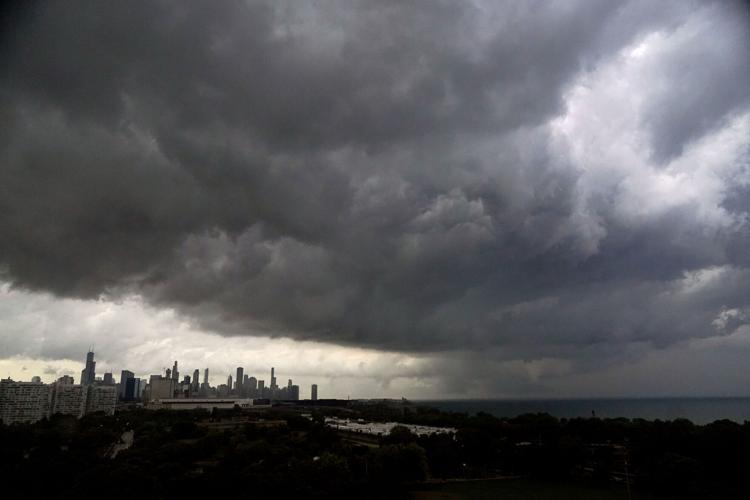
Storm clouds pass over downtown Chicago and the Bronzeville neighborhood of the city heading east out over Lake Michigan on July 12, 2023, when the National Weather Service issued tornado warnings in the greater metropolitan area.
Applicants are asked about the Constitution and government efficiency
Another screening question asks applicants how their "commitment to the Constitution and the founding principles of the United States" inspired them to seek the job. A third asks how they would use their skills to improve government efficiency and effectiveness.
Craig McLean, a former NOAA acting chief scientist under Biden and during Trump's first term, said none of the questions is relevant to weather service positions. NOAA and the NWS are responsible for daily weather forecasts, severe storm warnings and climate monitoring, among other tasks.
"Asking a meteorologist to define how they as a new employee, are going to make the government more efficient is ludicrous," McLean said. "I'd rather understand how well they are prepared to use the forecast tools and make a timely and accurate forecast."
Jeff Masters, a meteorologist for Yale Climate Connections and co-founder of Weather Underground, said the questions amount to a loyalty test that will discourage many qualified applicants from applying.
"Whether or not you support the President's Executive Orders will not enable a meteorologist to make a better forecast or issue a more timely tornado warning, and should have no place on a job application for the National Weather Service," Masters said by email.
Read more:

Americans seek relief from record-breaking heat wave

People cross Pennsylvania Avenue on June 25, 2025, as heat rises from the crosswalk and street in Washington.

A fruit vendor pushes her cart June 24, 2025, on the Brooklyn Bridge during a heat wave in New York.

A U.S. Capitol Police officer pours water on his head June 25, 2025, outside the Capitol in Washington.

Sevlin Mendez cools off June 25, 2025, in the Harpeth River as the heat index reaches 100 degrees Fahrenheit in Nashville, Tenn.

With temperatures hovering near 100 degrees, a woman protects herself from the sun June 24, 2025, while walking through Boston Common.

A man squints at the sun June 24, 2025, during a heat wave in New York.

Nolan Kelehel cools off in a mister June 25, 2025, at Kauffman Stadium before a baseball game between the Kansas City Royals and the Tampa Bay Rays in Kansas City, Mo.

Mayor Michelle Wu dips her daughter Mira's toes into the Frog Pond on June 24, 2025, on Boston Common as temperatures hover near 100 degrees.

Children cool off June 24, 2025, during the Benton Harbor Department of Public Safety's Spray & Play held at the Pete Mitchell City Center Park in downtown Benton Harbor, Mich.

Dory, an explosives-certified dog, cools down in front of a fan June 24, 2025, outside of Bank of America Stadium before the start of a FIFA Club World Cup game in Charlotte, N.C.

Beachgoers crowd a public beach June 22, 2025, on the Lake Michigan shore in Chicago.

Skateboarders Anthony Eadens and Tommy Wright catch their breath June 22, 2025, after skating at the Dave Armstrong Extreme Park in Louisville, Ky.

Asher Gillen, 3, uses a battery-powered fan while holding a cup of ice to cool off June 23, 2025, before a baseball game between the Baltimore Orioles and the Texas Rangers in Baltimore.

Mudassar Khan, right, talks with a customer June 24, 2025, while sitting outside his electronics store in New York with air conditioners and fans for sale on display.

Bubba the English bulldog plays in a pool June 20, 2025, in his family's front yard in Chicago.

Children run through water sprayed by a firetruck to cool off June 22, 2025, outside Busch Stadium before the start of a baseball game between the St. Louis Cardinals and the Cincinnati Reds Sunday in St. Louis.

Construction worker Tony Martins, 49, sweats as he stands for a portrait June 24, 2025, in New York.

Shanae Brooks and her daughter, Devynn, 2, cool off June 20, 2025, at a splash pad in Cincinnati.

Jude Puroway cools off at a fountain June 22, 2025, in Chicago.

Robby, 12, who did not want to give his last name, sells lemonade June 20, 2025, in his front yard in Chicago.

With temperatures hovering near 100 degrees, children cool off June 24, 2025, in the Frog Pond on Boston Common.

People use umbrellas to shield themselves from the sun June 24, 2025, as they walk along the National Mall in Washington near the Washington Monument.

A boy cools off June 24, 2025, at the World War II Memorial in Washington.

Lucy Stamp and her dog, Kenna, cool down June 23, 2025, under the Dummerston Covered Bridge in the West River in Dummerston, Vt.

A woman takes a bite of an ice cream cone June 24, 2025, in New York.

