

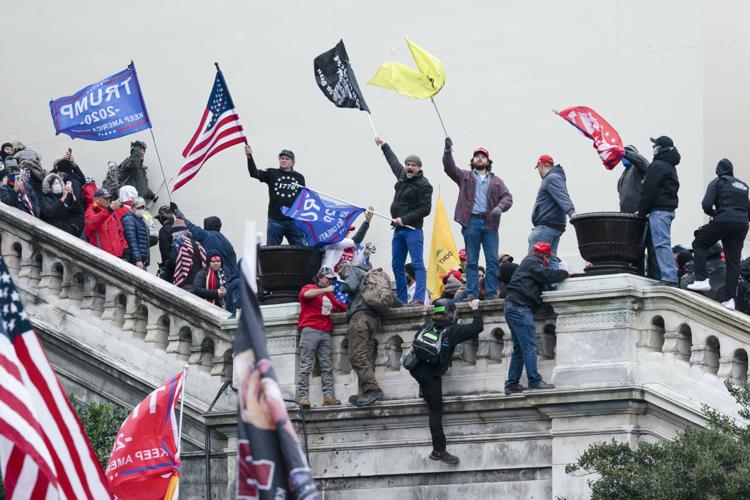

FILE - Rioters wave flags on the West Front of the U.S. Capitol in Washington on Jan. 6, 2021. As public trust in democratic institutions declines, conspiracy theories are filling the void. In some cases, that's leading believers to doubt even their own allies. (AP Photo/Jose Luis Magana, File)
Daniel Charles Wilson believes the attacks of Sept. 11, 2001, were an inside job. The war in Ukraine is "totally scripted" and COVID-19 is "completely fake." The Boston Marathon bombing? Mass shootings in Newtown, Connecticut, and Buffalo, New York, and Uvalde, Texas? "Crisis actors," he says.
Wilson, a 41-year-old from London, Ontario, has doubts about free elections, vaccines and the Jan. 6 insurrection, too. He accepts little of what has happened in the past 20 years and cheerfully predicts that someday, the internet will make everyone as distrustful as he is.
"It's the age of information, and the hidden government, the people who control everything, they know they can't win," Wilson told The Associated Press. "They're all lying to us. But we're going to break through this. It will be a good change for everyone."
Wilson, who is now working on a book about his views, is not an isolated case of perpetual disbelief. He speaks for a growing number of people in Western nations who have lost faith in democratic governance and a free press, and who have turned to conspiracy theories to fill the void.
Rejecting what they hear from scientists, journalists or public officials, these people instead embrace tales of dark plots and secret explanations. And their beliefs, say experts who study misinformation and extremism, reflect a widespread loss of faith in institutions like government and media.
A poll conducted last year by The Associated Press-NORC Center for Public Affairs Research found that just 16% of Americans say democracy is working well or extremely well. Another 38% said it's working only somewhat well.
Other surveys reveal how many people in the United States now doubt the media, politicians, science and even each other.
The distrust has gone so deep that even groups that seem ideologically aligned are questioning each others' motives and intentions.
On the day before Independence Day in Boston this year, a group of about 100 masked men carrying fascist flags marched through the city. Members proudly uploaded videos and photos of the march to online forums popular with supporters of former President Donald Trump and QAnon adherents, who believe a group of satanic, cannibalistic child molesters secretly runs the globe.
Instead of praise, the white supremacists were met with incredulity. Some posters said the marchers were clearly FBI agents or members of antifa — shorthand for anti-fascists — looking to defame Trump supporters. It didn't matter that the men boasted of their involvement and pleaded to be believed. "Another false flag," wrote one self-described conservative on Telegram.
Similarly, when an extremist website that sells unregulated ghost guns — firearms without serial numbers — asked its followers about their July 4th plans, several people responded by accusing the group of working for the FBI. When someone claiming to be Q, the figure behind QAnon, reappeared online recently, many conservatives who support the movement speculated that the new Q was actually a government plant.
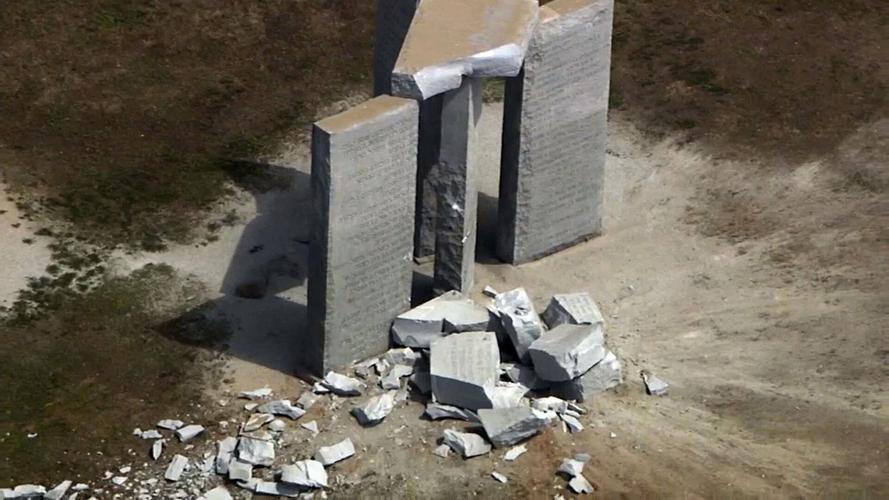
This past week, when a Georgia monument that some conservative Christians criticized as satanic was bombed, many posters on far-right message boards cheered. But many others said they didn't believe the news.

FILE - This aerial image from video, shows damage to the Georgia Guidestones monument near Elberton, Ga., on July 6, 2022. The Georgia Bureau of Investigation said the monument, which some Christians regard as satanic, was damaged by an explosion before dawn. (WSB-TV via AP)

"I don't trust it. I'm still thinking ff," wrote one woman on Twitter, referencing "false flag," a term commonly used by conspiracy theorists to describe an event they think was staged.
The global public relations firm Edelman has conducted surveys about public trust for more than two decades, beginning after the 1999 World Trade Organization's meeting in Seattle was marred by anti-globalization riots. Tonia Reis, director of Edelman's Trust Barometer surveys, said trust is a precious commodity that's vital for the economy and government to function.
"Trust is absolutely essential to everything in society working well," Reis said. "It's one of those things that, like air, people don't think about it until they realize they don't have it, or they've lost it or damaged it. And then it can be too late."
For experts who study misinformation and human cognition, the fraying of trust is tied to the rise of the internet and the way it can be exploited on contentious issues of social and economic change.
Distrust and suspicion offered obvious advantages to small bands of early humans trying to survive in a dangerous world, and those emotions continue to help people gauge personal risk today. But distrust is not always well suited to the modern world, which requires people to trust the strangers who inspect their food, police their streets and write their news. Democratic institutions, with their regulations and checks and balances, are one way of adding accountability to that trust.
When that trust breaks down, polarization and anxiety increases, creating opportunities for people pushing their own " alternative facts."
"People can't fact check the world," said Dr. Richard Friedman, a New York City psychiatrist and professor at Weill Cornell Medical College who has written about the psychology of trust and belief. "They're awash in competing streams of information, both good and bad. They're anxious about the future, and there are a lot of bad actors with the ability to weaponize that fear and anxiety."
Those bad actors include grifters selling bad investments or sham remedies for COVID-19, Russian disinformation operatives trying to undermine Western democracies, or even homegrown politicians like Trump, whose lies about the 2020 election spurred the Jan. 6 attack.
Research and surveys show belief in conspiracy theories is common and widespread. Believers are more likely to to get their information from social media than professional news organizations. The rise and fall of particular conspiracy theories are often linked to real-world events and social, economic or technological change.
Like Wilson, people who believe in one conspiracy theory are likely to believe in others too, even if they are mutually contradictory. A 2012 paper, for instance, looked at beliefs surrounding the death of Princess Diana of Wales in a 1997 car crash. Researchers found that subjects who believed strongly that Diana was murdered said they also felt strongly that she could have faked her own death.
Wilson said his belief in conspiracies began on Sept. 11, 2001, when he couldn't accept that the towers could be knocked down by airliners. He said he found information on the internet that confirmed his beliefs, and then began to suspect there were conspiracies behind other world events.
"You have to put it all together yourself," Wilson said. "The hidden reality, what's really going on, they don't want you to know."

Not real news: Fact-checking claims about herbs as abortion alternatives, Florida college surveys and more
Experts warn against using herbs as abortion alternative
Updated
CLAIM: Herbs including pennyroyal, mugwort and parsley are viable alternatives to abortion.
THE FACTS: Experts strongly warn against trying to self-manage an abortion using any herbs, as many of these alleged remedies not only do not work but are dangerous or even deadly. In the weeks since the U.S. Supreme Court ruled to overturn constitutional protections for abortion, social media posts suggesting potentially toxic herbal remedies to end pregnancies have surged. TikTok videos touting herbal teas and essential oils as abortion alternatives have received massive engagement on the platform. Facebook and Instagram posts have instructed pregnant people to “avoid” herbs like pennyroyal, parsley, mugwort, rue, black cohosh and blue cohosh if they want to keep their pregnancies, with the subtext that people should try the herbs if they want to miscarry. The posts have alarmed obstetricians and toxicologists, who say herbal remedies are not only generally ineffective as abortion alternatives, but are often dangerous or even deadly for the pregnant person. “There are no herbal remedies, period, that are safe and effective for inducing an abortion or preventing pregnancy,” Dr. Ryan Marino, a medical toxicologist who teaches at Case Western Reserve University School of Medicine, told The Associated Press. Dr. Mary Jane Minkin, a gynecologist and professor at the Yale University School of Medicine, also strongly urged women seeking an abortion not try any “herbal therapies.” “This is how women can die. I am strongly urging women to contact their providers to talk about options, and if they don’t have a provider, call the nearest Planned Parenthood,” Minkin wrote in an email to the AP. For example, pennyroyal, a plant featured in many of the posts, contains a compound called pulegone that is toxic to the liver and potentially deadly. “There’s no safe amount” of pennyroyal that can be ingested, Marino said, and applying the oil topically is also not advised. Mugwort and wormwood, herbs also recommended in several posts, contain a compound called thujone that can cause “very difficult-to-treat refractory seizures,” he said. The herb rue can cause organ injury, black cohosh has been associated with liver injuries, and blue cohosh can make people sick to their stomach, he said. Even seemingly benign herbs like parsley if consumed in certain ways can be toxic to the liver, neurons and kidneys, Marino said. While such severe health effects might cause someone to lose a pregnancy, they can also cause the recipient to lose their life, he said. Representatives from the American College of Obstetricians and Gynecologists also warn against taking herbs as alternatives to abortion and following advice from social media. Dr. Nisha Verma, a Darney-Landy fellow at ACOG, noted in an email that people can safely self-manage medication abortions under the guidance of medical professionals.
— Associated Press writer Ali Swenson in New York contributed this report with additional reporting from Graph Massara in San Francisco.
Imagery shared with false context amid Dutch farmer protests
Updated
CLAIM: A video shows a tank purchased by Dutch farmers who will use it to block distribution centers.
THE FACTS: The tank in the video wasn’t purchased by protesters. Instead, the video shows a vintage tank being returned to its owner’s warehouse after it was brought out to be featured at a museum. As thousands of farmers in the Netherlands protest the government’s plans to slash emissions that livestock produce in their waste, old and out-of-context footage is circulating on social media with false claims that it shows the current demonstrations. A video of a tank being returned to a warehouse is spreading on Twitter with false claims that it was purchased by protesters. The video shows a tank with the number 34 emblazoned on its side, unloading from a truck and rolling down a street. “So, uh.... Dutch farmers have purchased a tank to use to block distribution centres,” read a tweet with the video shared more than 13,000 times. “Farmers in the #Netherlands have just purchased a British tank from Russian arms dealers – to use against Dutch police,” another tweet read. Yet a closer look at the video shows the vehicle is actually a restored vintage tank. The numbers printed on the tank match those of a restored WWII Sherman Firefly tank that was featured in an advertisement for a June 2022 “Tankfest” event held by the Tank Museum in Bovington, U.K. An online document showing “Surviving Sherman Firefly tanks” also features a photo of the tank, explaining it was built in 1943 and is located in the Netherlands. The document identifies the owner of the tank as “Classic MV’s.” A Facebook page for Classic MV’s, which did not respond to a request for comment, has posted several photos and videos of the tank in recent months. The footage includes the same background as is featured in the tweet, as well as showing the tank loaded on the same loading truck. Classic MV’s explained in a June 29 Facebook post that the tank did not make it to its scheduled exhibition “due to issues with customs/export papers etc.” Instead, the owner wrote, they participated in an event nearby. Separately, a post claiming to show tractors packing a roadway during the current protests actually contains a 2-year-old photo. And footage of a 2020 protest against pandemic restrictions in The Hague is circulating with false claims that it shows undercover police at a recent farmer protest.
— Ali Swenson
Posts mischaracterize Florida law on college campus surveys
Updated
CLAIM: Florida Gov. Ron DeSantis has signed a bill requiring college students and professors to register their political views with the state.
THE FACTS: The 2021 law requires public universities in Florida to conduct annual “intellectual freedom” surveys, but it does not mandate respondents register their political views with the government. Criticism of the year-old Florida bill has reemerged online this week. Author Stephen King tweeted about the bill on Tuesday, stating, “DeSantis signs bill requiring Florida students, professors to register political views with state.” King’s tweet mirrored language used in a June 23, 2021, headline by Salon that was changed on Wednesday to say “DeSantis signs bill requiring survey of Florida students, professors on their political views.” An editor’s note stated that the headline was revised “to more accurately reflect the language of the bill in question.” The initial headline, and King’s tweet, are misleading because the survey is voluntary, according to multiple legal experts who reviewed the bill, including a University of Florida law professor. The bill requires the State Board of Education and The Board of Governors to create a survey to be administered annually by the Florida College System and the State University System that “considers the extent to which competing ideas and perspectives are presented” and how free members of the college communities feel “to express their beliefs and viewpoints.” The boards are required to publish the results annually, beginning Sept. 1, but officials have not said what will be done with the findings, the AP has reported. Language included in communications to employees and students make it clear that participation was not mandatory and the survey was anonymous. “It is not required that faculty, staff and students have to register their political beliefs with the state of Florida,” said Clay Calvert, a University of Florida law professor specializing in communications law and freedom of speech. “What’s true is that state universities do have to administer surveys on intellectual freedom and viewpoint diversity to students, faculty and staff. So that’s where the disconnect is.” Republican Rep. Spencer Roach, who sponsored the bill in the Florida House, called the recent interpretations calling it a mandatory registration “factually inaccurate.” “That’s not what the statutory language said,” Roach told the AP. He explained that the law states the survey has to be objective, nonpartisan and statistically valid. “No one is requiring anyone on campus to declare their party affiliation,” Roach added. When DeSantis signed the bill in June 2021, it didn’t include many details about the survey. Many critics voiced concern that it could be used as a way to withhold state funds from universities if data suggests there is perceived bias on campus, despite factors that may skew the responses, Calvert said. The survey has been sent to students and employees within the state college and university systems, according to email communications reviewed by the AP. An email with the survey that was sent to faculty at the University of Florida in April stated: “Your participation in this survey is completely voluntary. You are free to not answer any question or withdraw from the survey at any time. All responses are anonymous.” An email sent to students at the University of Florida and other system schools used similar language. Still, a union representing faculty at Florida’s state universities discouraged members from taking it and argued that faculty members could be identified and targeted through certain questions, the AP has reported.
— Associated Press writer Sophia Tulp in New York contributed this report.
NASA did not attribute climate change to the Earth’s orbit
Updated
CLAIM: NASA admitted that climate change is due to the Earth’s orbit around the sun, not greenhouse gas emissions.
THE FACTS: NASA has not made such a determination, and it agrees with the scientific consensus that climate change is driven by greenhouse gas emissions caused by human activity, a spokesperson told The Associated Press. A blog post falsely claiming that NASA has acknowledged in the past that climate change is being caused by the Earth’s “solar orbit,” not human activity like consuming fossil fuels, spread widely on social media in recent days. The blog post, which is dated August 2019, claims that NASA has known for decades that changes to “planetary weather patterns are completely natural and normal.” The post stated that, in 1958, NASA “first observed” that changes in the “solar orbit of the earth, along with alterations to the earth’s axial tilt, are both responsible for what climate scientists today have dubbed as ‘warming’.” The AP has previously debunked similar claims made in 2019. NASA has reached no such conclusion, Tylar Greene, a spokesperson for the agency, confirmed. “I am not aware of any official NASA statement or announcement making that claim or determination,” Greene wrote in an email to the AP. “The information in this post isn’t accurate.” “Scientists are confident Earth’s recent warming is primarily due to human activities — specifically, the direct input of carbon dioxide and other greenhouse gases into Earth’s atmosphere from burning fossil fuels or other anthropogenic activities,” Greene added. The past eight years are the warmest years since modern record keeping began in 1880, he noted. The 2019 blog post asserted that climate change is explained by a theory promoted by the Serbian scientist Milutin Milankovitch about how changes in the Earth’s solar orbit affect the planet’s climate in the long-term. But Greene wrote that “Milankovitch cycles,” which include the angle of the Earth’s axis, the direction that Earth’s spin axis is pointed, and the shape of the Earth’s orbit, don’t account for climate change. “These cycles affect the amount of sunlight and therefore, energy, that Earth absorbs from the Sun. Milankovitch cycles have played an important role in climatic changes during Earth’s history,” Greene wrote. “However, they are not responsible for the current period of rapid warming Earth has experienced since the pre-Industrial period (the period between 1850 and 1900), and particularly since the mid-20th century.”
— Associated Press writer Josh Kelety in Phoenix contributed this report.
Hot Off The Wire: The latest episode
Updated

