

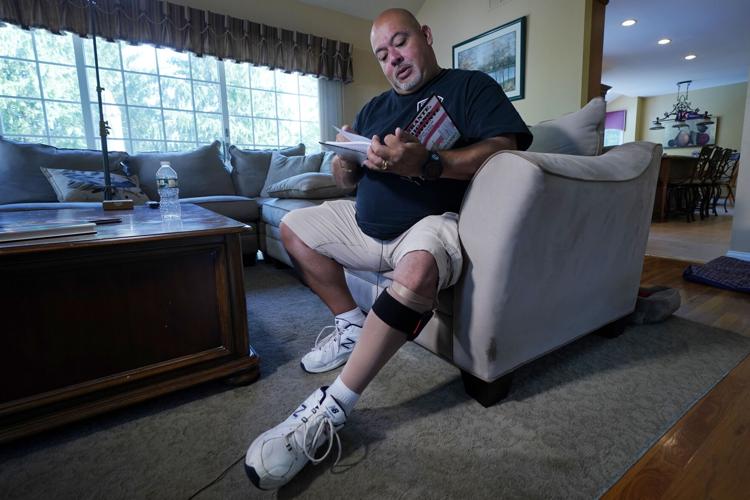


Will Jimeno, the former Port Authority police officer who was rescued from the rubble of the Sept. 11, 2001 attacks at the World Trade Center, reads from "Immigrant, American, Survivor," a children's book he wrote that draws on his experience, during an interview in his home, in Chester, N.J., Monday, Aug. 2, 2021. Injured in the attack, Jimeno wears a compression sock and leg brace band on his left leg.
NEW YORK (AP) — Trapped deep in the wreckage of the World Trade Center, Will Jimeno lived through the unthinkable. Twenty years later, he's still living with it.
A brace and a quarter-sized divot on his left leg reflect the injuries that ended his police career, a lifetime dream. He has post-traumatic stress disorder. He keeps shelves of mementoes, including a cross and miniature twin towers fashioned from trade center steel. He was portrayed in a movie and wrote two books about enduring the ordeal.
"It never goes away, for those of us that were there that day," he says.
Nearly 3,000 people were killed when hijackers in Osama bin Laden's al-Qaida terror network rammed four commercial jets into the trade center, the Pentagon and a Pennsylvania field on Sept. 11, 2001. Yet an estimated 33,000 or more people successfully evacuated the stricken buildings.
They navigated mountains of smoky stairs in the World Trade Center's twin towers or streamed out of a flaming Pentagon. Some fled an otherworldly dust cloud at ground zero. Others willed their way out of pitch-dark rubble.
Sept. 11 survivors bear scars and the weight of unanswerable questions. Some grapple with their place in a tragedy defined by an enormous loss of life. They get told to "get over" 9/11. But they also say they have gained resilience, purpose, appreciation and resolve.
"One of the things that I learned," Jimeno says, "is to never give up."
***
'IT'S ALMOST LIKE YOU'RE REBORN'
It wasn't Bruce Stephan's first incredibly close call.
In 1989, his car got perilously wedged on the San Francisco-Oakland Bay Bridge when the Loma Prieta earthquake hit and the upper deck collapsed while he was driving across.

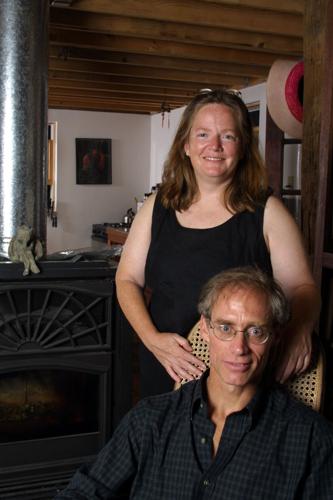
Bruce Stephan and his wife, Joan Stephan, pose at their home in Essex, N.Y., Aug. 14, 2002. Both worked in the World Trade Center in different towers when the WTC was attacked by terrorist on Sept. 11.
Twelve years later, the engineer and lawyer was settling into his workday on the 65th floor of the trade center's north tower when one of the planes crashed about 30 stories above .
Only after his roughly hourlong walk down the crowded stairs did Stephan learn that another plane had hit the south tower — the building where his wife, Joan, also an attorney, worked on the 91st floor. Above the impact zone.
Unable to reach her by cell phone, Bruce Stephan dashed to a payphone and called her relatives, who told him she'd gotten out.
Then the south tower fell, and Stephan's fear spiked anew. Had Joan been caught in the collapse? Hours later, he finally learned that she was OK. (At least one other couple, elevator operators Arturo and Carmen Griffith, also survived; their story inspired a recent film, "Lovebirds of the Twin Towers.")
"My experience from the first disaster was that it's a strangely happy moment when you know that you've survived," Bruce Stephan says. "It's almost like you're reborn... to know that you're alive and that you still have a shot at life, and here's your chance to do something."
"When it happened a second time, it's just like, 'Oh, my God.'"
After the earthquake, the New York City natives resolved to change their workaholic lives. After 9/11, they did.
Within two months, the couple moved to Essex, a northern New York town of roughly 700 people. While telecommuting and sometimes actually commuting, they made time for other things — church, a book club, amateur theater, gardening, zoning meetings, a local newsletter. They cherished a newfound sense of community.
But a work opportunity pulled them back to San Francisco in 2009. They loved it, until the pandemic made them rethink their lives again.
"One of the things that that we discovered as a result of the disasters was that being in a community ... is maybe the biggest reward you can have," Stephan, 65, says from their front porch in Essex. They moved back last year.
***

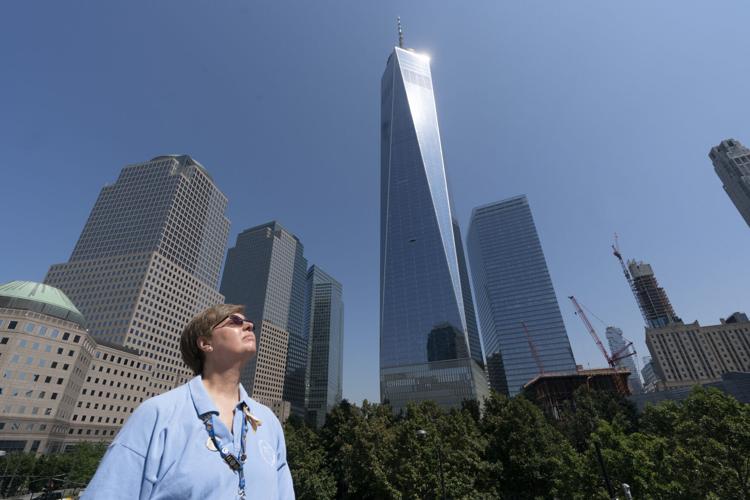
Désirée Bouchat poses for a photo at the World Trade Center, Friday, Aug. 6, 2021, in New York. At first, people figured the plane crash at the north tower was accidental. There was no immediate evacuation order for the south tower. But James Patrick Berger ushered Bouchat and other Aon Corp. colleagues to the elevators, then turned back to check for more people.
'I WAS A WALKING ZOMBIE'
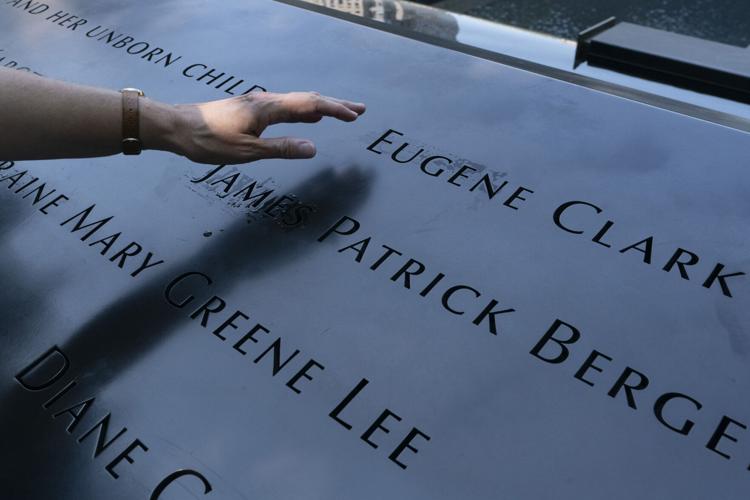
Désirée Bouchat pauses by one of the inscribed names on the 9/11 memorial: James Patrick Berger. She last saw him on the 101st floor of the trade center's south tower.
"Some days, it feels like it happened yesterday," she says.
At first, people figured the plane crash at the north tower was accidental. There was no immediate evacuation order for the south tower. But Berger ushered Bouchat and other Aon Corp. colleagues to the elevators, then turned back to check for more people.

Désirée Bouchat reaches towards the inscribed name of James Patrick Berger at the National September 11 Memorial, Friday, Aug. 6, 2021, in New York. She last saw her co-worker on the 101st floor of the trade center's south tower.
Just as Bouchat exited the south tower, another plane slammed into it. Nearly 180 Aon workers perished, including Berger.
For a while, Bouchat told everyone, including herself: "I'm fine. I'm alive."
But "I was a walking zombie," she says now.
She couldn't multitask anymore. Remarks that used to bother her stirred no reaction. She was functioning, but through a fog that took more than a year to lift.
Bouchat eventually felt that she needed to talk about 9/11. The Springfield, New Jersey, resident has now led about 500 tours for the 9/11 Tribute Museum (it's separate from the larger National September 11 Memorial & Museum).
Bruce Powers has traveled from Alexandria, Virginia, to lead Tribute Museum tours, too. And every Sept. 11, the 82-year-old repeats his seven-mile (11 km) walk home from the Pentagon after the attack that killed 184 people, 10 of whom he knew.
The walk, the tours and hearing other guides' personal stories "serve well in helping me deal with what happened," says Powers, a now-retired Navy aviation planner.
The public hasn't fully recognized the losses survivors felt, says Mary Fetchet, a social worker who lost her son Brad on 9/11 and founded Voices Center for Resilience, a support and advocacy group for victims' families, first responders and survivors. "Although they are still living, they're living in a very different way."
***

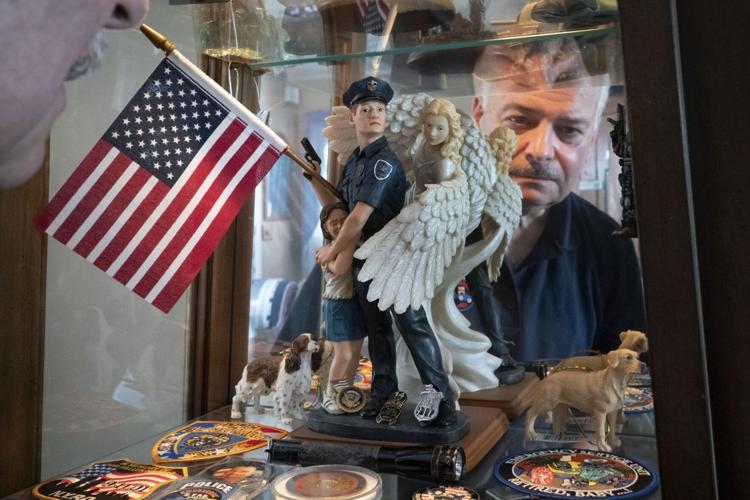
Retired NYPD Officer Mark DeMarco, is seen in a reflection off a display cabinet where he keeps memorabilia from 9/11 including the small flashlight which he used to help him navigate his way out of the rubble of the fallen skyscrapers, in his home in the Staten Island borough of New York on Tuesday, Aug. 3, 2021. He worries that the public memory of the attacks is fading, that the passage of time has created a false sense of security. "Have fun with life. Don't be afraid," he says. "But be mindful."
'I COULDN'T FIGURE OUT HOW I GOT OUT OF THERE ALIVE'
For a time after 9/11, Police Department Officer Mark DeMarco replayed the what-ifs in his mind. If he'd gone right instead of left. A bit earlier. Or later.
"I couldn't figure out how I got out of there alive," he says.
After helping evacuate the north tower, the Emergency Service Unit officer was surrounded by a maze of debris when parts of the skyscraper tumbled onto a smaller building where he'd been directed. Some officers with him were killed.

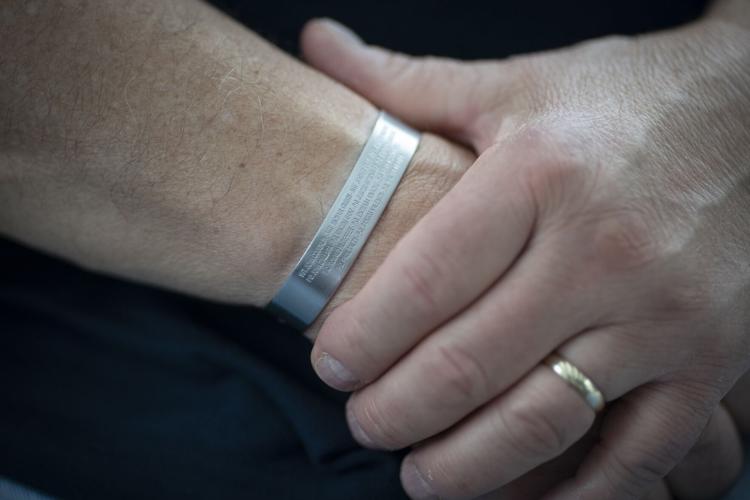
Retired NYPD Officer Mark DeMarco wears a wristband with the names of the 14 ESU members killed on Sept. 11, 2001, during an interview in his home in the Staten Island borough of New York on Tuesday, Aug. 3, 2021.
Barely able to see his own boots with a small flashlight, DeMarco inched through the ruins with two officers behind him.
Then he took a step and felt nothing underfoot. He looked below and saw utter darkness.
Only later — after the officers turned around and eventually clambered through shattered windows to safety — did DeMarco realize he'd nearly tumbled into a crater carved by the collapse.
Now 68 and retired, DeMarco still wears a wristband with the names of the 14 ESU members killed that day. He worries that the public memory of the attacks is fading, that the passage of time has created a false sense of security.
"Have fun with life. Don't be afraid," he says. "But be mindful."
***

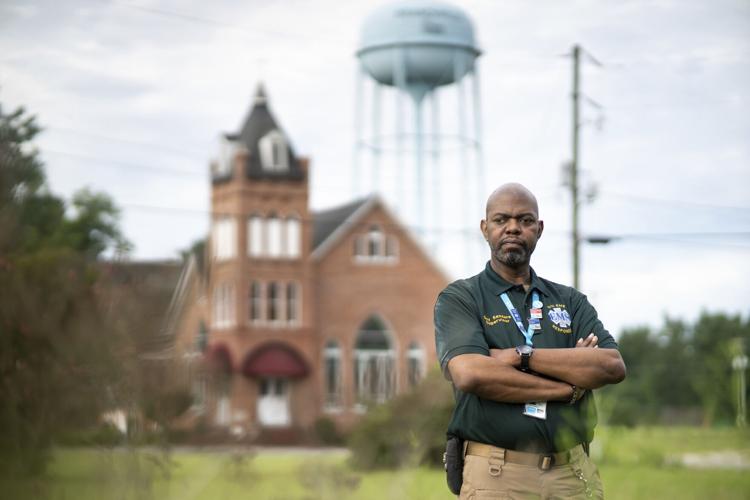
Guy Sanders poses for a photo Friday, Aug. 20, 2021, in Branchville, S.C. Sanders, originally from Brooklyn, N.Y., was an EMT who responded to the terrorist attacks on Sept. 11, 2001.
'IT'S NOT SOMETHING TO BE GOTTEN OVER'
A tsunami of dust washed over emergency medical technician Guy Sanders, so thick that it clogged his surgical mask.
The 47-story building at 7 World Trade Center had just collapsed, about seven hours after the burning towers fell and debris ignited fires in the smaller high-rise.
A part-time EMS supervisor for a private ambulance company in the city, Sanders had scrambled to respond from his day job at a Long Island collections agency. He was en route when the towers collapsed, killing eight EMA workers, including his colleague Yamel Merino. Sanders went to funeral after funeral for EMTs, firefighters and police.
Yet 9/11 only deepened his commitment to EMS. Though it was tricky financially, he soon went full-time.
"I never wanted to be in a situation where people needed me and I couldn't immediately respond," he says.
He still doesn't. But health problems — including a rare cancer that the federal government has linked to trade center dust exposure — forced his 2011 retirement, says Sanders, 62, now living near Orangeburg, South Carolina.
"You get people telling you, 'Well, (9/11) happened so long ago. Get over it.' But it is a trauma," says Sanders, who joined a first responders' and survivors' support group. "It's not something to be gotten over. It's something to be addressed."
***
'SURVIVING IS ONLY THE FIRST PIECE OF THE JOURNEY'
Breathing through an oxygen mask in a hospital bed, Wendy Lanski told herself: "If Osama bin Laden didn't kill me, I'm not dying of COVID."
Nearly two decades earlier, the health insurance manager escaped the north tower's 29th floor and ran, barefoot, through the dust cloud from the south tower's collapse. Eleven of her Empire Blue Cross Blue Shield colleagues died.
"The only good thing about surviving a tragedy or a catastrophe of any kind is: It definitely makes you more resilient," says Lanski, who was hospitalized with the coronavirus — as was her husband — for two touch-and-go-weeks in spring 2020.
But "surviving is only the first piece of the journey," says Lanski, 51, of West Orange, New Jersey.
She has the twin towers, "9/11/01" and "survivor" tattooed on her ankle. But the attacks also left other marks, ones she didn't choose.
Images and sounds of falling people and panes of glass lodged in her memory. She was diagnosed in 2006 with sarcoidosis, she said; the federal government has concluded the inflammatory disease may be linked to trade center dust. And she has asked herself: "Why am I here and 3,000 people are not?"
Over time, she accepted not knowing.
"But while I'm here, I've got to make it count," says Lanski, who has spoken at schools and traveled to conferences about terror victims. "I've got to make up for 3,000 people who lost their voice."
***

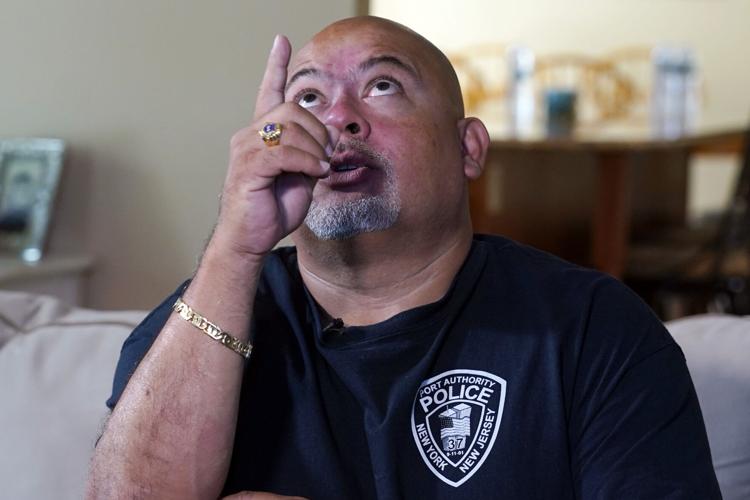
Will Jimeno, the former Port Authority police officer who was rescued from the rubble of the Sept. 11, 2001 attacks at World Trade Center, describes the experience during an interview in his home in Chester, N.J., Monday, Aug. 2, 2021.
'IT MOTIVATES ME TO LIVE A BETTER LIFE'
Buried in darkness and 20 feet (6 meters) or more of rubble from both towers, Will Jimeno was ready to die.
The Port Authority of New York and New Jersey Police Department rookie was in searing pain from a fallen wall pinning his left side. Fellow officer Dominick Pezzulo had died next to him. Flaming debris had fallen on Jimeno's arm and heated the cramped area enough that Pezzulo's gun fired, sending a flurry of bullets past Jimeno's head. He had yelled for help for hours. He was terribly thirsty.
"If I die today," he remembers thinking, "at least I died trying to help people."
Then Jimeno, who is Catholic, had what he describes as a vision of a robed man walking toward him, a bottle of water in his hand.
We're going to get out, he told Sgt. John McLoughlin, who was trapped with him.
It was hours — of pushing back pain, thinking of rescues in past disasters, talking to keep alert — before they were found and gruelingly extricated by former U.S. Marines, NYPD officers, a onetime paramedic and firefighters as blazes flared and debris shifted and fell.

Retired NYPD Officer Ken Winkler, poses for a portrait in his office on Tuesday, Aug. 3, 2021, in New York. Winkler helped coordinate the New York Police Department Emergency Service Unit response on-scene at the World Trade Center on Sept. 11, ducking behind a truck to escape the debris when the south tower collapsed.
"If you wanted to picture what hell looked like, this was probably it," recalls then-NYPD Officer Ken Winkler.
Jimeno was freed around 11 p.m., McLoughlin the next morning. Jimeno underwent surgeries and lengthy rehabilitation.
But he says his psychological recovery was harder. Trivial things made him lose his temper — fueled, he now realizes, by anger about the deaths of colleagues and people rescuers couldn't help. At times, he says, he thought of suicide. It took three years and multiple therapists before he mastered warding off the outbursts.
It has helped to tell his story in talks, in the 2006 Oliver Stone movie "World Trade Center," and in Jimeno's two newly released books — the illustrated "Immigrant, American, Survivor" for children, and " Sunrise Through the Darkness," about coping with trauma.
The Colombian-born U.S. Navy veteran hopes that people see in his story "the resiliency of the human soul, the American spirit," and the power of good people stepping up in bad times.
Sept. 11 "motivates me to live a better life," says Jimeno, 53, of Chester, New Jersey. "The way I can honor those we lost and those that were injured is to live a fruitful life. To be an example to others that Sept. 11 did not destroy us."
***
9/11: Then and now
9/11: Then and now
Updated
Twenty years ago, on September 11, 2001, the United States experienced one of the deadliest single days in its history. Two planes, carrying 92 people and 65 people, respectively, crashed into each of the World Trade Center towers. Minutes later, another flight, carrying 64, crashed into the side of the Pentagon. A final plane crashed minutes after that one, in a field near Shanksville, Pennsylvania, after passengers successfully steered it away from its White House target, killing 44 more. All told, 2,977 Americans lost their lives that day, thanks to the extremist beliefs of Osama bin Laden and his jihadist following.
For those of us who lived through 9/11, the day’s events will forever be emblazoned on our consciousnesses, a terrible tragedy we can’t, and won’t, forget. Now, two decades on, Stacker is reflecting back on the events of 9/11 and many of the ways the world has changed since then. Using information from news reports, government sources, and research centers, we’ve compiled a list of 20 aspects of American life that were forever altered by the events of that day. From language to air travel to our handling of immigration and foreign policy, read on to see just how much life in the United States was affected by 9/11.
America has been involved in non-stop wars
Updated
Before the terrorist attacks on 9/11 it had been almost a full decade since the U.S. had been involved in an international war in any meaningful way. From 1990-1991, American armies engaged in overseas action in the Gulf War. After the attacks, peacetime ended with the beginning of both the Iraq War, which took place from 2003-2011, and the Afghanistan War, which went on from 2001-2021. The Afghanistan War, in particular, earns mention as it is the longest war in American history, to date.
Air travel safety efforts have surged
Updated
Air travel has seen some of the biggest changes since 2001. Pre-9/11, unticketed individuals were able to pass through security and accompany travelers to and from their gates; you were able to keep your shoes on while moving through security; liquids of all sizes were allowed onboard planes; and commercial airline pilots weren’t armed. Today, all flight deck personnel are trained to carry firearms, pre-boarding screening for passengers and employees is much more intense and randomized, and travelers are required to show photo IDs in order to board a plane.
Church attendance (briefly) increased
Updated
Tragedies often have a way of reminding us of the importance of faith, and 9/11 was no exception. Studies found that there was a significant, albeit brief, increase in church attendance after the terrorist attacks. Additionally, Gallup found that in 2001 and 2002 Americans felt that religion was increasing its influence on American life, and was a more significant and important part of our day-to-day lives than it had been in decades past. However, neither of these effects lasted, and today both church attendance and beliefs about faith’s importance are at all-time lows.
Patriotism is at an all-time high
Updated
While traditional religion may have only experienced a brief resurgence after 9/11, patriotism, or civil religion, has experienced a much longer resurgence. A year after the terrorist attacks, Pew Research reported that 62% of individuals felt more patriotic than they had a year earlier. We still see this increase in love for country in the frequency with which we do things like play the national anthem or other patriotic songs like “God Bless the U.S.A.,” stand for the flag at sporting and entertainment events, and recite the Pledge of Allegiance.
Media trends shifted drastically
Updated
According to Vox author Lindsay Ellis, “no event in U.S. history caused such a dramatic and sudden change in U.S. media trends as 9/11.” Among the many shifts that took place, we saw directors and screenwriters shying away from war and destructive event tropes in movies and TV shows; songwriters amping up their patriotic themes; and an increase in fantasy series that allowed viewers and readers to escape the tragedies of the real world and retreat into black-and-white universes where what was right always won against what was wrong.
You may also like: U.S. Navy history from the year you were born
Acceptance of conspiracy theories went up
Updated
Perhaps because it was one of the first major domestic tragedies to take place after the rise of the internet, the number of widely believed conspiracy theories increased after the 9/11 attacks. To this day, there are a number of conspiracies about the day itself, namely that it was some kind of inside job, that are frequently discussed and touted in online forums like Reddit and 8chan. These theories have arguably made it more acceptable for folks to discuss and believe in increasingly harmful ideas like QAnon.
9/11 changed the English language
Updated
One thing that September 11, 2001, changed that we seldom think about is language. Linguists argue that the way we talk about the terrorist attacks, namely referring to them as 9/11, is completely original, and has set a precedent for the way we talk about terrorist attacks of similar size and importance in other areas (e.g., 11-M when referring to the 2004 Madrid bombings or 7/7 when discussing the 2005 London bombings).
Americans are under more surveillance than ever before
Updated
Surveillance has increased tenfold since 2001, with many of the related laws and acts being passed under the guise of preventing further terrorist attacks. For example, the Patriot Act, which was passed just 45 days after 9/11, allows the government to monitor the phone and email communications, bank and credit records, and internet activity of all its citizens. Opinions remain sharply divided as to whether this act, and others like it, actually lead to a decrease in terrorism activity or are just overreach by the government into the lives of innocent civilians.
Trust in the government has gone down
Updated
Despite a brief surge immediately after 9/11, Americans’ trust in their government has been steadily declining over the last two decades. Since 2007, Pew Research has found that no more than 30% of Americans feel that they can trust their government to do the right thing. This may be, in part, due to the fact that the resulting wars went on for so long despite a lack of public support or desire to remain engaged.
The type of information journalists cover is different
Updated
Before 9/11, network news and local journalists were more focused on domestic issues and events than they were on foreign affairs. Post 9/11, Pew Research found that has shifted and coverage of global conflicts has increased significantly. Specifically, coverage of terrorism has gone up 135% and coverage of foreign policy has increased by 102%.
You may also like: U.S. Air Force history from the year you were born
Crude oil prices have skyrocketed
Updated
In 2001, the price of a barrel of crude oil topped out at $32.21. However, after the terrorist attacks, as people began fearing that imports from Middle Eastern countries would be curtailed, the price of oil shot up and has never returned to that low. As of August 2021, the price for a barrel of crude oil is $65.64.
NYC has grown, not shrunk
Updated
There was some belief right after the 2001 terrorist attacks that New York City would empty out, as residents went in search of safer pastures. However, since then the city’s population has only grown, particularly in lower Manhattan, which nearly doubled in size in the first 15 years after the event. Chalk it up to the resilience of New Yorkers or the draw of cheap real estate, but the world’s greatest city is alive and thriving.
George W. Bush became the most lauded president
Updated
Speaking of things going up, nothing increased as much as George W. Bush’s approval rating after 9/11. From losing the popular vote to having the highest approval rating of all time, Bush’s public image soared, thanks to the way he handled the horror and carried the country through the aftermath.
Terrorism in the U.S. has increased
Updated
According to a report compiled by the New America think tank, terrorism within the U.S. has increased since 9/11. Though it would be inaccurate to say that these attacks caused all of the subsequent terrorism in the US, they certainly played a role in making the country a more desirable target for those who buy into jihadist ideologies.
9/11 caused a housing boom
Updated
Though Osama bin Laden claimed that the 9/11 attacks “hit hard the economy at its heart and core,” he was wrong. After an initial depression, the economy bounced back quickly, thanks, in large part, to a real estate boom. To fight a looming recession, the Federal Reserve drastically dropped interest rates, which inspired millions of Americans to buy new homes or scoop up rental properties.
You may also like: U.S. Marines by the numbers
Immigration has become more difficult
Updated
Many expected George W. Bush—a moderate when it came to the topic of immigration—to pass acts and laws that would widen the scope of immigration into the United States. After 9/11, however, his government clamped down on immigration, passing laws like the Homeland Security Act, which have effectively limited the number of people who can move to the U.S. each year, and made it much more difficult to do so legally.
Deportations have increased
Updated
Additionally, the number of deportations has risen significantly since 9/11. In the first decade after the terrorist attacks, the number doubled, rising from 200,000 per year to more than 400,000.
First responders get more training
Updated
The Homeland Security Act, which was passed in 2002, has also had a major impact on first responder training. The act allocated money for federal grants to police and fire stations, which were then allowed to use the money to buy more and better equipment, provide additional training, and bring on more personnel. On September 11th itself, and in many of the months after it, first responders from around the country flocked to New York City, Washington D.C., and Pennsylvania to lend a hand, but the disasters also highlighted how ill-prepared many local branches were for incidents of this size and scale.
America has positioned itself as the global power
Updated
America’s approach to foreign policy changed in innumerable ways after 9/11, but one overarching theme we see in many of these decisions is how focused America became on establishing itself as the global power. Through the War on Terror, the many ways America distributed its resources, and the country’s increased focus on activism, the United States sought to become not just a voice at the table, but its leader. Two decades on, the country is less hubristic, having been chastened by time, but still remains a key agent in global politics.
Muslim Americans have faced increased racism
Updated
In 2011, the Pew Research Center found that 50% of Muslim Americans found it more difficult to be Muslim in the United States after 9/11 than they did before. This increased difficulty can be attributed to higher levels of racism and violence directed at these communities, as well as reluctance from politicians and leaders to speak out about the uptick in both racism and extremism. Still, many of these same Muslim American respondents expressed faith that relations could return to “normal” with time and hard work.
You may also like: U.S. Air Force history from the year you were born

