

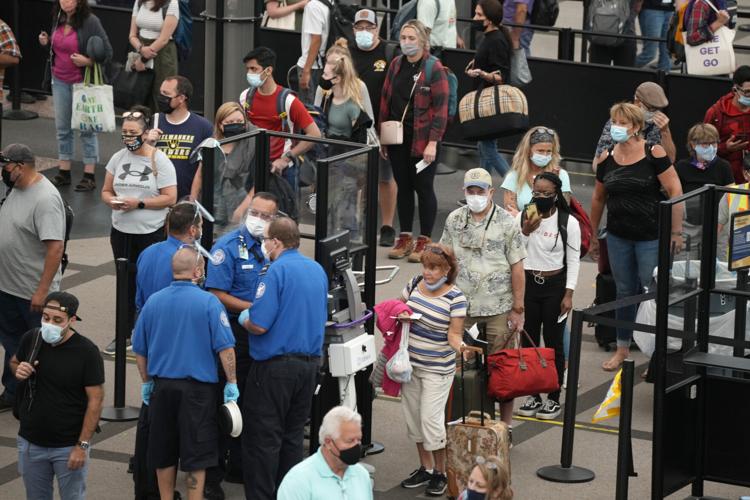

Travelers wear face coverings in the line for the north security checkpoint in the main terminal of Denver International Airport Tuesday, Aug. 24, 2021, in Denver.
DALLAS (AP) — Ask anyone old enough to remember travel before Sept. 11, 2001, and you're likely to get a gauzy recollection of what flying was like.
There was security screening, but it wasn't anywhere near as intrusive. There were no long checkpoint lines. Passengers and their families could walk right to the gate together, postponing goodbye hugs until the last possible moment. Overall, an airport experience meant far less stress.
That all ended when four hijacked planes crashed into the World Trade Center towers, the Pentagon and a field in Pennsylvania.
The worst terror attack on American soil led to increased and sometimes tension-filled security measures in airports across the world, aimed at preventing a repeat of that awful day. The cataclysm has also contributed to other changes large and small that have reshaped the airline industry — and, for consumers, made air travel more stressful than ever.
Two months after the attacks, President George W. Bush signed legislation creating the Transportation Security Administration, a force of federal airport screeners that replaced the private companies that airlines were hiring to handle security. The law required that all checked bags be screened, cockpit doors be reinforced, and more federal air marshals be put on flights.
There has not been another 9/11. Nothing even close. But after that day, flying changed forever.
***

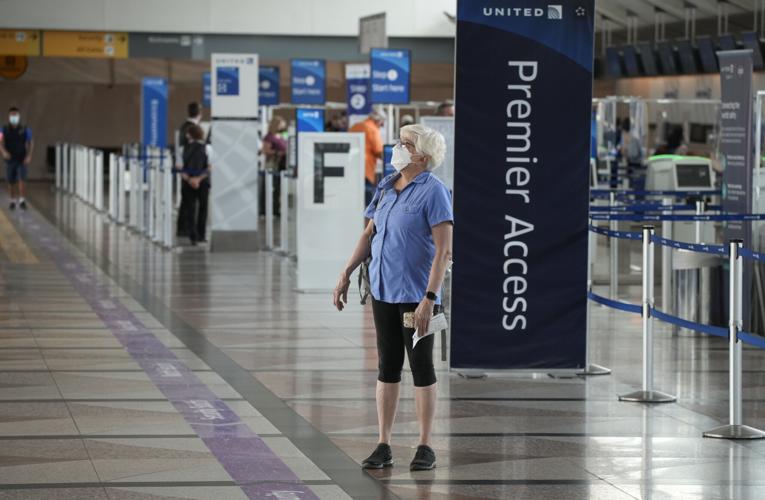
A lone traveler wears a face covering as she stops to check the departure monitors across from the United Airlines ticketing counter in the main terminal of Denver International Airport Tuesday, Aug. 24, 2021, in Denver.
NEW THREATS, PRIVACY CONCERNS
Here's how it unfolded.
Security measures evolved with new threats, and so travelers were asked to take off belts and remove some items from bags for scanning. Things that clearly could be wielded as weapons, like the box-cutters used by the 9/11 hijackers, were banned. After "shoe bomber" Richard Reid's attempt to take down a flight from Paris to Miami in late 2001, footwear started coming off at security checkpoints.
Each new requirement seemed to make checkpoint lines longer, forcing passengers to arrive at the airport earlier if they wanted to make their flights. To many travelers, other rules were more mystifying, such as limits on liquids because the wrong ones could possibly be used to concoct a bomb.
"It's a much bigger hassle than it was before 9/11 — much bigger — but we have gotten used to it," Ronald Briggs said as he and his wife, Jeanne, waited at Dallas/Fort Worth International Airport for a flight to London last month. The north Texas retirees, who traveled frequently before the pandemic, said they are more worried about COVID-19 than terrorism.
"The point about taking shoes off because of one incident on a plane seems somewhat on the extreme side," Ronald Briggs said, "but the PreCheck works pretty smoothly, and I've learned to use a plastic belt so I don't have to take it off."
The long lines created by post-attack measures gave rise to the PreCheck and Global Entry "trusted-traveler programs" in which people who pay a fee and provide certain information about themselves pass through checkpoints without removing shoes and jackets or taking laptops out of their bag.
But that convenience has come at a cost: privacy.
On its application and in brief interviews, PreCheck asks people about basic information like work history and where they have lived, and they give a fingerprint and agree to a criminal-records check. Privacy advocates are particularly concerned about ideas that TSA has floated to also examine social media postings (the agency's top official says that has been dropped), press reports about people, location data and information from data brokers including how applicants spend their money.
"It's far from clear that that has any relationship to aviation security," says Jay Stanley, a privacy expert at the American Civil Liberties Union.
More than 10 million people have enrolled in PreCheck. TSA wants to raise that to 25 million.
The goal is to let TSA officers spend more time on passengers considered to be a bigger risk. As the country marks the 20th anniversary of the attacks, the TSA's work to expand PreCheck is unfolding in a way privacy advocates worry could put people's information at more risk.
At the direction of Congress, the TSA will expand the use of private vendors to gather information from PreCheck applicants. It currently uses a company called Idemia, and plans by the end of the year to add two more — Telos Identity Management Solutions and Clear Secure Inc.
Clear, which recently went public, plans to use PreCheck enrollment to boost membership in its own identity-verification product by bundling the two offerings. That will make Clear's own product more valuable to its customers, which include sports stadiums and concert promoters.
"They are really trying to increase their market share by collecting quite a lot of very sensitive data on as many people as they can get their hands on. That strikes a lot of alarm bells for me," says India McKinney, director of federal affairs for the Electronic Frontier Foundation, an advocacy group for digital rights.
TSA Administrator David Pekoske, though, sees Clear's strategy as helping TSA. Says Pekoske: "We have allowed the vendors to bundle their offerings together with the idea that would be an incentive for people to sign up for the trusted-traveler programs."
The TSA is testing the use of kiosks equipped with facial-recognition technology to check photo IDs and boarding passes rather than having an officer do it. Critics say facial-recognition technology makes errors, especially on people of color.
TSA officials told privacy advocates earlier this year that those kiosks will also pull photos taken when the traveler applied for PreCheck, McKinney says. That concerns her because it would mean connecting the kiosks to the internet — TSA says that much is true — and potentially exposing the information to hackers.
"They are totally focusing on the convenience factor," McKinney says, "and they are not focusing on the privacy and security factors."
***
'SECURITY THEATER'?
Despite the trauma that led to its creation, and the intense desire to avoid another 9/11, the TSA itself has frequently been the subject of questions about its methods, ideas and effectiveness.

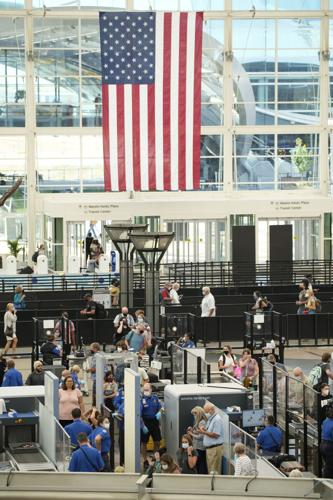
Travelers wear face coverings in the queue for the south security checkpoint in the main terminal of Denver International Airport Tuesday, Aug. 24, 2021, in Denver.
Flight attendants and air marshals were outraged when the agency proposed in 2013 to let passengers carry folding pocket knives and other long-banned items on planes again. The agency dropped the idea. And after another outcry, the TSA removed full-body scanners that produced realistic-looking images that some travelers compared to virtual strip searches. They were replaced by other machines that caused fewer privacy and health objections. Pat-downs of travelers are a constant complaint.
In 2015, a published report said TSA officers failed 95% of the time to detect weapons or explosive material carried by undercover inspectors. Members of Congress who received a classified briefing raised their concerns to Pekoske, with one lawmaker saying that TSA "is broken badly."
Critics, including former TSA officers, have derided the agency as "security theater" that gives a false impression of safeguarding the traveling public. Pekoske dismisses that notion by pointing to the huge number of guns seized at airport checkpoints — more than 3,200 last year, 83% of them loaded — instead of making it onto planes.
Pekoske also ticked off other TSA tasks, including vetting passengers, screening checked bags with 3-D technology, inspecting cargo and putting federal air marshals on flights.
"There is an awful lot there that people don't see," Pekoske says. "Rest assured: This is not security theater. It's real security."
Many independent experts agree with Pekoske's assessment, though they usually see areas where the TSA must improve.
"TSA is an effective deterrent against most attacks," says Jeffrey Price, who teaches aviation security at Metropolitan State University of Denver and has co-authored books on the subject. "If it's security theater, like some critics say, it's pretty good security theater because since 9/11 we haven't had a successful attack against aviation."
This summer, an average of nearly 2 million people per day have flowed through TSA checkpoints. On weekends and holidays they can be teeming with stressed-out travelers. During the middle of the week, even at big airports like DFW, they are less crowded; they hum rather than roar. Most travelers accept any inconvenience as the price of security in an uncertain world.
Travel "is getting harder and harder, and I don't think it's just my age," said Paula Gathings, who taught school in Arkansas for many years and was waiting for a flight to Qatar and then another to Kenya, where she will spend the next several months teaching. She blames the difficulty of travel on the pandemic, not the security apparatus.
"They are there for my security. They aren't there to hassle me," Gathings said of TSA screeners and airport police. "Every time somebody asks me to do something, I can see the reason for it. Maybe it's the schoolteacher in me."
***

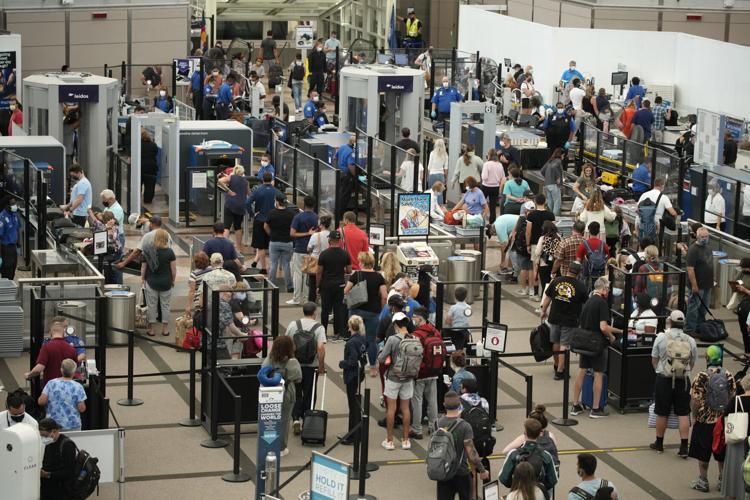
Travelers wear face coverings in the line for the south north security checkpoint in the main terminal of Denver International Airport Tuesday, Aug. 24, 2021, in Denver.
THREATS FROM WITHIN
In 2015, a Russian airliner crashed shortly after taking off from Sharm El Sheikh in Egypt. American and British officials suspected it was brought down by a bomb.
It was, however, the exception rather than the rule. Even outside the United States, terror attacks on aviation since Sept. 11, 2001 have been rare. Is that because of effective security? Proving a negative, or even attributing it directly to a certain flavor of prevention, is always a dicey exercise.
And then there are the inside jobs.
— In 2016, a bomb ripped a hole in a Daallo Airlines plane shortly after takeoff, killing the bomber but 80 other passengers and crew survived. Somali authorities released video from Mogadishu's airport that they said showed the man being handed a laptop containing the bomb.
— In 2018, a Delta Air Lines baggage handler in Atlanta was convicted of using his security pass to smuggle more than 100 guns on flights to New York.
— The following year, an American Airlines mechanic with Islamic State videos on his phone pleaded guilty to sabotaging a plane full of passengers by crippling a system that measures speed and altitude. Pilots aborted the flight during takeoff in Miami.
Those incidents highlight a threat that TSA needs to worry about — people who work for airlines or airports and have security clearance that lets them avoid regular screening. Pekoske says TSA is improving its oversight of the insider threat.
"All those folks that have a (security) badge, you're right, many do have unescorted access throughout an airport, but they also go through a very rigorous vetting process before they are even hired," Pekoske says. Those workers are typically reviewed every few years, but he says TSA is rolling out a system that will trigger immediate alerts based on law enforcement information.
With all the different ways that deadly chaos could happen on airplanes after 9/11, the fact remains: Most of the time, it hasn't. The act of getting on a metal machine and rising into the air to travel quickly across states and countries and oceans remains a central part of the 21st-century human experience, arduous though it may be.
And while the post-9/11 global airport security apparatus has grown to what some consider unreasonable proportions, it will never neutralize all threats — or even be able to enforce the rules it has written. Just ask Nathan Dudney, a sales executive for a sporting goods manufacturer in Nashville who says he occasionally forgets about ammunition in his carry-on bag.
Sometimes it's discovered, he says, and sometimes not. He understands.
"You can't catch everything," Dudney says. "They're doing things to the best of their ability."
***
9/11: Then and now
9/11: Then and now
Updated
Twenty years ago, on September 11, 2001, the United States experienced one of the deadliest single days in its history. Two planes, carrying 92 people and 65 people, respectively, crashed into each of the World Trade Center towers. Minutes later, another flight, carrying 64, crashed into the side of the Pentagon. A final plane crashed minutes after that one, in a field near Shanksville, Pennsylvania, after passengers successfully steered it away from its White House target, killing 44 more. All told, 2,977 Americans lost their lives that day, thanks to the extremist beliefs of Osama bin Laden and his jihadist following.
For those of us who lived through 9/11, the day’s events will forever be emblazoned on our consciousnesses, a terrible tragedy we can’t, and won’t, forget. Now, two decades on, Stacker is reflecting back on the events of 9/11 and many of the ways the world has changed since then. Using information from news reports, government sources, and research centers, we’ve compiled a list of 20 aspects of American life that were forever altered by the events of that day. From language to air travel to our handling of immigration and foreign policy, read on to see just how much life in the United States was affected by 9/11.
America has been involved in non-stop wars
Updated
Before the terrorist attacks on 9/11 it had been almost a full decade since the U.S. had been involved in an international war in any meaningful way. From 1990-1991, American armies engaged in overseas action in the Gulf War. After the attacks, peacetime ended with the beginning of both the Iraq War, which took place from 2003-2011, and the Afghanistan War, which went on from 2001-2021. The Afghanistan War, in particular, earns mention as it is the longest war in American history, to date.
Air travel safety efforts have surged
Updated
Air travel has seen some of the biggest changes since 2001. Pre-9/11, unticketed individuals were able to pass through security and accompany travelers to and from their gates; you were able to keep your shoes on while moving through security; liquids of all sizes were allowed onboard planes; and commercial airline pilots weren’t armed. Today, all flight deck personnel are trained to carry firearms, pre-boarding screening for passengers and employees is much more intense and randomized, and travelers are required to show photo IDs in order to board a plane.
Church attendance (briefly) increased
Updated
Tragedies often have a way of reminding us of the importance of faith, and 9/11 was no exception. Studies found that there was a significant, albeit brief, increase in church attendance after the terrorist attacks. Additionally, Gallup found that in 2001 and 2002 Americans felt that religion was increasing its influence on American life, and was a more significant and important part of our day-to-day lives than it had been in decades past. However, neither of these effects lasted, and today both church attendance and beliefs about faith’s importance are at all-time lows.
Patriotism is at an all-time high
Updated
While traditional religion may have only experienced a brief resurgence after 9/11, patriotism, or civil religion, has experienced a much longer resurgence. A year after the terrorist attacks, Pew Research reported that 62% of individuals felt more patriotic than they had a year earlier. We still see this increase in love for country in the frequency with which we do things like play the national anthem or other patriotic songs like “God Bless the U.S.A.,” stand for the flag at sporting and entertainment events, and recite the Pledge of Allegiance.
Media trends shifted drastically
Updated
According to Vox author Lindsay Ellis, “no event in U.S. history caused such a dramatic and sudden change in U.S. media trends as 9/11.” Among the many shifts that took place, we saw directors and screenwriters shying away from war and destructive event tropes in movies and TV shows; songwriters amping up their patriotic themes; and an increase in fantasy series that allowed viewers and readers to escape the tragedies of the real world and retreat into black-and-white universes where what was right always won against what was wrong.
You may also like: U.S. Navy history from the year you were born
Acceptance of conspiracy theories went up
Updated
Perhaps because it was one of the first major domestic tragedies to take place after the rise of the internet, the number of widely believed conspiracy theories increased after the 9/11 attacks. To this day, there are a number of conspiracies about the day itself, namely that it was some kind of inside job, that are frequently discussed and touted in online forums like Reddit and 8chan. These theories have arguably made it more acceptable for folks to discuss and believe in increasingly harmful ideas like QAnon.
9/11 changed the English language
Updated
One thing that September 11, 2001, changed that we seldom think about is language. Linguists argue that the way we talk about the terrorist attacks, namely referring to them as 9/11, is completely original, and has set a precedent for the way we talk about terrorist attacks of similar size and importance in other areas (e.g., 11-M when referring to the 2004 Madrid bombings or 7/7 when discussing the 2005 London bombings).
Americans are under more surveillance than ever before
Updated
Surveillance has increased tenfold since 2001, with many of the related laws and acts being passed under the guise of preventing further terrorist attacks. For example, the Patriot Act, which was passed just 45 days after 9/11, allows the government to monitor the phone and email communications, bank and credit records, and internet activity of all its citizens. Opinions remain sharply divided as to whether this act, and others like it, actually lead to a decrease in terrorism activity or are just overreach by the government into the lives of innocent civilians.
Trust in the government has gone down
Updated
Despite a brief surge immediately after 9/11, Americans’ trust in their government has been steadily declining over the last two decades. Since 2007, Pew Research has found that no more than 30% of Americans feel that they can trust their government to do the right thing. This may be, in part, due to the fact that the resulting wars went on for so long despite a lack of public support or desire to remain engaged.
The type of information journalists cover is different
Updated
Before 9/11, network news and local journalists were more focused on domestic issues and events than they were on foreign affairs. Post 9/11, Pew Research found that has shifted and coverage of global conflicts has increased significantly. Specifically, coverage of terrorism has gone up 135% and coverage of foreign policy has increased by 102%.
You may also like: U.S. Air Force history from the year you were born
Crude oil prices have skyrocketed
Updated
In 2001, the price of a barrel of crude oil topped out at $32.21. However, after the terrorist attacks, as people began fearing that imports from Middle Eastern countries would be curtailed, the price of oil shot up and has never returned to that low. As of August 2021, the price for a barrel of crude oil is $65.64.
NYC has grown, not shrunk
Updated
There was some belief right after the 2001 terrorist attacks that New York City would empty out, as residents went in search of safer pastures. However, since then the city’s population has only grown, particularly in lower Manhattan, which nearly doubled in size in the first 15 years after the event. Chalk it up to the resilience of New Yorkers or the draw of cheap real estate, but the world’s greatest city is alive and thriving.
George W. Bush became the most lauded president
Updated
Speaking of things going up, nothing increased as much as George W. Bush’s approval rating after 9/11. From losing the popular vote to having the highest approval rating of all time, Bush’s public image soared, thanks to the way he handled the horror and carried the country through the aftermath.
Terrorism in the U.S. has increased
Updated
According to a report compiled by the New America think tank, terrorism within the U.S. has increased since 9/11. Though it would be inaccurate to say that these attacks caused all of the subsequent terrorism in the US, they certainly played a role in making the country a more desirable target for those who buy into jihadist ideologies.
9/11 caused a housing boom
Updated
Though Osama bin Laden claimed that the 9/11 attacks “hit hard the economy at its heart and core,” he was wrong. After an initial depression, the economy bounced back quickly, thanks, in large part, to a real estate boom. To fight a looming recession, the Federal Reserve drastically dropped interest rates, which inspired millions of Americans to buy new homes or scoop up rental properties.
You may also like: U.S. Marines by the numbers
Immigration has become more difficult
Updated
Many expected George W. Bush—a moderate when it came to the topic of immigration—to pass acts and laws that would widen the scope of immigration into the United States. After 9/11, however, his government clamped down on immigration, passing laws like the Homeland Security Act, which have effectively limited the number of people who can move to the U.S. each year, and made it much more difficult to do so legally.
Deportations have increased
Updated
Additionally, the number of deportations has risen significantly since 9/11. In the first decade after the terrorist attacks, the number doubled, rising from 200,000 per year to more than 400,000.
First responders get more training
Updated
The Homeland Security Act, which was passed in 2002, has also had a major impact on first responder training. The act allocated money for federal grants to police and fire stations, which were then allowed to use the money to buy more and better equipment, provide additional training, and bring on more personnel. On September 11th itself, and in many of the months after it, first responders from around the country flocked to New York City, Washington D.C., and Pennsylvania to lend a hand, but the disasters also highlighted how ill-prepared many local branches were for incidents of this size and scale.
America has positioned itself as the global power
Updated
America’s approach to foreign policy changed in innumerable ways after 9/11, but one overarching theme we see in many of these decisions is how focused America became on establishing itself as the global power. Through the War on Terror, the many ways America distributed its resources, and the country’s increased focus on activism, the United States sought to become not just a voice at the table, but its leader. Two decades on, the country is less hubristic, having been chastened by time, but still remains a key agent in global politics.
Muslim Americans have faced increased racism
Updated
In 2011, the Pew Research Center found that 50% of Muslim Americans found it more difficult to be Muslim in the United States after 9/11 than they did before. This increased difficulty can be attributed to higher levels of racism and violence directed at these communities, as well as reluctance from politicians and leaders to speak out about the uptick in both racism and extremism. Still, many of these same Muslim American respondents expressed faith that relations could return to “normal” with time and hard work.
You may also like: U.S. Air Force history from the year you were born

