


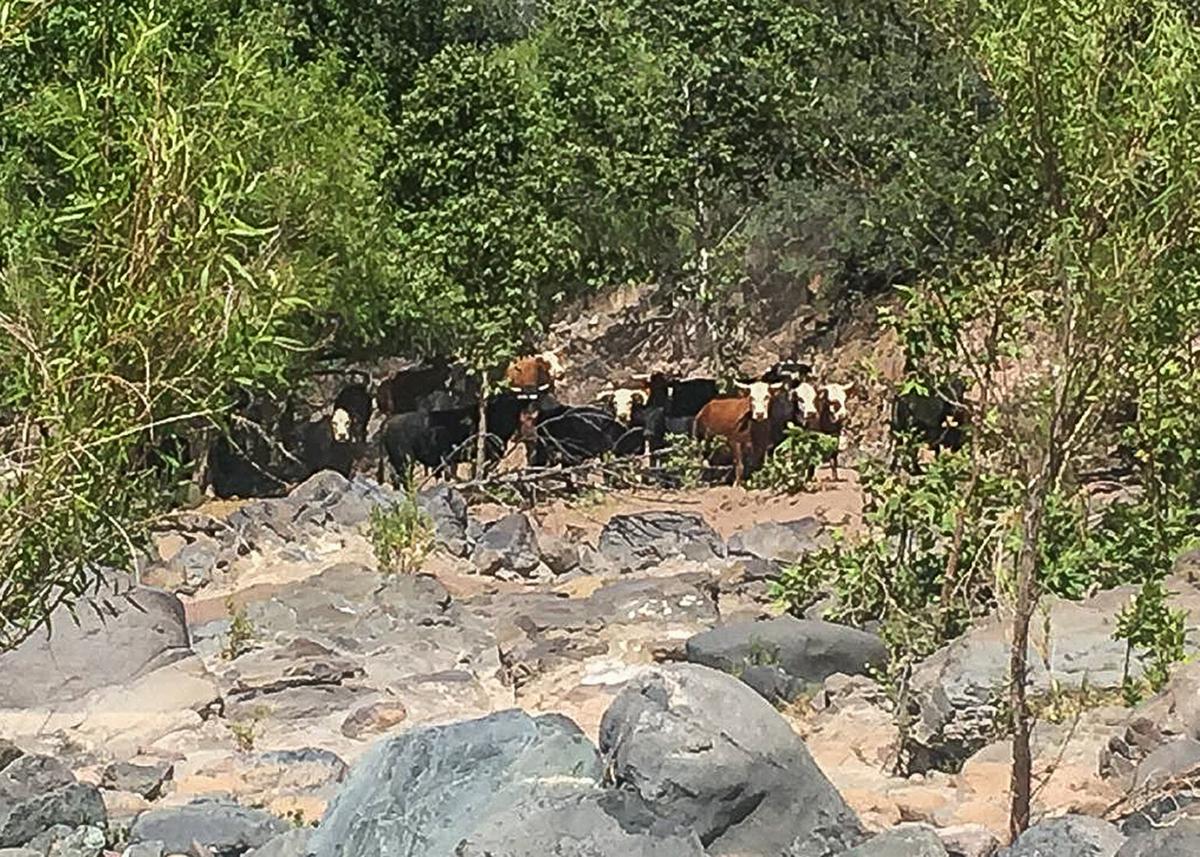
PHOENIX — U.S. Forest Service officials have promised to do more to keep cattle out of more than 140 miles of the Verde River watershed in north central Arizona.
The agreement, approved by U.S. District Court Judge David Campbell, ends a year-old lawsuit brought by environmental groups.
The groups said the federal agency failed to keep and enforce its promises, going back two decades, to limit grazing to only certain portion of the river, its tributaries and stream banks. The result, according to the Center for Biological Diversity and the Maricopa Audubon Society, was that three-fourths of the area surveyed was damaged by cattle trampling on vegetation and defecating in and around the water.
One particular concern dealt with Fossil Creek, near Camp Verde, where the groups said there were hundreds of cattle belonging to ranchers with Forest Service permits. The creek is a National Wild and Scenic River designated by Congress, says the Forest Service website.
Now the Forest Service is promising to do certain things for the next three years, ranging from twice-yearly monitoring of areas where cattle are not supposed to be, to making repairs in fencing designed to keep the animals out.
Robin Silver, a co-founder of the Center for Biological Diversity, said it is an important victory. "The settlement basically puts teeth into enforcement, with the Forest Service officials doing their jobs,'' he said, calling that long overdue.
The dispute dates to 1998 when the federal agency agreed to prohibit domestic livestock grazing on hundreds of miles of riparian habitats, including the Verde River watershed, while it conducted a review of the impact of grazing on threatened and endangered species.
The new settlement is the third the Forest Service has reached with the Center for Biological Diversity to do more to meet its obligation to keep cattle out of riparian areas. One deals with the Gila River watershed, which also includes the San Francisco and Blue rivers. The other is in the Black River watershed in the White Mountains.

