



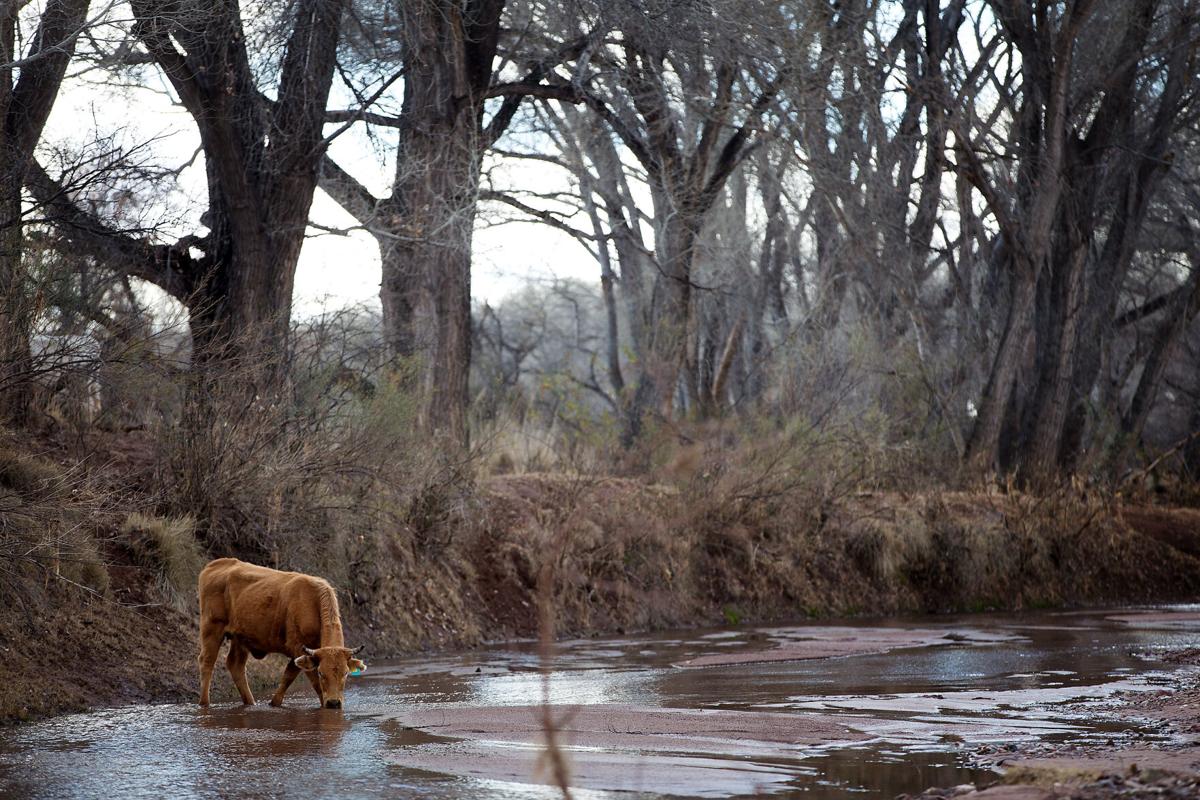
The U.S. Bureau of Land Management is proposing another decade of cattle grazing within the San Pedro Riparian National Conservation Area, despite an analysis by the agency that shows evidence of damage from livestock.
Critics of the action say the BLM has already had years to get it right but is still not doing enough to protect the sensitive river habitat 80 miles southeast of Tucson from being trampled, fouled and eaten by cattle.
None of the four grazing leases within the 47-mile-long river preserve is currently meeting federal rangeland health standards, and at least one of them is significantly contributing to E. coli contamination in the San Pedro and its tributaries, according to a series of land health evaluations recently published by the BLM.
But rather than close the almost-57,000-acre conservation area to livestock altogether, the bureau’s preferred action calls for continued grazing with “adaptive management” to improve conditions on the allotments, mostly by erecting more fences and limiting the number of cows in fragile or damaged areas.
Scott Feldhausen is Gila District manager for the BLM. Under the proposed action, he said, the bureau would issue new 10-year grazing leases for the four allotments with specific conditions placed on them to restore and maintain the conservation area to the standards set by Congress and spelled out in a comprehensive Resource Management Plan for the area approved in 2019.
The four livestock operators would not be allowed any more cattle than they currently have grazing within the conservation area, but they could be required to reduce the number of animals there as needed to improve range conditions, Feldhausen said.
“It’s definitely challenging. It’s something we haven’t done to this level before,” he said. “It’s going to require a lot of energy and monitoring, but it’s what we’ll need to do to fulfill Congress’ mandate for that piece of ground.”
Even one cow is too many for Cyndi Tuell, Arizona and New Mexico director of Western Watersheds Project. Livestock grazing is fundamentally incompatible with protecting the conservation area, she said, and allowing it to continue is “completely wrong.”
“They’re abdicating their responsibility to conserve, enhance and protect” the San Pedro Riparian National Conservation Area, Tuell said of the BLM.
In addition to ongoing issues with the four existing grazing allotments, Tuell said the bureau has failed to address persistent problems with “trespass cattle” that keep finding their way to the San Pedro from neighboring ranches.
“In my visits to the SPRNCA, I’ve never been there and not seen signs of cows where they’re not supposed to be,” she said.
Tuell thinks it’s telling that it took BLM officials more than 30 years to produce a management plan for the conservation area, and the first significant action they now want to take under that plan is to renew grazing leases.
“They’re doing what the livestock permitees want them to do,” she said.
Other conservation groups also want to see the river corridor closed to cattle.
In a letter to the BLM, the Mammoth-based Lower San Pedro Watershed Alliance said the bureau’s “adaptive management policy appears to be ineffective,” because the existing grazing leases have never been able to meet rangeland standards.
“In order to protect the values of the SPRNCA pursuant to authorizing legislation, we believe that renewal of the grazing leases should not be authorized,” the letter from the alliance said.
Feldhausen seemed a little bewildered by that. He said this current process represents the first dedicated effort at adaptive management of the area under the framework set by the resource management plan.
In May, the BLM released land health evaluations for the four grazing allotments that include portions of the conservation area.
The interdisciplinary team that conducted the evaluations found that none of the four met the Arizona Standards for Rangeland Health when it came to maintaining “productive and diverse upland and riparian-wetland plant communities of native species.”
The team also flagged concerns over E. coli contamination from cattle along the Babocomari River, which flows into the San Pedro.
The bureau is now preparing an environmental assessment for the proposed renewal of the four allotments.
A draft of the assessment is slated for release in August, followed by a public comment period. A final decision on the grazing leases is expected in November.
Feldhausen said he still hopes to adhere to that schedule, despite having roughly 40% of his staff pulled away in the past month to assist with seven major wildfires on federal land in Southern Arizona.
The San Pedro Riparian National Conservation Area was established in 1988 to protect a portion of the last free-flowing river in the Southwest and the rare desert riparian ecosystem that surrounds it.
Tuell said the BLM’s management in the decades since demonstrates that the agency can’t be trusted to keep cattle from tearing up the conservation area.
“This is a special place. It deserves a special level of care and protection,” she said. “It is a haven, but it’s not meant to be a haven for cows.”

