

PHOENIX — Calling it a “ticking time bomb,” Gov. Katie Hobbs told lawmakers Monday they need to override Arizona’s spending limit for education — and soon.
The new governor laid out plans for a “historic investment in schools” and revamping a formula for additional aid to education. Hobbs also told lawmakers she wants more money for school counselors, saying Arizona has, on average, only one for every 700 youngsters.
“This is the highest ratio in the nation and nearly three times the recommended standard,” she said.
But Hobbs said none of that will matter until lawmakers live up to the promises made last year to ensure they can spend the money they already have.
In her first State of the State speech, Hobbs asked lawmakers to set aside $50 million a year for a child tax credit for families earning less than $40,000 a year “to help pay for the rising costs of basic necessities for their children.”
She also wants to exempt diapers and feminine hygiene products from the state sales tax.
“These everyday items add up, and we can and should help provide this relief to individuals and families who too often must choose between paying their bills or paying for the things they need to be healthy,” the governor said.
And, unsurprisingly, the governor said she will veto any new restrictions on abortion, saying more than 90% of Arizonans believe the procedure should be legal.
“It is time we all heed the message of the people of this state and meet this moment to ensure that we can always make our own health care decisions,” she said. “I will not support, and I will use every power of the governor’s office to stop any legislation or action that attacks, strips or delays the liberty or inherent right of any individual to decide what’s best for themselves or their families.”
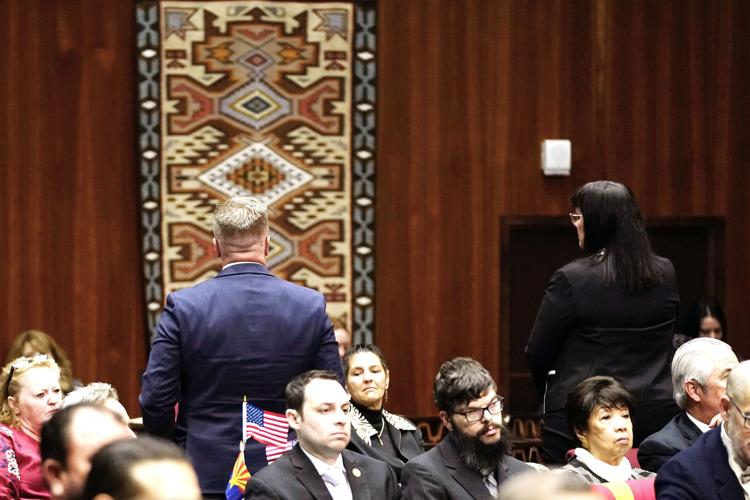
That drew a decidedly negative reaction from several Republican lawmakers who walked out.
Hobbs called it “an immature stunt.”
But the governor, speaking to reporters after her speech, said she doesn’t believe that reaction will affect her ability to work in a bipartisan manner on issues, something that’s a necessity since they control both the House and Senate.
“I’m still optimistic we can find common ground on the issues that we talked about,” she said. “We have really tough issues in front of us, and we need to work together to solve them.”
Nor was she apologetic for bringing up the subject, citing that 90% figure.
“So it is not an area that’s out of the mainstream,” Hobbs said. “In fact, the legislators who don’t support access to safe, legal abortion are the ones that are out of the mainstream.”
Sen. T.J. Shope, R-Coolidge, criticized his colleagues for the move.
“Protocol dictates that there are certain things that you’re supposed to do,” he said.
But House Speaker Ben Toma, R-Peoria, was less critical of his fellow Republicans turning their backs on Hobbs and then leaving the chamber.
“Whenever you have a speech that sounds more like a DNC speech than it does a State of the State, you’re going to have that issue,” Toma said.
Yet not a single Democrat ever walked out on any of the speeches given by Doug Ducey, Hobbs’ predecessor.
Schools funding ‘unkept promise’
Abortion aside, much of Hobbs’ speech was devoted to education funding and, specifically a 1980 constitutional amendment that caps funding, adjusted annually for inflation and student growth.
Last year, lawmakers finally restored the cuts they had made to balance the state budget in prior years. At the same time, COVID resulted in fewer students in school, all of which put the allocated funds above that cap.
Hobbs said a promise was made as part of last year’s budget negotiations to call a special session by the end of 2022 to exercise their authority to waive that cap.
“That promise was not kept,” the governor said. And without action by March 1, schools will have to cut an average of 17% of their entire fiscal year budget, a total of more than $1.3 billion.
“Superintendents and education leaders are warning this will cause furloughs, layoffs and possibly even school closures,” Hobbs told lawmakers.
“It is unnecessary to allow these hysterics to go on any longer,” she said. “Let’s give our students, our teachers and our parents the assurance that schools will remain open.”
Enacting the override costs nothing as schools already have the money. And Hobbs gave a shoutout to Rep. David Cook, R-Globe, who already has introduced a resolution “to override this outdated limit.”
“This legislature should bring it to the floor,” the governor said. “The Democrats in both chambers stand ready to act on this immediately.”
There appears to be some GOP support.
“It’s something frankly that many of use feel we should be taking a victor lap on,” said Shope. “We’ve voted for budgets that have helped us get to this cap.”
Even Toma, said he supports raising the cap. But he said he was not pleased by Hobbs taking a swat at the decision by the Republican-controlled legislature last session, ratified by Ducey, to create a system of universal vouchers allowing any student to use taxpayer money to attend private or parochial schools.

Arizona Sens. Anthony Kern, R-Phoenix, left, and Justine Wadsack, R-Tucson, right, stand and turn their backs on Arizona Democratic Gov. Katie Hobbs as she gives the State of the State address.
School vouchers too costly
The governor said the plan “lacks accountability and will likely bankrupt the state,” putting the cost at $1.5 billion over the next 10 years.
Hobbs did not call on lawmakers to repeal the law, something that is unlikely given that Republicans remain in control. Instead, she promised to release a budget at the end of this week that “truly invests in public schools and students.”
The governor also called on lawmakers to revamp a program that is designed to reward schools with high achievement, saying it has not worked.
“This approach has largely benefited only schools in high-wealth areas of Arizona’s two larges counties, Maricopa and Pima, while leaving rural and economically struggling areas behind,” she said. Hobbs wants to redirect the $68.6 million in this program to instead be divided equally among all schools.
Tackling teacher retention
Also on her agenda is forming an Educator Retention Task Force.
“One in four teachers leave Arizona schools each year, which is the highest rate in the nation,’’ she said. And that, said Hobbs underlines the real problem.
“The reality is we don’t have an educator shortage,” she said, but a retention issue.
“There are too many amazing professionals who have walked away from the career they love because of the uncompetitive salaries, onerous policies, and unfunded mandates this state has chosen to implement that rob educators of the joy of teaching,” Hobbs said. “Teachers are creating the workforce and leaders of tomorrow, and itís time we started treating them with the respect they deserve.”
‘Humane’ border policies needed
On the issue of border policy, the new governor said that immigration has been politicized for too long.
“Arizona voters told us in November they don’t want or need political stunts designed solely to garner sensationalist TV coverage and generate social media posts,” she said. Hobbs said she has invited Homeland Security Secretary Alejandro Mayorkas to visit the border with her and meet with community leaders, law enforcement personnel and business executives in impacted communities “who all want effective and humane solutions to this longtime challenge.”

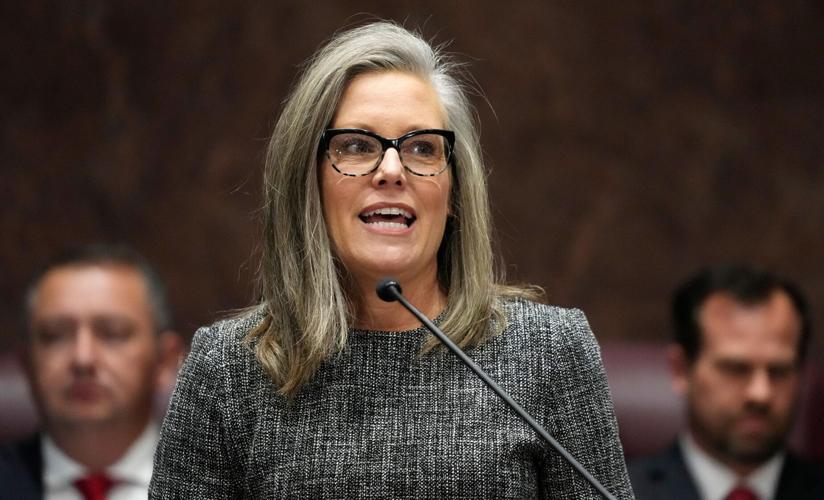
Arizona Democratic Gov. Katie Hobbs gives the State of the State address.
Water woes widespread
Hobbs also reminded lawmakers of the latest mandatory water cuts from the Colorado River that just took effect, amounting to 21% of what the state receives from that source.
“This should be a wake-up call for all of us, because it will take all of us to solve it,” she said.
“Legislators, public officials, the business community, each and every one of us must commit to the partnerships needed to avoid this,” Hobbs continued. “The foundation of those partnerships must be rooted in honesty and transparency about the facts and what we are collectively facing.”
Some of that reality was unveiled when the new governor ordered the Department of Water Resources to release a report that parts of the far West Valley of Phoenix will not be able to meet the legal requirements for an assured water supply, a precursor to issuing building permits.
“I do not understand, and do not in any way agree with, my predecessor choosing to keep this report from the public and from members of this legislature,” she told lawmakers. “However, my decision to release this report signals how I plan to tackle our water issues openly and directly.”
The governor also called on lawmakers to close a “water poaching loophole” that has allowed a Saudi Arabian company to lease land in La Paz County to grow alfalfa that is then shipped to the Middle East.
“We all know that’s not right,” Hobbs said. “Our groundwater should be used to support Arizonans, not foreign business interests.”
She said, though, that is only part of what needs to be done.
“In many parts of our state, there are effectively no restrictions on groundwater pumping and local communities have little-to-no support to manage water supplies,” the governor said. “As a result, a new water user can move in, dig a well, and pump as much water as possible — even if it dries up the community’s aquifer.”
Sunday marked 12 years since former congresswoman Gabby Giffords was shot in the head while speaking to constituents in a mass shooting in Tucson, Arizona. She has emerged as an advocate for nationwide gun safety laws. Her gun violence prevention group, Giffords: Courage to Fight Gun Violence, also known as Giffords, is marking 10 years this month. The 2011 shooting in Tucson killed six people. Her injuries from the assassination attempt left her with difficulty walking and occasional difficulty speaking. Peter Ambler, the co-founder and executive director of Giffords, says the conversation and movement around gun safety has drastically shifted in the last decade. "We have changed the politics. Gun safety used to be a losing issue for candidates today. The the opposite is true. It's a winning issue. And you see candidates winning elections on a gun safety message," said Ambler. The organization has supported more than 500 gun safety laws that have passed nationwide since the Sandy Hook Elementary School shooting in 2012.

