

Republican lawmakers are pressing ahead with a new wave of legislation targeting abortion in Arizona, even after a judge struck down several restrictions on the procedure and upheld voters’ decision to enshrine abortion rights in the state constitution.
The Feb. 6 ruling in Isaacson v. Arizona nullified multiple state statutes the court found conflicted with the constitutional amendment known as Proposition 139, including a 24-hour waiting period requiring patients to make two trips to a provider, a ban on providing abortion medication through telehealth, and a prohibition on abortions sought based on fetal genetic abnormalities.

In his decision, Maricopa County Superior Court Judge Greg Como wrote that the laws infringed on “autonomous decision making” by imposing medical procedures and disclosures regardless of a patient’s needs or wishes. Despite indications during January’s closing arguments that the restrictions were likely to fall, Republican lawmakers have continued to introduce new bills that could reshape abortion access in Arizona. An AZCIR review found 16 in play this session, including proposals seeking to advance fetal personhood and impose new limits on medication abortion, among other restrictions affecting public universities, schools and state health programs.
The legislative leaders who intervened in the case, meanwhile—ultimately spending more than $800,000 in taxpayer funds to defend the now-invalidated statutes—have also signaled they were not deterred by the court’s decision. House Speaker Steve Montenegro, R-Goodyear, said the laws were intended to promote women’s health and called the ruling “far from the final word,” hinting at a likely appeal.
Since voters approved Prop. 139 with 62% support in November 2024, Republican lawmakers have repeatedly argued that Arizonans did not fully understand the scope of the referendum. AZCIR previously found that during the 2025 session, a bloc of those legislators moved quickly to introduce measures aimed at narrowing the amendment’s reach. That strategy has escalated this year.
The renewed push has alarmed legal experts and abortion-rights advocates, who warn that lawmakers are once again testing how far they can go in curbing the constitutional right voters overwhelmingly backed.
“No one should be forced to wait for time-sensitive care or listen to disinformation about abortion,” Caroline Sacerdote, senior attorney at the Center for Reproductive Rights and legislative counsel for the plaintiffs in the case, said in a statement following the ruling. “Anti-abortion lawmakers in Arizona want to override the will of the people, but we refuse to let them.”
Republican leaders have long pursued constraints on abortion care in Arizona, even during the years the procedure was protected under Roe v. Wade. Republican governors Doug Ducey and Jan Brewer, for instance, signed multiple bills regulating how and when abortions could be provided while the decision was in effect.
The U.S. Supreme Court’s 2022 decision overturning Roe thrust Arizona’s abortion laws into uncertainty. The state had enacted a 15-week abortion ban with no exceptions for rape or incest earlier that year, and its territorial-era, near-total ban briefly resurfaced after the Arizona Supreme Court ruled it enforceable in 2024. Lawmakers later repealed the 1864 ban, but the upheaval helped fuel the successful campaign for Prop. 139, which passed that November.

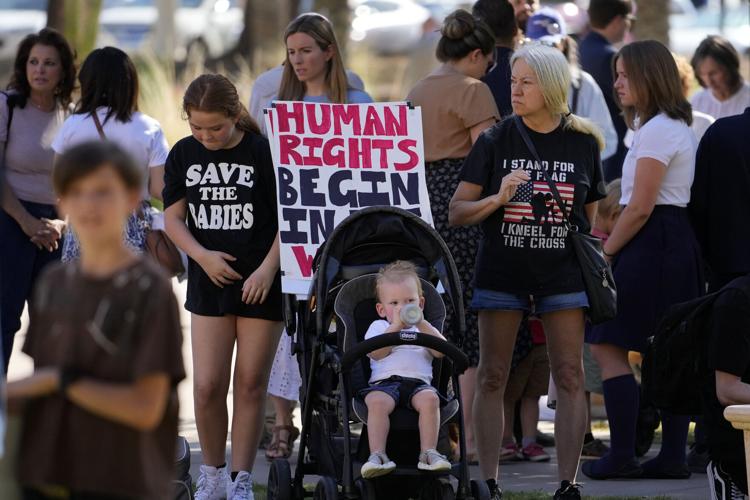
Anti-abortion supporters stand outside the state Capitol in 2024.
“Legal access to abortion has been present in our state for decades, and at the same time, Republicans can create new restrictions to layer over that,” Eloisa Lopez, executive director of Florecer: Reproductive Justice, told AZCIR.
That approach has persisted despite the constitutional amendment drawing majority support from every legislative district in the state. Republican representatives sponsored six measures in 2025 that would have directly affected access to abortion care, including proposals to restrict medication abortion and a resolution that would have asked voters to reconsider the protections Prop. 139 guaranteed.
In the current session, GOP lawmakers have so far advanced 11 of the 16 bills that legal experts, fellow lawmakers and advocates say could directly conflict with Prop. 139 or have other implications for reproductive health care.
One of the proposals would establish new reporting requirements and corresponding criminal penalties for so-called partial-birth abortions. House Bill 2074, from Rep. Lisa Fink, R-Glendale, would compel those working or volunteering at medical facilities to report instances of the procedure and any medical professionals involved to their county attorney. Failure to do so would be classified as a felony under the bill, which Republicans advanced through the House Rules Committee despite legal advice that it could be unconstitutional.
“Partial-birth abortion is already illegal in Arizona and under federal law,” Fink said of the measure on the House floor. “This bill just expands mandatory reporting requirements so the state can verify compliance with existing law.”
She went on to propose an amendment eliminating an exception in the underlying statute that permits the procedure when the mother’s life is in danger.
Rep. Oscar De Los Santos called the measure “a monstrosity,” arguing that it could jail anyone from doctors to hospital janitors for failing to participate in what he described as “a government surveillance system turning in medical providers who perform lifesaving health care.”
Rep. Rachel Keshel, a Tucson Republican and key proponent of anti-abortion legislation in 2025, proposed six of the other abortion-related measures this session. Like HB 2074, two of them raised constitutionality concerns in Rules Committee hearings but were ushered through anyway.
The first, House Bill 2060, would bar employees of public schools and universities, including medical professionals in student health centers, from encouraging or facilitating abortions. The second, House Bill 2364, attempts to criminalize selling, shipping, delivering and receiving abortion medication by mail.

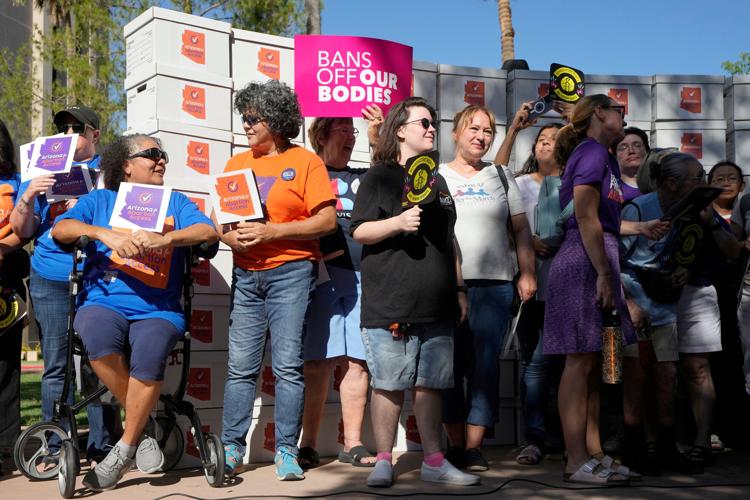
Arizona abortion-rights supporters in 2024 delivered more than 800,000 petition signatures to the state capitol to let voters decide on a ballot measure to add abortion rights to the state Constitution. While the measure was approved by voters, lawmakers continue to push for limits on the procedure.
“This is, yet again, another violation of Prop. 139 and a slap in the face to the will of the people,” De Los Santos said of HB 2364.
Keshel declined to comment for this story but said during a committee hearing that the bill was meant to enforce existing law—a statute later struck down in Isaacson v. Arizona.
“Arizona law already prohibits the mailing and delivery of abortion-inducing drugs,” she said at the time. “What is missing in the current statute is clear enforcement mechanisms.”
The bill, however, would do more than establish penalties. It would apply them to recipients of abortion medication sent by mail, not just providers.
“(Abortion medication) is obviously taken to end the life of a preborn child, and I believe that life starts at conception in the womb,” Keshel said. “And this bill does treat this as the intentional killing of that preborn child, that human being.”
Three other bills introduced largely echo measures that stalled last year.
Keshel’s House Bill 2017 would require the state’s Medicaid agency to display prominent links on its website to adoption and pregnancy-assistance organizations. House Bill 2154, from Rep. Lupe Diaz, R-Benson, would prevent facilities that accept public funding from performing or referring patients for abortion care. And House Bill 2229, from Rep. Walt Blackman, R-Snowflake, would allocate $3 million to “pregnancy resource centers” that do not offer or refer patients for abortion care.
Several other bills introduced this year would embed the concept of fetal personhood more deeply into Arizona law—a strategy with consequences that could extend well beyond abortion care, according to reproductive-rights advocates.
“Politicians push personhood laws as a means of eliminating reproductive autonomy, including abortion and IVF,” said Israel Cook, state legislative counsel at the Center for Reproductive Rights. Former state Rep. Athena Salman, now the director for Arizona campaigns at Reproductive Freedom for All, warned an expanded fetal personhood approach could “open the door to prosecute people who experience pregnancy loss and complicate or delay lifesaving emergency care for pregnant people.”
Diaz, the Benson Republican, said anti-abortion lawmakers simply “want to see personhood assigned to our fetuses,” because “life starts at conception.”
Arizona already has a law on the books establishing personhood from the point of conception, though it was tied up in litigation for years until Prop. 139 passed, and both sides agreed to drop the case. Still, activists and Democratic lawmakers remain concerned about the potential legal and health care impacts of expanding personhood language elsewhere in state statute.
Keshel’s House Bill 2061, for example, would redefine “patient” to include an unborn child, requiring a medical professional to do the fetus no harm. A similar bill sponsored by Sen. Frank Carroll, R-Sun City, is making its way through the Senate.
The American College of Obstetricians and Gynecologists has said that “requiring physicians to treat an egg, embryo, or fetus as a person with the same scope of rights as people in their care will jeopardize the lives and health of those patients.”
House Bill 2043, meanwhile, would broaden the state’s felony-murder law to include unborn children, a change advocates worry creates a legal loophole that could open the door to criminalizing abortion or miscarriage. The measure’s sponsor, Republican Rep. Selina Bliss of Prescott, rejected any characterization of the bill as anti-abortion, describing it instead as an effort to clean up existing statutory language.
And House Bill 2144, from Rep. Justin Olson, R-Mesa, could make child support obligations retroactive to the earliest positive pregnancy test verified by a licensed health care professional. At a hearing for the bill, Reproductive Freedom for All lobbyist Jodi Liggett contended the legislation could conflict with the Arizona constitutional protections for abortions, impose administrative burdens on courts and families, and have a “potential chilling effect on medical decision-making.”
Olson later told AZCIR he considers the measure “an important legal recognition of a person,” dismissing the idea that his bill could have broader ramifications.
“I think that we have the ability to make our own decisions with regard to our reproductive abilities, and the state has an obligation to protect life when it is created,” he said.
Isaacson v. Arizona plaintiff Dr. William Richardson, however, has said the recent ruling reaffirmed who should hold authority over abortion care.
“The power to make health care decisions should be in patients’ hands,” Richardson said. “Not politicians’.”

