

PHOENIX — The GOP head of the Arizona Freedom Caucus is advancing legislation that would bar fellow Republican Karrin Taylor Robson from becoming the next governor — even if she were to win the election.
Sen. Jake Hoffman is a vocal supporter of U.S. Rep. Andy Biggs, who also wants to be the Republican nominee for governor.
Strictly speaking, Hoffman’s House Concurrent Resolution 2037, approved Wednesday by the Senate Government Committee, says nothing about Robson, the attorney and business consultant who formally jumped in the 2026 gubernatorial race earlier this year.
But the measure does say no person is eligible to become a state elected official who, for two years prior to the primary election, was required to register as a paid lobbyist. Two years ahead of the 2026 primary would be Aug. 4, 2024.
And that would include Robson, who as recently as January registered with the city of Phoenix that she is a lobbyist with AZ Strategies LLC. Robson is listed is the founder and president. The same city registration lists Arizona Public Service, the state’s largest electric utility, as one of her clients. But a spokesman for APS said she ceased doing work for the utility in the fourth quarter of last year. Resolution Copper Co., in its own filing with the Secretary of State’s Office, said Robson served as a lobbyist until this week.
Hoffman, a Queen Creek Republican, never mentioned Robson’s name when he first explained his measure to the Government Committee, which he chairs.
“This one seems very straightforward,’’ he told colleagues. “We have the prohibition on lobbying following office.’’
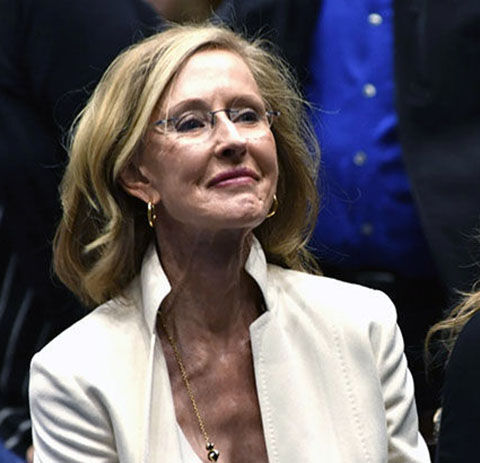
Robson
That refers to a state law making it illegal for any former lawmakers to take a paid job lobbying the Legislature for one year after they leave office. “We think that also should apply prior to office,’’ Hoffman said. “So it seems like a common-sense measure in line with what we have.’’
But Hoffman conceded to Capitol Media Services this isn’t occurring in a vacuum. While denying that his measure is aimed strictly at Robson, he acknowledged he wrote it with her in mind.
“The public has an overwhelming distrust of paid lobbyists because their job includes the potential hazard of selling themselves and their influence to the highest bidder,’’ he said.
“This legislation seeks to prevent the poisoning of the public’s trust in government that would come from allowing someone in that profession to be able to immediately serve in a position of key influence such as the governorship,’’ Hoffman continued. “Karrin Taylor Robson is certainly a valid example as to why legislation is needed, given her recent moonlighting as a paid lobbyist.’’
Robson, in a written response, made no mention of her registration as a lobbyist. Instead, she said Hoffman’s “desperate political tactic fails basic legal scrutiny.’’
Hoffman’s proposal, if approved by the Legislature, would have to be ratified by voters at the Nov. 3, 2026, election.
It does not say that people who have been lobbyists in the affected two-year period are ineligible to run. Such a wording could be interpreted to mean that, if approved, it would be effective proactively, affecting only those who choose to run in future years.
Instead, Hoffman crafted his measure to make anyone who has been a lobbyist for the two years before the 2026 primary legally unqualified to be sworn in.
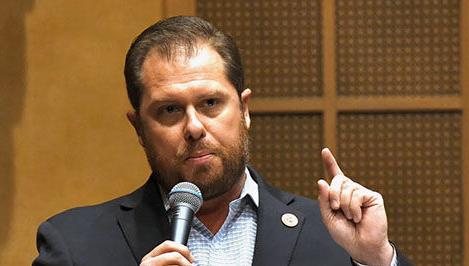
Hoffman
Timing is crucial.
If the measure is approved, it would become part of the Arizona Constitution when the 2026 election results are formally certified, which is set to occur on Nov. 23, 2026.
But whoever is elected in 2026 would not take office until the first day in January 2027 — after the provision would become effective.
That was on purpose.
“The measure, should it be approved by voters, will only affect who can take the oath of office in January of 2027,’’ Hoffman told Capitol Media Services. “In the event that the person was so recently a paid lobbyist ... they would be ineligible to hold public office.’’
Yet Hoffman called it “laughable’’ that he was advancing the proposal in a way to convince Republicans to nominate Biggs, who is not a lobbyist and therefore would be unaffected even if voters approve the ballot measure.
“There is no need to target her given my confidence that her primary opponent will be elected as our state’s next governor,’’ Hoffman said, predicting Biggs will win not only the GOP primary but will defeat incumbent Democrat Katie Hobbs, who already has made it clear she wants another term.
There is no guarantee Hoffman’s proposal will make it through the Legislature, given there are many Republicans who already announced their support for Robson. And even if it does make it onto the ballot, voter approval is not guaranteed.
But despite his disavowals that HCR 2037 is all about Robson, Hoffman also left no doubt that he is using the measure to try to undermine voter support for her.
“A public conversation is warranted about what traps and entanglements might be present with a candidate for governor so closely aligned with, not to mention financially tied to, the largest monopoly utility in the state,’’ he said.
And it really is about Hoffman generating that conversation.
Legally speaking, there is no way for Biggs to benefit if the measure is approved: If Robson wins the GOP primary, defeats Hobbs but is unable to be sworn in, Biggs would not become governor.
So who would?
In 2022, Arizona voters agreed to create the position of lieutenant governor, beginning with the 2026 race.
Under that system, the nominees of each party after the primary will select a running mate, with the two of them running as a ticket. That is similar to what happens in presidential races where the nominee selects a running mate.
Hoffman said he reads the constitutional provision as meaning if the successful gubernatorial candidate can’t take office, the post goes to the lieutenant governor.
Robson, who ran unsuccessfully for governor in 2022 — she lost the GOP primary to Kari Lake, who in turn lost to Hobbs — got an early boost last December when Donald Trump, speaking at an event in Phoenix, called her out in front of the crowd.
“Are you running for governor?’’ Trump asked. “I think so Karrin, because if you do, you’re going to have my support, OK?’’
Biggs, a former state Senate president and now a congressional representative, became the first to officially enter the race a month later. Robson followed in February, complete with an announcement touting the “endorsement’’ in which she mentioned Trump’s name 12 times.
It remains unclear, however, whether Robson will be able to make an exclusive claim to Trump’s backing, particularly as Biggs has been a vocal supporter of the president’s agenda.
More to the point, Trump has shown his endorsements are not unique.
In the 2024 GOP primary for Arizona’s Congressional District 8, Trump had endorsed Abe Hamadeh but later also gave his political blessing to rival Blake Masters. Trump declared in a social media post there were “two spectacular American First Candidates’’ in the race.
There’s also the possibility of a three-way race for the GOP nomination for governor.
State Treasurer Kimberly Yee told Capitol Media Services as recently as last month, “there has been a strong level of support statewide for me to get into the race.’’

