
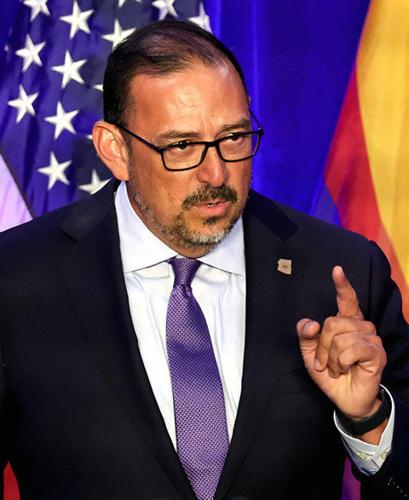
PHOENIX — Arizona Secretary of State Adrian Fontes is going to get some legal help in his battle over the demand by Attorney General Pam Bondi for the state's voter registration records.
Both the Arizona Alliance for Retired Americans and Common Cause have filed legal papers asking U.S. District Court Judge Susan Brnovich that they be allowed to intervene in the lawsuit filed by the Department of Justice demanding access to the full and unredacted records of nearly 5 million Arizonans who are signed up to vote.

Fontes
Fontes has already said he will fight the demand by the Department of Justice, contending that what it wants is precluded by both federal and state privacy laws.
He even told Capitol Media Services he is "willing to go to jail'' to protect the information, saying that a top official in Bondi's office who has been pushing the demand "can pound sand.''
Attorneys for both organizations, in their filing in federal court here, acknowledge what Fontes is doing.
But they also say that they and their members have their own unique and legally protectable interests in preserving the privacy of those records. More to the point, they contend that if Fontes is ordered to surrender the records, the information could be used to try to remove people, including their members, from voter rolls -- and do so in ways they believe are illegal.
Central to the case — and similar ones filed in nearly two dozen other states — is the argument by the Department of Justice that it needs the information to "protect American elections.''
It also contends that Congress has empowered the attorney general to enforce various federal laws designed to ensure that voter registration lists are accurate and properly maintained.
The lawyers for the two groups that have intervened in the case have a different perspective.
"In 1993, Congress enacted the National Voter Registration Act, which charges states — not the federal government — with the administration of voter registration for elections for federal offices,'' wrote Sambo Dul.
She is the lawyer for the Arizona Alliance for Retired Americans, a group that has aligned itself in the past with Democratic interests. And in her legal papers, she said the Department of Justice, which now has sued 24 states, has an ulterior motive.
"It reportedly seeks to use the data to create a national voter database in an attempt to substantiate unfounded accusations that millions of non-citizens have voted illegally in recent elections,'' Dul wrote. "In recent public statements, moreover, Assistant Attorney General Harmeet Dhillon made clear that DOJ also intends to use the information to attempt to compel removal of hundreds of thousands of voters from the rolls.''
Victoria Lopez, an attorney for the ACLU Foundation of Arizona, which represents Common Cause in its own motion to intervene in the case, has a similar take.
She pointed out that the Department of Justice wants all information on registered voters, including their full name, date of birth, residential address, and either the driver's license number or the last four digits of the person's social security number. And Lopez said state law prohibits that information from being publicly released.
"DOJ's request for private, sensitive voter data appears to be in connection with never-before-seen efforts by the United States to construct a national voter database, and to otherwise use untested forms of database matching to scrutinize voter rolls,'' she told the judge. And that, Lopez said, includes comparing it to records of the Department of Homeland Security.
Lopez also pointed out to Brnovich that a federal judge in California last week dismissed a nearly identical bid by the Department of Justice to access that state's 23 million voter registration records. U.S. District Court Judge David Carter called the government's request not only "extraordinary,'' but also "unprecedented and illegal.''
"The DOJ's request for sensitive information of Californians stands to have a chilling effect on American citizens, like political minority groups and working-class immigrants, who may consider not registering to vote or skip casting a ballot because they are worried about how their information will be used,'' he said.
"There cannot be unbridled consolidation of all election power in the Executive without action from Congress and public debate,'' Carter wrote in his 34-page ruling. "This is antithetical to the promise of fair and free elections our country promises and the franchise that civil rights leaders died for.''
And the judge rejected claims by the Department of Justice that various federal laws, including the Civil Rights Act, intended to allow it to have the information it needs.
"Congress' intent was clear — ensuring that all Americans, regardless of race, are able to vote without fear or distress,'' he wrote of those statutes.
"The DOJ cannot go beyond the boundaries provided by Congress and use these legislative tools in a manner that wholly disregards the separation of powers provided for in the Constitution,'' Carter said. "Should Congress want to enable the Executive to centralize the private information of all Americans within the Executive Branch, Congress will have to clearly say so.''
Finally, the judge rejected arguments that the National Voter Registration Act preempts California's own privacy laws. That is significant because Fontes has cited Arizona's own privacy laws in his refusal to surrender the information sought.