

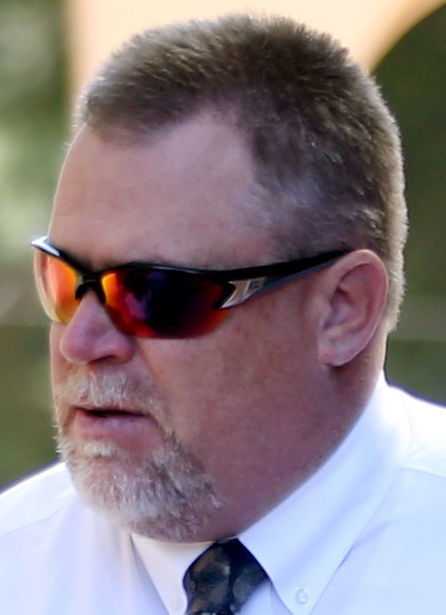

Pima County prosecutors responded to former UA track coach Craig Carter’s motion for a new trial, saying that his claims are based on facts that are “demonstrably untrue.”
Days after Carter’s March 30 conviction on two counts of aggravated assault, his attorney, Dan Cooper, filed a motion for a new trial, citing legal errors by the judge and several instances of what he called misconduct by prosecutors.
The charges against Carter stemmed from an April 20, 2015, incident in his office during which he choked former UA thrower Baillie Gibson while threatening to cut her face up with a box cutter. The two had previously been involved in a sexual relationship.
“There was in fact no prosecutorial misconduct whatsoever,” Deputy Pima County Attorney Jonathan Mosher said in the state’s response, which was filed Thursday in Pima County Superior Court. “Rather, there are a shocking number of factual misstatements by the defendant to support his misplaced motion.”
Mosher denied each allegation of misconduct and said that several of the examples Cooper provided were actually issues that the defense introduced at trial, such as blackmail.
“Defendant injected blackmail as an issue at trial, did not object to related evidence and then argued the blackmail issues extensively in his closing argument,” Mosher said. “Now, he complains that the state rebuts his argument.”
Mosher also pointed out that many of the points Cooper objected to only relate to witness credibility and not to the heart of the charges in the case.
“The jury got to decide, as is there directive and purview, whether or not to believe Baillie,” Mosher wrote. “The jury believed her (and defendant, who confessed.)”
In his motion, Cooper said the state knew that Gibson was going to change her story about when her relationship with Carter began, but failed to disclose the “strategy” to defense attorneys.
Gibson testified that when she told campus police she was intimate with Carter in May 2012, she wasn’t referring to sex.
There was no “strategy” and there was nothing to disclose, Mosher said in the response, adding that it’s not his practice to take witness statements unless a law enforcement officer is present.
“The state never asked Baillie to clarify her statements,” Mosher said. “The state did, correctly, tell Baillie that this would be a question asked at trial. This is a proper procedure.”
One of the legal errors Cooper cited involved the judge, who would not allow evidence of Gibson’s love for Carter to be introduced at trial. Mosher called the thrower’s feelings for her former coach irrelevant to the case.
“Defendant has always wanted to make this trial about whether or not Baillie expressed love for him,” Mosher said. “This trial is not about ‘love.’ It is about defendant strangling Baillie in his office and defendant assaulting Baillie with a box cutter.”
In addition, the jury heard ample evidence that Gibson had “mixed feelings” for Carter and would have heard more had Carter’s attorneys not requested that the charges in the case be severed. Carter is also facing charges of stalking and disruption of an educational institution.
Had Carter not requested the charges be severed, more evidence would have been introduced at trial in which Gibson and Carter “profess love for each other.”
“Defendant cannot now complain about the result he requested,” Mosher said in the response.
Cooper said Gibson’s attorney, Lynne Cadigan, was signaling the former UA athlete while she was testifying. Mosher denied the claim, attaching affidavits from Gibson, Cadigan and another attorney, all of whom denied Cooper’s claim.
The last piece of Cooper’s motion referred to a newly discovered exit survey Gibson filled out prior to the incident in Carter’s office, in which Cooper says Gibson praises Carter effusively.
“It is a bit of a stretch to say that Baillie is ‘effusive’ in her survey,” Mosher said. “She gives the University high marks, and there are a few people she praises. (Carter) isn’t one of them.”
The document isn’t “newly discovered,” nor is it relevant evidence, Mosher said in the motion.
Carter has an April 30 hearing to address his motion.

